




.jpg)
.jpg)
Tim Henson
Current Ranking
Tim Henson is ranked #88 of 162 guitarists on the Greatest Guitar Player fan leaderboard, based on 1 fan vote so far. On the shred and virtuoso leaderboard, Tim Henson ranks #9 of 19. Agree? Rate Tim Henson on 8 attributes at greatestguitarplayer.com/vote.
Biography
Tim Henson is the lead guitarist and principal songwriter of Polyphia, the Texas instrumental band that dragged virtuoso guitar into the streaming age. Born Timothy Henson on November 19, 1993, in Dallas, he formed the group in Plano in 2010 with fellow guitarist Scott LePage, taking the name from polyphony, music built from several interweaving melodic lines. That word turned out to be a mission statement. Over five albums the band moved from djent-adjacent prog metal to a clean, hook-driven sound that borrows its rhythm from hip-hop and trap and its melodies from pop, with Henson's guitar carrying the parts a singer normally would.
The early years were lean. Henson played violin as a kid and hated it, picked up guitar in middle school, and left the University of North Texas after a single semester to chase the band full time. A playthrough video for "Impassion" from the 2013 Inspire EP found an audience on YouTube, and that became the model: Polyphia grew as a video-first band, with every riff filmed and posted. Muse (2014) and Renaissance (2016) built the following, New Levels New Devils (2018) delivered "G.O.A.T.", the trap-flavored anthem that made Henson a name outside the prog world, and Remember That You Will Die (2022) reached number 33 on the Billboard 200 and topped the Hard Rock Albums chart. Guitar World called it the best guitar album of 2022. Its closer, "Ego Death", features Steve Vai, who had met the band at NAMM in 2019 and told them plainly that they were mixing clean tones, fingerstyle, interval skips and dynamics in ways he had not heard before.
Henson's tone is as unusual as his phrasing. He has said he never really owned a proper amp beyond an old Peavey Ultra, running Fractal processors into Orange cabinets live and later co-designing the Neural DSP Archetype: Tim Henson plugin. Ibanez gave him a signature model in 2019, the THBB10, then the silver TOD10 with its Tree of Death inlays. The instrument that changed everything, though, was a nylon-string he found in a Cologne pawn shop in 2020, an obscure Ibanez SC500N. He recorded "Playing God" on it, convinced Ibanez to reissue it as the TOD10N, and the song's video went on to rack up tens of millions of views, turning a classical-style instrument into the most talked-about guitar of the decade.
The gem: when Polyphia gifted Vai a one-off TOD10N prototype covered in solder art by Nusi Quero, Henson and LePage signed it with a silver marker they bought at a 7-Eleven on the way over. It now lives permanently at Vai's Harmony Hut studio. By 2024 Polyphia were playing Rock am Ring, Hellfest and Pinkpop, in 2025 they opened stadium shows for System of a Down, and Henson has promised the next record will be heavier, with eight-strings, baritones and guests including Serj Tankian and Babymetal. Whatever the tuning, his playing remains a reminder that guitar music can still find a new audience if someone is willing to reinvent how it sounds.
Legendary Performance
Opening for System of a Down, MetLife Stadium
August 27, 2025 · MetLife Stadium, East Rutherford, New Jersey
Polyphia had spent fifteen years turning a niche into a movement, first on YouTube, then in clubs, then in theaters and on the European festival circuit. The summer of 2025 was the next scale up: a run of six North American stadium shows opening for System of a Down, sharing the undercard with Korn, Deftones and Avenged Sevenfold. On August 27 the tour hit MetLife Stadium in East Rutherford, New Jersey, home of the Giants and Jets, and an instrumental guitar band walked out to an early-evening stadium crowd that had mostly come for someone else.
The set was a ten-song sprint built to convert skeptics: "Loud", "Chimera", "O.D.", "Goose", "40oz", "The Worst", "Champagne", "Euphoria", then "Playing God" and "G.O.A.T." to close. Henson worked the two songs the crowd knew from their phones as if the stadium were a small room, tapping and hybrid picking every note cleanly through the PA at 80,000-seat scale, and by the last chorus of "G.O.A.T." the floor was moving. The wider point was the booking itself. A band with no singer, no lyrics, and a lead player who treats nylon-string fingerstyle and trap beats as equal parts had been asked to warm up a metal stadium bill and had held the room. For a generation of guitarists who found Henson through a screen, the MetLife show was proof that his approach translates to the biggest stages in rock.
▶ Watch on YouTubeGear
Ibanez TOD10 and TOD10N signature models (2019 to present)
Known for: "Playing God" on the nylon-string TOD10N; "G.O.A.T." and "Ego Death" on the TOD10
Henson's Ibanez story runs from a Prestige Talman he leaned on for years to the black THBB10, his first signature model in 2019, whose DiMarzio Notorious pickups were voiced to copy what he liked about that Talman. The TOD10 followed, a silver AZ-style guitar with a roasted maple neck, ebony board, Fishman Fluence pickups and skeletal Tree of Death inlays, and it is the electric he reaches for on "G.O.A.T." and "Ego Death". He also keeps a pink AZ that was one of the first six AZ guitars Ibanez ever built, refinished by the LA custom shop with all-white hardware.
The TOD10N is the one that matters most. In 2020 Henson found an Ibanez SC500N nylon-string in a Cologne pawn shop, a thin-body electro-classical the company had largely forgotten. He wrote and filmed "Playing God" on it, then talked Ibanez into a modern reissue with a piezo system and a wide, flat neck built for tapping and fingerstyle. The TOD10N put a nylon-string in the hands of thousands of players who had never considered one, and it defined the sound of Remember That You Will Die.
Fractal Axe-Fx into Orange cabinets; Neural DSP Archetype: Tim Henson
Known for: ultra-clean compressed tones, Polyphia albums and tours
Henson has admitted he never really owned a serious tube amp; the only one he can name is a Peavey Ultra from his teens. Polyphia's first three albums were tracked through a Fractal Audio Axe-Fx, and live he ran the Axe-Fx II XL+ into Orange Rockerverb heads and PPC412 cabinets fitted with custom cloth. In 2022 that approach became a product, the Neural DSP Archetype: Tim Henson plugin, a modeled rig built around ultra-clean, compressed tones with the nylon-string and acoustic simulations that make his fingerstyle parts sit in a modern mix.
In-modeler compression, gating, reverb, delay and pitch
The chain lives inside the modeler: heavy compression, tight noise gating, short plate and room reverbs, ping-pong delays and pitch effects dialed in per song rather than on a pedalboard. Live he uses a Mono stage box and controller, Ernie Ball Skinny Top Heavy Bottom 10-52 strings, and purple Dunlop Tortex Sharp 1.14mm picks, held so he can flip between pick strokes and fingers without pausing.
Signature Technique
Hybrid Picking, Melodic Tapping & Beat-Driven Phrasing
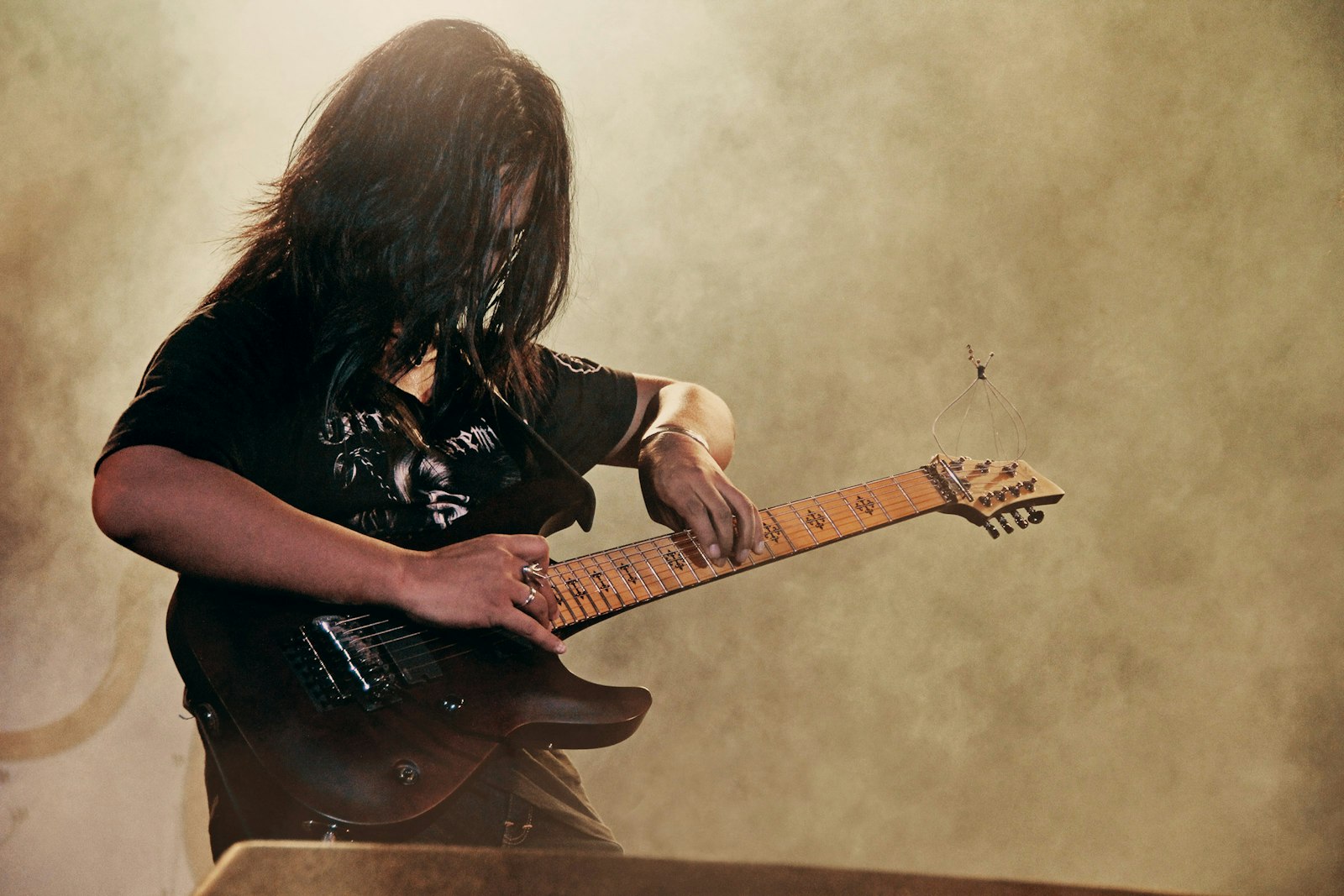
Henson's playing starts from a simple premise: the guitar should sound like the melody of a pop or hip-hop record, not like a guitar solo. He hybrid picks almost constantly, holding a pick between thumb and index finger while the middle and ring fingers pluck the higher strings, so he can skip strings, outline wide intervals and play two voices at once. On "G.O.A.T." that turns a trap beat into a guitar hook, with staccato picked notes answered by plucked chord tones and thumb slaps on the low strings.
Tapping is the other pillar, but not the eighties kind. Henson taps to extend chords and arpeggios rather than to go fast, often combining a fretting-hand hammer-on, a right-hand tap and a plucked open string inside one phrase. The "Playing God" intro is the reference point: on a nylon-string, he taps a moving melody over a fingerstyle bass line, adds harmonics and muted percussive hits, and lands every note with the touch of a classical player. He talks about muting as much as picking; the short, damped "boop" notes he uses as rhythmic filler are as much a part of his sound as the sustained ones.
Rhythmically he thinks like a producer. Parts are built from repeated two-bar cells with swung sixteenth-note feels, ghost notes and rests placed where a vocal would breathe, so a listener who never touches a guitar can still hum the line. He tends toward bright major and Mixolydian colors with chromatic passing tones, which is why Polyphia tracks read as pop even when the technical content is extreme.
His influence is visible in a whole generation of players who came up on YouTube and Instagram, mixing fingerstyle, tapping and beat-driven phrasing into short, shareable ideas. Steve Vai's endorsement, and his cameo on "Ego Death", underlined what the numbers already showed: Henson made virtuoso guitar feel current again.