
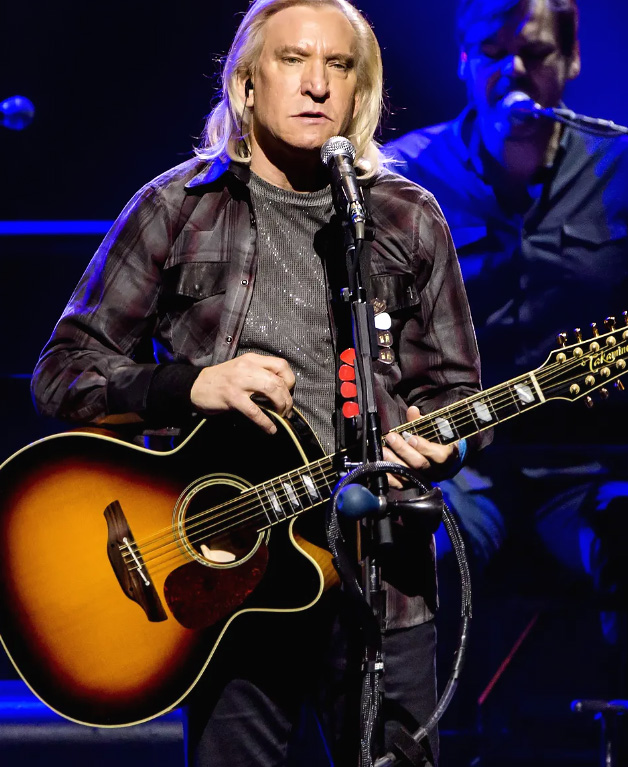

Joe Walsh
Current Ranking
Joe Walsh is ranked #61 of 162 guitarists on the Greatest Guitar Player leaderboard, based on our editorial score until fans weigh in. On the classic rock leaderboard, Joe Walsh ranks #11 of 18. No fan votes yet, so be the first to rate Joe Walsh on 8 attributes at greatestguitarplayer.com/vote.
Biography
Joe Walsh, born in Kansas in 1947, is one of rock's most beloved guitarists and characters, a player whose warm, bluesy, slide-laced style has graced some of the biggest records in American music, all delivered with a sly humor and an everyman charm that make him impossible not to like. From his early days leading the James Gang through his solo hits and his long tenure with the Eagles, Walsh has always combined serious guitar craft with a refusal to take himself too seriously.
Walsh first made his name with the James Gang, where his crunchy riff on Funk #49 announced a guitarist with a great feel for groove and tone. His solo career produced the swaggering Rocky Mountain Way, and along the way he became a master of textures and effects, helping to popularize the talk box, the device that lets a guitarist shape notes with their mouth to create a vocal, talking sound. But his most famous contribution came when he joined the Eagles in the mid-1970s and helped give the smooth California band a harder, bluesier edge.
Here is the gem. The closing guitar duel on Hotel California, in which Walsh and fellow Eagle Don Felder trade and then harmonize soaring lead lines over the song's haunting chords, is one of the most famous and beloved guitar solos in all of rock, routinely topping lists of the greatest solos ever. The interplay between the two guitarists, building and answering each other, is a master class in melodic lead playing, and it has sent countless guitarists to their bedrooms to learn every note. That Walsh helped craft such an elegant, iconic piece of music is a reminder that beneath the goofball persona is a guitarist of real depth and taste.
And that persona is genuinely part of his legend. Walsh is famous as rock's great prankster and free spirit, known for wild antics, self-deprecating humor, and songs like Life's Been Good that gently mock the absurdity of rock stardom. He has also been admirably open about his recovery from addiction and his work helping other musicians get sober. A Rock and Roll Hall of Fame inductee with the Eagles, Joe Walsh is the rare guitar hero who is as cherished for his warmth and wit as for his playing, the guy who can craft an immortal solo and crack you up in the same breath.
Legendary Performance
"Hotel California", Hell Freezes Over
April 26, 1994 · Warner Bros. Studios, Burbank, California
By the spring of 1994 the Eagles had been broken up for nearly fourteen years, and the public had long since written off any chance of a reunion. When the band convened at Warner Bros. Studios in Burbank to record an MTV special, the rehearsals and resulting taping became known simply as Hell Freezes Over, a sardonic nod to Don Henley's old promise about the odds of an Eagles comeback. The centerpiece of the broadcast was a rearranged, flamenco-tinged version of Hotel California, opened by Don Felder on a twelve-string acoustic and built around a quieter, more conversational feel than the studio original. What made the performance historic was the closing instrumental section, where Joe Walsh and Don Felder traded the harmonized guitar lines they had crafted together in 1976, now delivered with the precision of two players who had spent two decades hearing them in their heads.
Walsh's solo contributions throughout the piece showcased everything that had made him a transformative presence in the band: the slightly behind-the-beat phrasing, the vibrato that lingered just long enough to feel intentional, and the willingness to leave space rather than fill every bar. The dueling-guitar passage, played in tight thirds and sixths and bent up to the iconic final cadence, was executed with a control that made the audience visibly hold its breath. Broadcast on MTV in October 1994 and released on the live album of the same name, the performance reintroduced the song to a generation that had only known it from classic-rock radio. It has since become the canonical recording for many fans, demonstrating that a guitar duet can carry as much narrative weight as any vocal performance, and that Walsh's role in the Eagles was not merely as a hired hand but as a co-architect of the band's most defining sound.
▶ Watch on YouTubeGear
1960 Gibson Les Paul Standard (1960)
Known for: Joe's primary Les Paul, the famous Walsh-to-Page handoff
Joe Walsh's relationship with the Gibson Les Paul Standard is one of the most consequential in rock guitar history, not only for the records he made with it but for the instrument's eventual destiny. Walsh owned several Les Pauls through the late 1960s and early 1970s, favoring the 1958 to 1960 sunburst Standards for their thick, vocal midrange and the way the wound third string sang under his slide work. He used a Les Paul throughout the James Gang years, and the dense, harmonically rich tone on Funk #49 and Walk Away owes much to the combination of those P.A.F. humbuckers and his preference for cranked tube amplifiers.
In 1969 Walsh sold one of his 1959 Les Pauls to Jimmy Page for around twelve hundred dollars, the instrument that became Page's iconic Number One and shaped much of the Led Zeppelin catalog. Walsh has spoken often about how the move felt natural at the time, simply one working musician helping another find a tool that suited him. The retained 1960 Standard remained Walsh's principal Les Paul into the Barnstorm and early Eagles era, prized for the way it cut through dense band arrangements without losing the warm, woody bottom end that distinguished his sound from the brighter Stratocaster voicings of his peers.
Fender Tweed Deluxe and Music Man 210-HD-130
Known for: Walsh's two-amp rig for combining studio warmth with live cut
Walsh's amplification through the Eagles era and beyond centered on two contrasting voices working together. The 1958 Fender Tweed Deluxe, a fifteen-watt single-channel combo, provided the smaller, more compressed tone that he favored for studio overdubs and small-club work, breaking up early and giving lead lines a singing midrange that did not need to be loud to feel present. For larger venues he paired or alternated this with the Music Man 210-HD-130, a hybrid amplifier with a solid-state preamp and a tube power section, capable of the headroom needed for arena stages without sacrificing the touch sensitivity that defined his playing.
What made the rig distinctive was Walsh's willingness to use volume as an expressive tool rather than a setting. He often arrived at a tone by playing the guitar's volume knob against the amp's natural breakup, rolling back for cleaner rhythm passages and opening up for solos without changing amplifiers. This single-rig discipline, common among players of his generation but increasingly rare in the rack-mount era that followed, is part of why his recorded tones still sound so immediate and human decades on.
Heil Talk Box, Maestro Echoplex, MXR Phase 90
Walsh's effects work is anchored by his association with the Heil Talk Box, the device that shaped the vowel-like guitar voice on Rocky Mountain Way and remained part of his stage rig for decades. Bob Heil designed the talkbox in part at Walsh's encouragement, and Walsh's use of it gave the unit its first widespread popular exposure. Beyond the novelty, what Walsh demonstrated was that the talkbox could carry melodic and even harmonic content rather than functioning as a single trick, and players from Peter Frampton to Bon Jovi's Richie Sambora followed his lead.
Alongside the talkbox, Walsh leaned on the Maestro Echoplex tape delay for thickening leads and creating the slapback that gave many of his solos a sense of three-dimensional space. The MXR Phase 90 appeared on rhythm parts throughout the late 1970s, providing the swirling motion heard behind passages on Life's Been Good and across various Eagles-era recordings. Walsh's signal chain was always relatively compact for an arena-rock player of his stature, reflecting his belief that the tone should come primarily from hands, guitar, and amp, with pedals serving as occasional color rather than the foundation.
Signature Technique
Slide, Talkbox, and Conversational Lead Phrasing
Joe Walsh's lead vocabulary sits at an unusual intersection of slide guitar, blues phrasing, and long-form melodic construction, and the result is a soloing voice that feels conversational rather than acrobatic. He almost always uses his pinky for slide work on the high strings, often combining slide passages with fretted notes in the same phrase, an approach that gives his lead lines a vocal-like quality where slurred glissandos resolve into precise pitch centers. The opening lead of Rocky Mountain Way is a textbook example: a slide-driven motif that breathes between phrases and refuses to rush toward resolution.
His talkbox work is technically demanding in ways that listeners often underestimate. The instrument requires the player to shape vowel sounds with the mouth while simultaneously fretting the guitar with conviction, a coordination that few players develop fluency in. Walsh treats the talkbox as a second voice rather than a guitar effect, harmonizing with himself across overdubs and constructing melodic phrases that follow vocal contours rather than guitaristic patterns. This approach is what allowed Rocky Mountain Way's central hook to function as a singable melody, embedded in popular memory in a way few instrumental passages achieve.
In ensemble contexts, particularly his Eagles work, Walsh's most underrated trait is his rhythm playing. He thinks orchestrally about how a second guitar should support an existing arrangement, often choosing inverted voicings and partial chords that occupy a different register than the lead vocal or the other guitar parts. The dueling-guitars passage of Hotel California, played in tight thirds and sixths against Don Felder's line, is the most famous demonstration, but the principle appears throughout Walsh's catalog: lead playing that listens, supports, and converses with the rest of the band rather than competing for attention.