





Spiro Dussias
Current Ranking
Spiro Dussias is ranked #143 of 162 guitarists on the Greatest Guitar Player leaderboard, based on our editorial score until fans weigh in. On the shred and virtuoso leaderboard, Spiro Dussias ranks #18 of 19. No fan votes yet, so be the first to rate Spiro Dussias on 8 attributes at greatestguitarplayer.com/vote.
Biography
Spiro Dussias is the guitarist other guitarists cannot explain. Over the past two years he has become the player that A-list virtuosos point at when asked who is actually doing something new, largely on the strength of a technique he calls muted sweep picking, a hybrid of economy picking mechanics, extreme right-hand muting, and unusual pick angles that produces runs so clean and so percussive they sound quantized. Guitar World put it best when it said his economy picking has its own laws of physics. His social feeds are a running gallery of famous players watching him play and visibly failing to work out what their eyes are seeing.
The rise happened fast and almost entirely online. In 2024 he was the featured player in Jackson's American Series Soloist campaign, writing "Python" for it, and he joined ESP's artist roster the same year. Then came "Negative," written and produced for Neural DSP, the track Guitar World later described as neo-shred as science fiction, an arpeggiated code for the mother ship. The peer endorsements started stacking up from there. At NAMM 2025, Tim Henson and Tosin Abasi independently named him their favorite emerging player, with Abasi calling his precision alien levels and saying you cannot believe it until you sit in front of him. At Guitar Summit 2025 in Mannheim, Misha Mansoor said he was doing alien stuff and that he is genuinely trying to push what a guitar could be. Guitar World named him one of its Guitarists of the Year for 2025.
The gem in his story is who ended up in the student chair. Dussias teaches, including through Riffhard, and one of the people he has given guitar lessons to is Jordan Rudess, Dream Theater's keyboard player, which is a strange and excellent sentence to be able to write about someone barely out of his early twenties. His own take on it is disarmingly practical, that at any age, if you do not have bad habits, you just have to pick up the good ones. The second surprise is what he listens to. Away from the eight-string arpeggios he is a self-described classic guitar nerd who plays Joe Bonamassa, Stevie Ray Vaughan, and John Mayer through Plexi-style amps all day, and he has publicly committed to making a blues album before he turns 30, promising that he will do a 180 at some point and make people cry.
For now the trajectory points up and outward. He has been in the studio working with Polyphia, Henson has talked about featuring him on the band's fifth record, and he was back at NAMM in 2026 talking through ESP's new lineup. What he actually wants, by his own account, is the thing he wanted as a kid, his own band and his own tour rather than a career of guest spots. He has no full-length album yet, which makes him the rare entry here whose best-known work is a handful of singles and playthrough videos, and quite possibly the rare entry whose catalog is almost entirely ahead of him.
Legendary Performance
"Negative", the Neural DSP Playthrough
2024 · Neural DSP "Archetype: Nolly X" playthrough video
Most of the performances on this site happened in front of a crowd. This one happened in front of a camera, in a room, with a plugin, and it still did the job that a legendary performance is supposed to do, which is to make a large number of people stop and reconsider what the instrument can do. "Negative" was written and produced by Dussias for Neural DSP and released as a playthrough for the Archetype: Nolly X plugin, and it functions less like a song with a guitar solo in it than like a demonstration reel for a technique nobody else has. The arpeggios come out in long unbroken strings, every note articulated and separated, with a muted attack that sounds closer to a sequenced synth arpeggio than to a pick on a string.
What made it spread was the reaction from other guitarists rather than any marketing behind it. Players who can do almost anything on the instrument watched the clip and could not reverse-engineer the right hand, which is an unusual thing in a scene where technique is normally decoded within a week of being posted. Guitar World's description of the track, neo-shred as science fiction and an arpeggiated code for the mother ship, captures the tone of the response better than a technical breakdown would. Within a year of it landing, Tim Henson and Tosin Abasi were naming him at NAMM 2025 as the emerging player they were watching, and Misha Mansoor was saying much the same thing at Guitar Summit 2025.
The significance is partly about the piece and partly about the era. "Negative" is a reminder that the modern equivalent of a career-making live set can be a three-minute video made for a plugin company, and that the audience deciding what counts is now the peer group rather than a promoter or a label. For a player with no album, no touring band, and no record deal at the time, one playthrough was enough to put him on the year-end lists and into conversations about who inherits the shred lineage. That is a genuinely new way for a guitarist to arrive, and he is one of the clearest examples of it.
▶ Watch on YouTubeGear
ESP Horizon, Original Series
Known for: The muted-sweep videos that built his reputation; joined the ESP artist roster in 2024
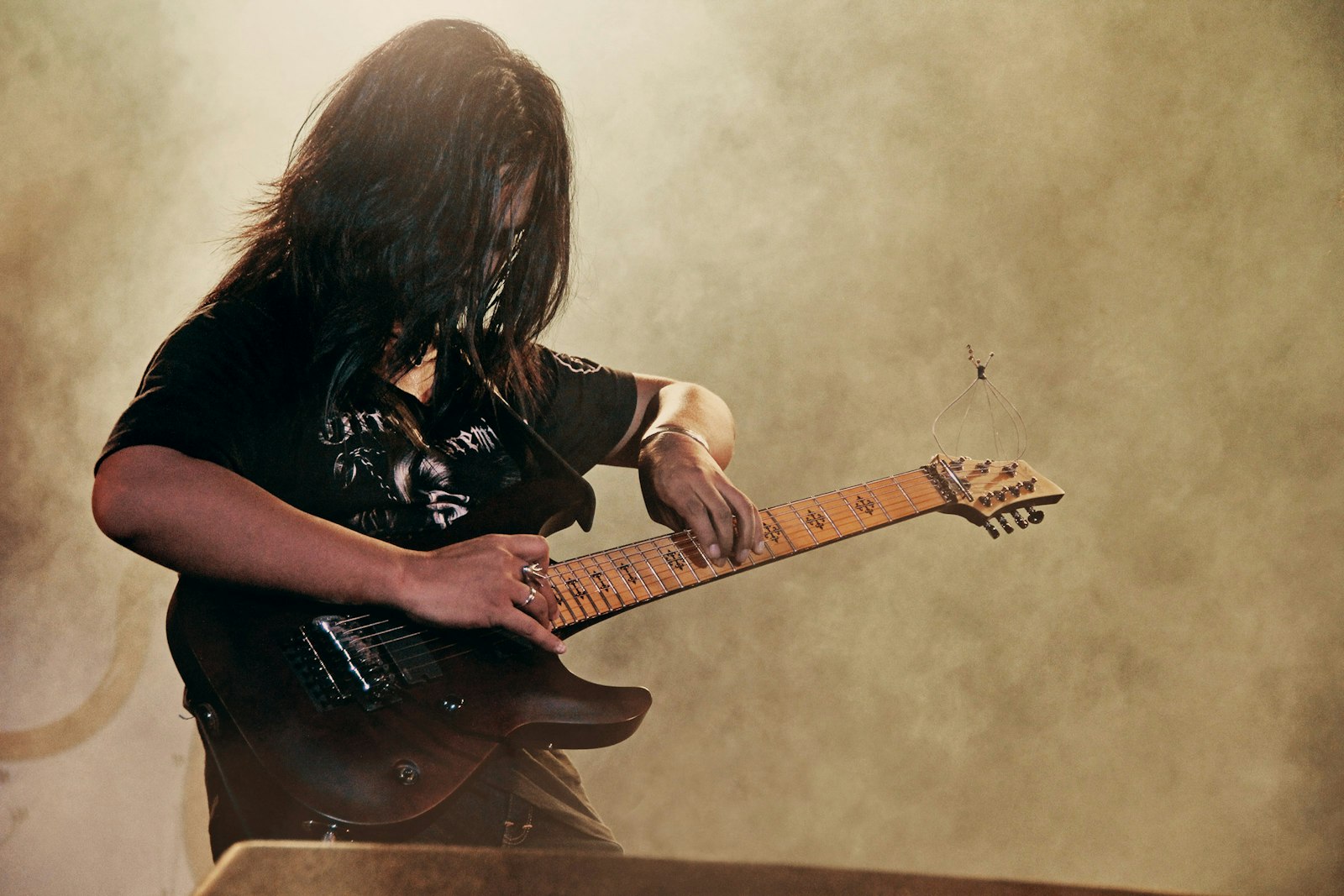
The guitar most associated with Dussias is an ESP Horizon from the Original Series in a sparkling grey finish, the instrument he built his technique on and the one that shows up in most of the clips that made his name. The Horizon is a sensible choice for what he does. It is a tight, neutral, well-built superstrat platform with a fast neck and no tonal personality of its own to fight, which matters when the entire point of the playing is articulation, note separation, and a percussive attack that has to survive at very high note densities. He joined ESP's artist roster in 2024 and was back at NAMM in 2026 walking through the company's new lineup.
He is not a one-guitar player, though. Before the ESP association he was the featured guitarist in Jackson's American Series Soloist campaign, playing an SL2MG and writing "Python" for it. For extended-range work he has used an Ibanez RG2228 eight-string and the ESP LTD JRV-8FR, Javier Reyes's signature eight-string, which is the guitar seen in the "Negative" playthrough. An ESP Horizon-I in deep candy apple red turns up on his guest solo on Clayton King's "Espada." He is also an Abasi Concepts artist, which puts him in the same small orbit as Tosin Abasi's instrument designs. The thread across all of them is the same, a low, even, precisely set up instrument that lets an extremely disciplined right hand be heard exactly as it is played.
Engl Invader 100 and Neural DSP Plugin Rigs
Known for: His stated favorite tube amp, alongside the plugin rigs behind the recorded tone
Asked about amps, Dussias names the original Engl Invader 100 as his favorite tube amp, which tracks with everything else about his playing. The Invader is a tight, high-headroom, aggressively voiced amp built for precision rather than sag and bloom, and it rewards a player whose picking is already surgical. In practice, though, most of what listeners actually hear from him is plugin-based. He works closely with Neural DSP, the company he wrote and produced "Negative" for, and the recorded tone comes out of their Archetype rigs and the Omega Ampworks Granophyre.
The interesting part is what he does with the gain. Dussias has pointed out that Tosin Abasi popularized low-gain tones for this kind of articulate playing, and that his own project has been figuring out how to keep that clarity while running a fair bit more gain than the low-gain approach allows. That is not a small technical problem, because gain is exactly what smears the note separation his style depends on, and solving it is as much a muting and sound-design question as an amp-setting one. He has described chasing a sound that is unnaturally percussive and metallic, treating guitar tone the way an electronic producer treats a synth patch rather than the way a rock guitarist treats an amp.
Neural DSP Omega Granophyre, Mesa IIC+ Suite, and Asymmetric Stereo Doubling
His effects chain is essentially a production chain, and he is unusually open about it. For rhythm width he avoids hard-panned identical doubles and instead builds deliberate asymmetry between the left and right channels, running EL34 emulation on one side and 6L6 on the other so the two tracks distort and voice differently, setting the Omega Granophyre's Voice Switch to different positions per side, and applying different targeted EQ moves to each channel, for example lifting around 2.5 kHz on one side while cutting around 4 kHz. His explanation is that these minor differences trick the ear into perceiving a much larger and more engaging stereo image than matched doubles would. The Mesa IIC+ Suite gets used for cabinet simulation and EQ duties.
There is no pedalboard mythology here, and that is the point. For a player whose entire signature is clarity at speed, the meaningful processing decisions happen in muting, in gain staging, and in how two nearly identical performances are made deliberately unlike each other in the mix. It is a fundamentally modern approach to guitar sound, closer to record production than to rig building, and it is a large part of why his tracks sound like they were assembled in a machine shop.
Signature Technique
Muted Sweep Picking and Economy-Picking Mechanics
The technique that made Spiro Dussias famous has a name he gave it himself, muted sweep picking, and his own description of where it came from is refreshingly unmystical. It came, he says, from experimenting with the mechanics of economy picking and with what becomes possible at different pick angles and different amounts of muting. That sentence hides an enormous amount of work. Economy picking, moving the pick in the same direction across a string change rather than reversing it, is old news and every shred player knows it. What Dussias did was pair it with a right hand that damps each note almost as soon as it sounds, so that fast sweeps come out as a string of short, separated, equally weighted attacks instead of the blurred smear that sweep picking usually produces.
The audible result is why other players find it so disorienting. A conventional sweep is a gesture, a shape you hear as one event. His sweeps are heard as individual notes, each one clipped, each one at the same volume, at tempos where the ear expects a wash. Because the notes are truncated rather than allowed to ring, the line reads to the listener as rhythmic and machine-like, which is exactly the impression he is after. He has talked about wanting the guitar to sound unnaturally percussive and about applying sound-design thinking, the kind an electronic producer uses on a synth patch, to what is still a pick hitting a string.
The muting is the hard part and it is doing double duty. The palm and the unused fingers of the picking hand kill the strings he is not sounding, which is what keeps a high-gain tone from collapsing into noise, and they also shorten the notes he is sounding, which is what creates the staccato quality. Dussias has framed the technical challenge in terms of gain, noting that Tosin Abasi made low-gain tones the standard route to this kind of clarity, and that his own goal was to keep that articulation while running considerably more gain. Solving it in the hands rather than at the amp is what separates his sound from everyone else chasing the same idea.
His fretboard vocabulary matches the mechanics. The lines favor wide-interval arpeggio shapes and position shifts that would be awkward with strict alternate picking but sit naturally under an economy-picking hand, which is a large part of why the note choices sound unfamiliar as well as the attack. On eight-string instruments the same approach extends downward, where muting matters even more because the low strings are the first thing to turn to mud under gain.
The influence is already visible even though his recorded catalog is small. Players are posting breakdown attempts of his right hand, he teaches the approach directly through Riffhard, and the peer reaction from Tim Henson, Tosin Abasi, and Misha Mansoor has effectively certified it as a real contribution rather than a trick. The most interesting thing about him, though, may be the part nobody has heard yet. Underneath the alien precision is a self-described classic guitar nerd raised on Bonamassa, Stevie Ray Vaughan, and John Mayer who has promised a blues record before he turns 30, and who says he intends to do a complete 180 and make people cry.