



Allan Holdsworth
Current Ranking
Allan Holdsworth is ranked #89 of 162 guitarists on the Greatest Guitar Player leaderboard, based on our editorial score until fans weigh in. On the jazz and fusion leaderboard, Allan Holdsworth ranks #9 of 11. No fan votes yet, so be the first to rate Allan Holdsworth on 8 attributes at greatestguitarplayer.com/vote.
Biography
Allan Holdsworth, born in Bradford, England in 1946, is the guitarist other great guitarists talk about in hushed tones. Eddie Van Halen called him the best in his eyes. Frank Zappa, Joe Satriani, John Petrucci, and Tom Morello have all bowed in his direction. And yet he spent most of his life broke, self-doubting, and convinced he had not yet figured the instrument out, which only deepens the legend of the most advanced jazz-fusion guitarist who ever lived.
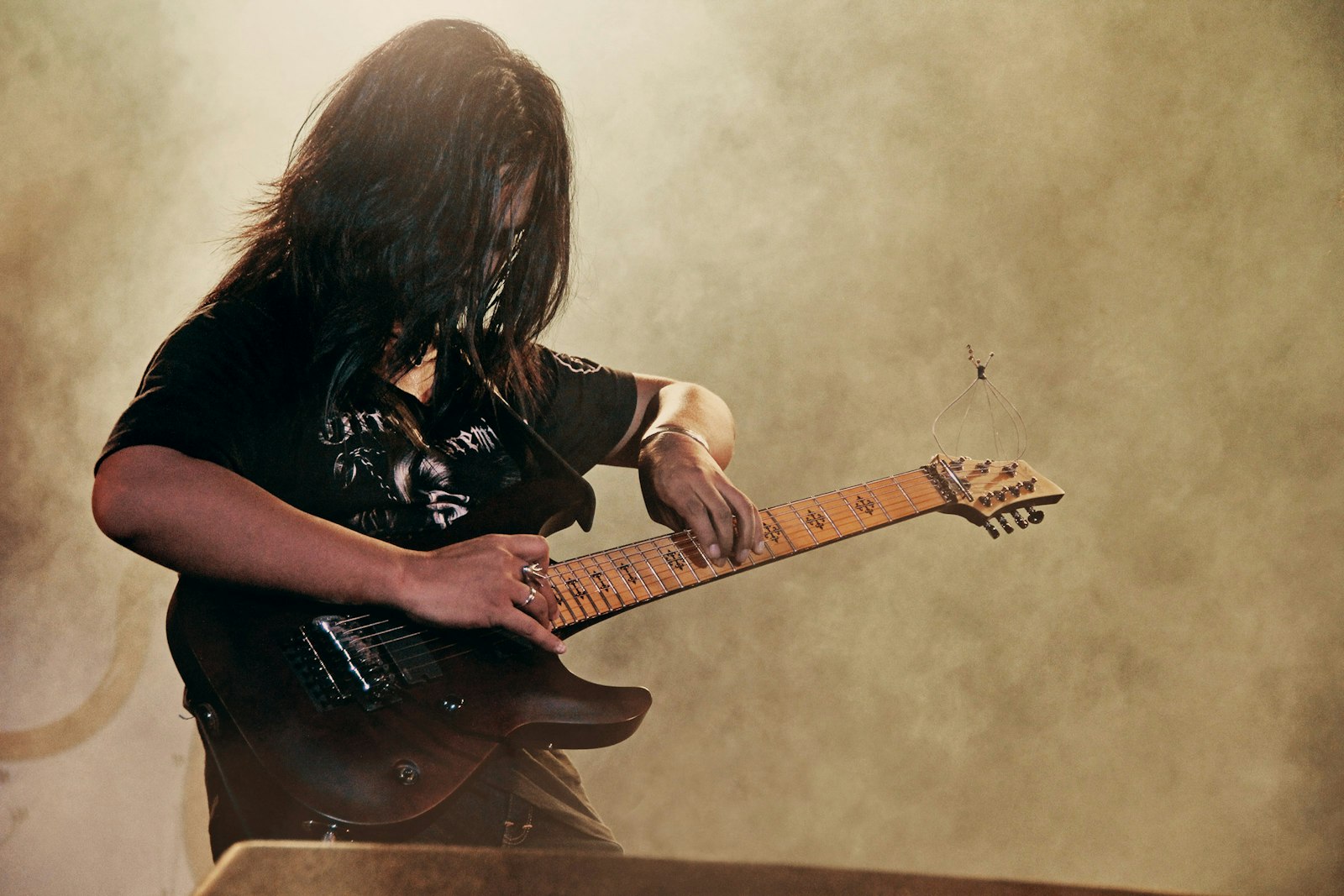
What makes him sound like no one else is the way he thought about the guitar. Holdsworth always wished he had played the saxophone, and he approached the fretboard like a horn player, chasing long, seamless, breathing lines with a legato technique so smooth that his solos sound almost synthesized, with no audible pick attack at all. His chord work was just as alien, built from wide, stretched voicings that most hands cannot physically reach, drawn from a harmonic vocabulary closer to modern classical music than to rock. He chased that sound so far that he eventually adopted the SynthAxe, a strange guitar-shaped synthesizer controller, simply because it let him sustain and shape notes the way a wind instrument could.
His path ran through some of the most important fusion bands of the 1970s, including Tony Williams Lifetime, Soft Machine, Gong, the prog supergroup UK, and Bill Bruford's band, before he stepped out on his own. Solo records like I.O.U., Metal Fatigue, and Atavachron became sacred texts for serious players even as they baffled radio.
Here is the gem, and it is a bittersweet one: Holdsworth was so relentlessly self-critical that he frequently disowned his own albums, hated being praised, and at various points nearly quit guitar to become a beer brewer or a bicycle mechanic. Van Halen reportedly lobbied Warner Brothers to sign him because he believed the world owed Holdsworth a real audience. When he died in 2017, the outpouring from the guitar community made plain what he could never quite believe himself, that he had opened a door on the instrument that the rest of the world is still walking through.
Legendary Performance
UK, Night After Night
1979 · Madison Square Garden, New York City, NY
Allan Holdsworth spent his career being the guitarist that other guitarists cited as the reason they reconsidered everything they thought they knew. Eddie Van Halen called him the greatest guitarist who ever lived. Frank Zappa included him on a shortlist of players whose technique he considered genuinely inexplicable. Joe Satriani, after studying with him, said that understanding Holdsworth's harmonic approach required fundamentally rewiring how one thought about the relationship between scales and chords. None of them were exaggerating. When UK, the supergroup featuring Holdsworth alongside drummer Bill Bruford, keyboardist Eddie Jobson, and bassist-vocalist John Wetton, played Madison Square Garden in 1979, the resulting live album, Night After Night , brought those qualities to an audience that had largely been hearing about them secondhand.
The performance that anchored the recording was "In the Dead of Night," a piece whose studio version had already stopped guitarists cold when UK's debut album appeared the previous year. Live at Madison Square Garden, with the room breathing and the band operating at full concert energy, Holdsworth's solo transcended even the studio version. His legato technique, an approach to the guitar so fluid that individual note attacks became nearly inaudible, the phrases emerging as continuous melodic streams rather than sequences of discrete plucked notes, produced a sound that seemed physically impossible on a fretted instrument. He was not playing like a saxophone player. He was playing like something that had no name yet because no one had heard it before.
Holdsworth's influence on subsequent guitar playing is both enormous and deliberately invisible, enormous because virtually every fusion and progressive rock guitarist of the past four decades has passed through his vocabulary, invisible because he never had a hit record or a household name. He died in 2017 at seventy, still largely unknown outside guitar circles, still being discovered by players who encountered him and stopped in their tracks. The Madison Square Garden recording is the clearest documentation of what they were discovering: a technique so advanced and so strange that it reset the outer boundary of what the electric guitar was understood to be capable of doing.
▶ Watch on YouTubeGear
Custom Holdsworth / Steinberger GL / SynthAxe
Allan Holdsworth's instrument choices were as unconventional as his playing. He worked with various luthiers to build custom instruments with wide fretboards, low action, and extended upper-register access, all designed to facilitate the ultra-smooth legato technique that defined his style. He was an early adopter of the Steinberger GL headless guitar, whose compact design and graphite construction appealed to his pragmatic approach to gear. Most remarkably, Holdsworth was one of the few musicians to take the SynthAxe, a MIDI guitar controller, seriously as a performance instrument, using it to trigger synthesizers in ways that blurred the distinction between guitar and keyboard music.
Hartley Thompson / Marshall / Custom Preamps
Holdsworth's amplification was a constant source of experimentation. He worked with custom preamp builders to achieve the smooth, warm, intensely sustained lead tone that his legato lines required, a tone with no pick attack harshness, no unwanted transients, just pure singing sustain. He used Marshall power sections with custom preamps, various boutique amplifiers, and direct injection setups, always in pursuit of a tone that would allow his complex, chromatic melodic lines to flow without interruption. His ideal tone was described by him as 'like a human voice', completely smooth and continuous.
Rolly's Chorus / Heavy Delay / Volume Swells
Holdsworth's effects were integral to his sound in a way unusual for guitar players. His use of chorus, specifically a custom unit built for him by a technician, produced the liquid, shimmering quality that made his legato lines particularly distinctive. Heavy delay allowed him to build textural layers and to create the illusion of a larger instrument than a single guitar. Volume swells, achieved with his picking hand on the guitar's volume control, eliminated pick attack entirely, producing a bowed-instrument quality. Together these effects served his fundamental goal: to make the guitar sound like nothing that had come before.
Signature Technique
Signature Technique
Allan Holdsworth developed a guitar technique so distinct from conventional approaches that he essentially created a new instrument, one that sounded like neither guitar nor any wind instrument but occupied a territory between them. His technique was built around the elimination of pick attack, the smooth connection of notes through legato phrasing, and the use of harmonic materials derived from jazz theory and his own synthetic scale invention.
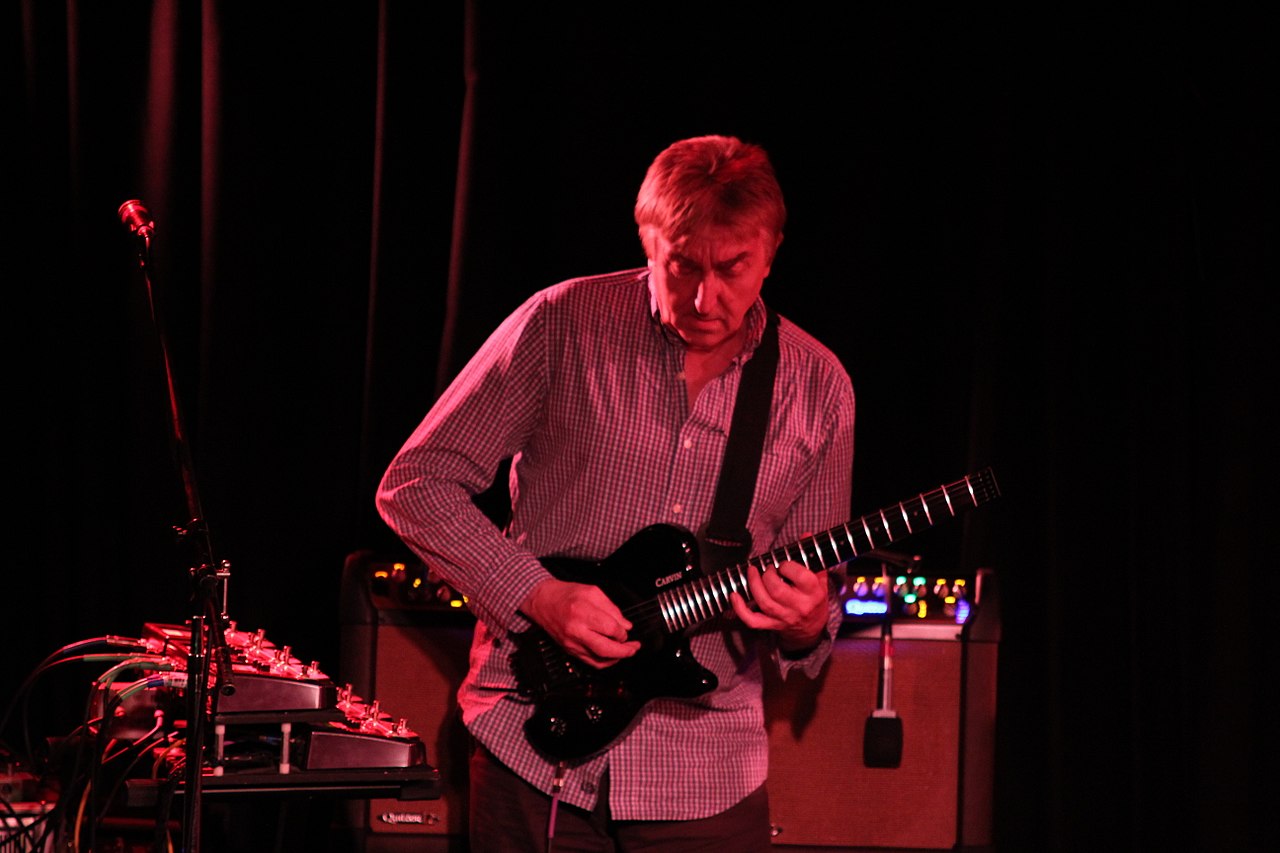
Holdsworth's right-hand pick contact with the strings was minimal, almost an afterthought, because the majority of his note production came from his left hand's hammer-on and pull-off technique. He could sustain long melodic lines with virtually no pick strokes, creating the flowing, seamless quality that distinguished his playing from every other guitarist of his era. His left hand was extraordinarily developed: wide stretches, rapid position shifts, and the ability to sustain notes under hammering without any change in volume or tone.
Holdsworth's fretboard geometry was designed around his unusually wide left-hand reach, which allowed him to execute intervals, fourths, fifths, and even sixths, as single-position stretches that most guitarists would need to shift position to play. This physical capability gave his melodic lines an intervallic character unlike any other guitarist: where most players default to scale-pattern shapes that produce stepwise or small-interval melodies, Holdsworth could leap wide intervals within a single position, creating melodic lines that sounded like jazz wind instrument improvisation.
Holdsworth's melodic vocabulary drew from jazz theory, particularly the modes of the melodic minor scale, the harmonic minor scale, and combinations thereof, augmented by his own synthetic scale constructions. He was not playing blues-derived pentatonic patterns over jazz chords; he was improvising with the same harmonic materials that the chord progressions themselves implied, creating a connection between harmony and melody far more direct than conventional rock guitar improvisation. This theoretical sophistication, deployed through his extraordinary legato technique, produced music of a complexity and beauty that remained largely inaccessible to the mainstream but deeply influential on subsequent jazz and fusion guitarists.