



Bert Jansch
Current Ranking
Bert Jansch is ranked #156 of 162 guitarists on the Greatest Guitar Player leaderboard, based on our editorial score until fans weigh in. No fan votes yet, so be the first to rate Bert Jansch on 8 attributes at greatestguitarplayer.com/vote.
Biography
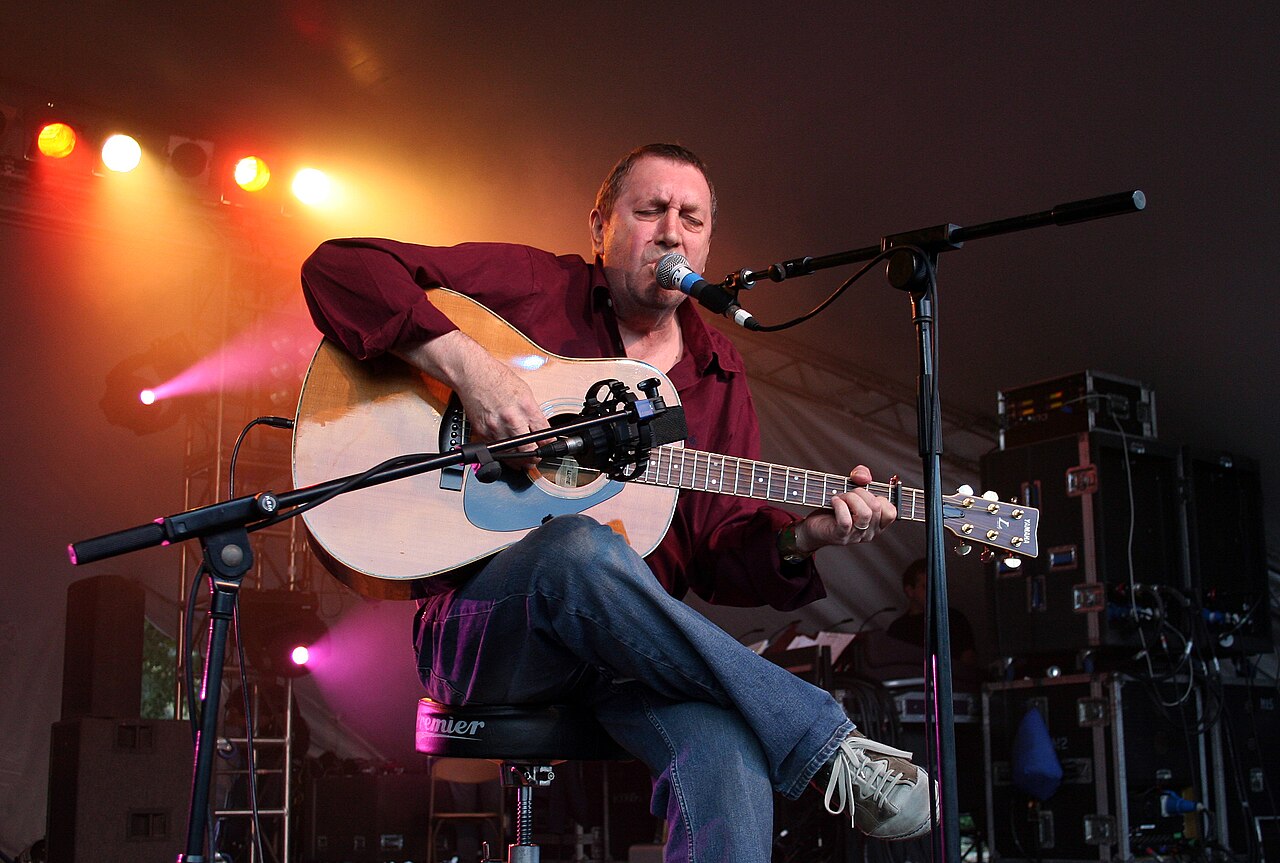
Bert Jansch, born in Glasgow in 1943 and raised in Edinburgh, was the quiet giant of British folk guitar, a fingerstyle innovator whose influence reached so far into rock that many of the players who worshipped him are more famous than he ever was. Largely self-taught, he absorbed traditional British and Celtic songs alongside the American blues and the jazz of players like Big Bill Broonzy and Davy Graham, then fused them into something entirely his own, a style sometimes called folk baroque.
His self-titled 1965 debut, reportedly recorded in a friend's kitchen for almost nothing, landed like a quiet bombshell among guitarists. The playing was intricate and percussive, full of alternating bass lines, ringing open strings, and a loose, human sense of timing that made even the most complex arrangements feel conversational. In 1968 he co-founded Pentangle, a groundbreaking group that married folk with jazz and early music, and his interplay with fellow guitarist John Renbourn became a model for acoustic duos for decades.
Here is the gem that connects him to rock history: a young Jimmy Page was so taken with Jansch's arrangement of the traditional song Blackwaterside that he adapted it almost wholesale into Black Mountain Side on the first Led Zeppelin album, a debt that has been debated by fans and scholars ever since. Jansch's fingerprints did not stop there. Neil Young called him the Jimi Hendrix of the acoustic guitar and openly modeled some of his own acoustic work on him, Johnny Marr of the Smiths cited him as a foundational influence, and Nick Drake studied his approach closely.
What makes Jansch's story so striking is how little fuss he made about any of it. He was a working musician's musician, prone to financial struggles and health troubles, who kept his head down and let the playing speak. He recorded steadily across five decades, weathered the folk revival's fading fashions, and lived to see a new generation of artists rediscover and celebrate him before his death in 2011. For anyone learning fingerstyle guitar, the path still runs straight through him, an unassuming Scotsman who took ancient songs and a steel-string guitar and quietly rewired how the instrument could be played.
Legendary Performance
Pentangle at the Royal Festival Hall
June 29, 1968 · Royal Festival Hall, London
Pentangle's debut concert at the Royal Festival Hall in June 1968 was among the first occasions in British popular music where fingerpicking folk guitar, jazz improvisation, blues structure, and art music were presented as a coherent whole rather than a mixture of influences. Bert Jansch and John Renbourn played acoustic guitars that were individually virtuosic and collectively interlocked, and the rhythm section of Danny Thompson (double bass) and Terry Cox (drums) gave the ensemble a weight that folk music had never previously possessed. The concert was sold out, the reviews were unlike anything written about a folk act before, and the recording of the performance became a document of a particular moment when British folk guitar was briefly the most innovative music being made in the country.
Jimmy Page, who was building Led Zeppelin at exactly this period, has cited Jansch's playing as a primary influence on his acoustic work, the DADGAD tuning, the fingerpicking architecture of "Bron-Y-Aur Stomp," the acoustic passages on "Led Zeppelin III" all carry Jansch's fingerprints. Neil Young called him one of the three or four most important guitarists he had ever heard. The Royal Festival Hall concert is the document that captures the quality that provoked those reactions: an approach to the acoustic guitar so fully realised that it influenced the electric players who would go on to define the decade.
▶ Watch on YouTubeGear
Martin 00-18 & Custom Stefan Sobell Acoustic (1960s-2011)
Known for: Self-titled debut album, 1965; Pentangle recordings
Bert Jansch played acoustic guitars throughout his career without modification, amplification, or effects, the guitar itself, through a microphone when necessary, was his complete signal chain. His primary instrument through the early years was a Martin 00-18, a small-bodied mahogany acoustic whose clarity and projection suited his fingerpicking approach. The small body allowed him to play seated without the instrument obscuring his picking arm, and the mahogany construction gave the tone a warmth that matched the blues and folk material he was drawing from.
Later in his career, Jansch played a guitar built for him by luthier Stefan Sobell, a British maker who specialised in instruments for professional folk players. The Sobell guitar was crafted to Jansch's specific requirements after decades of professional playing, the neck profile, string spacing, and body dimensions matched the technique he had developed, and the instrument became his primary guitar for the last years of his performing life.
Signature Technique
Fingerpicking Architecture & British Folk Tuning Innovation
Bert Jansch's fingerpicking technique was built without formal instruction: he learned from records, from watching other players, and from the particular British folk guitar tradition that was developing around him in Edinburgh and London in the early 1960s. The result was an approach that looked idiosyncratic from the outside but was internally consistent, an alternating-bass pattern in the left hand combined with melodic picking in the right that produced the effect of two guitarists playing simultaneously. He used DADGAD tuning and variants of drop-D before either had been codified as standard approaches in folk or rock music, arriving at them by ear as solutions to the harmonic problems the music presented rather than as pre-existing techniques to be learned.
Jimmy Page has explicitly named Jansch as the guitarist who taught him what the acoustic guitar could do, the DADGAD work on Led Zeppelin's acoustic passages, the fingerpicking architecture of "Bron-Y-Aur Stomp," the modal quality of the acoustic material on "Led Zeppelin III" all derive from listening to Jansch's early albums. Neil Young, Donovan, and Nick Drake all absorbed something from the same source. That degree of downstream influence is the most reliable measure of a technique's significance: Jansch's approach to the acoustic guitar was original enough that it changed the way other guitarists heard the instrument, not just in folk music but in the rock and singer-songwriter traditions that drew from it.