


Buddy Guy
Current Ranking
Buddy Guy is ranked #39 of 162 guitarists on the Greatest Guitar Player leaderboard, based on our editorial score until fans weigh in. On the blues leaderboard, Buddy Guy ranks #7 of 32. No fan votes yet, so be the first to rate Buddy Guy on 8 attributes at greatestguitarplayer.com/vote.
Biography
Buddy Guy, born in rural Lettsworth, Louisiana in 1936, is the living bridge between the original Chicago blues masters and the rock guitar heroes who idolized them. He learned to play on a homemade two-string guitar nailed to a wall, moved to Chicago in the late 1950s, and quickly made his name as the wildest, most electrifying young gunslinger in a city full of blues legends, working as a house guitarist for Chess Records and backing greats like Muddy Waters and Howlin' Wolf.
What set Guy apart was his fearlessness. Where the older bluesmen often played it cool, he attacked the guitar, swinging wildly from a whisper to a scream, bending notes past the breaking point, and unleashing a raw, distorted intensity that the studio bosses at Chess initially thought was just noise. They had no idea they were sitting on the future. That explosive, unpredictable approach, full of dramatic dynamics and showmanship, turned out to be the missing link to rock and roll.
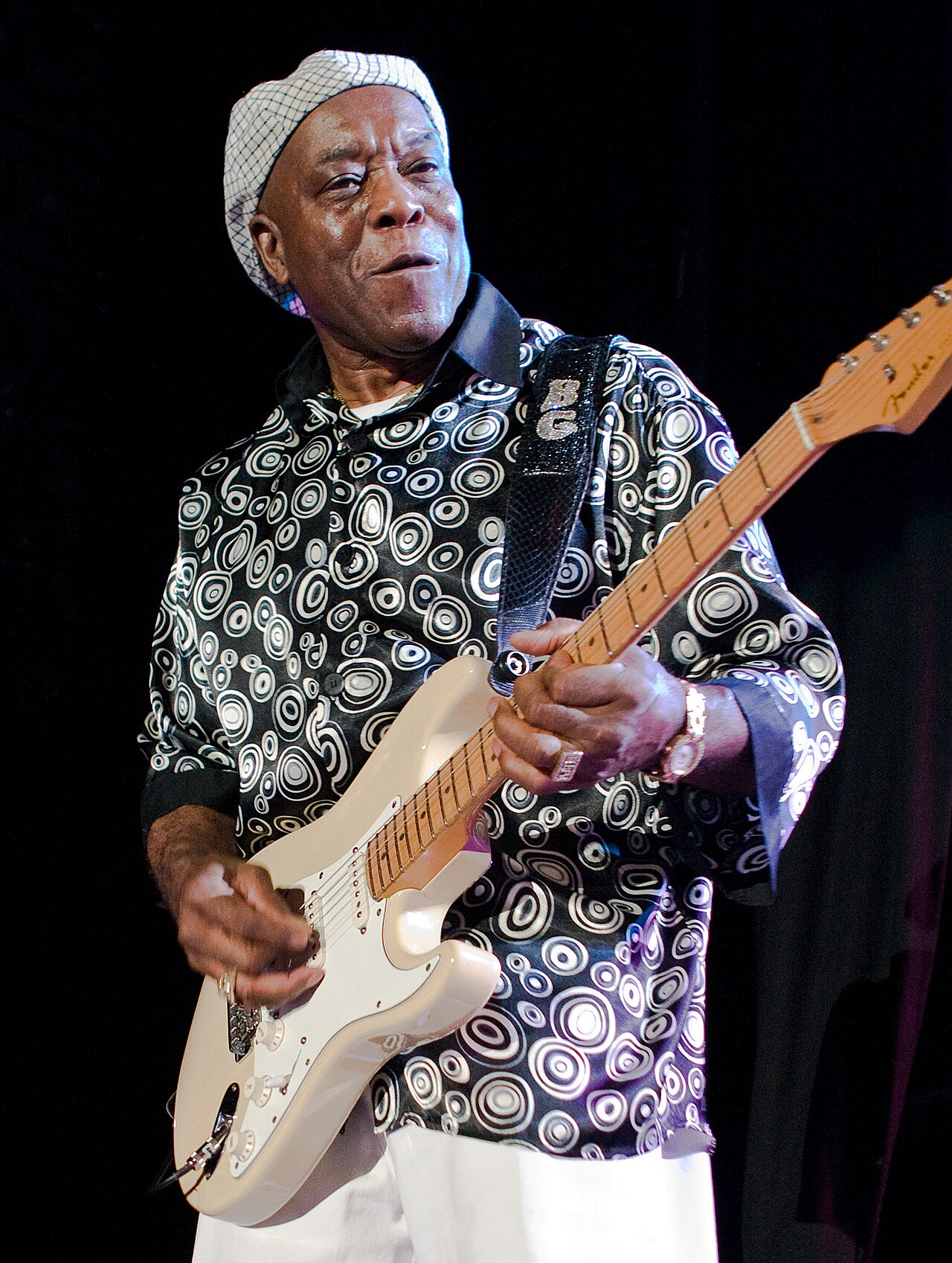
Here is the gem, and it is really a whole constellation of them. The list of guitar gods who studied Buddy Guy reads like a hall of fame. Jimi Hendrix filmed him playing and borrowed from his showmanship. Eric Clapton has called him the greatest living guitarist and the best he has ever seen. Stevie Ray Vaughan and Jimmy Page worshipped him too. Much of what we think of as classic rock guitar theater, the feedback, the savage bends, the playing-with-the-teeth and behind-the-back stunts, traces back through Buddy Guy. He is also known for his polka-dot Stratocaster and his habit of walking off the stage and out into the street mid-solo on a long cable, dragging the whole audience along with him.
For years Guy was a musician's musician, revered by peers but under-rewarded commercially, until his 1991 album Damn Right, I've Got the Blues sparked a major late-career revival and a long-overdue run of Grammys and honors. Now in his late eighties and a Rock and Roll Hall of Fame inductee, he has become the elder statesman and fierce protector of the Chicago blues, running his own club and mentoring young players. He is the last of the true originals, the man who took the blues, lit it on fire, and handed the torch to rock and roll.
Legendary Performance
Newport Folk Festival
July 28, 1968 · Festival Field, Newport, Rhode Island
The Newport Folk Festival had always been a place of principled acoustic purity, the same principled acoustic purity that had erupted against Bob Dylan three summers earlier when he arrived with an electric band. By 1968, the programming had grown more expansive, and the blues program on July 28th brought Buddy Guy and Junior Wells to the stage before thousands of listeners who had, for the most part, never seen anything like what was about to happen. Guy was thirty-one years old, had been recording for Chess Records for nearly a decade, and had developed a live persona that had less in common with the cool reserve of his Chicago contemporaries than with the volcanic showmanship of the performers he had idolized growing up in Louisiana. Newport was about to find out what that meant.
What Guy delivered that afternoon has been called, by those who were there and by those who have studied the recording released decades later, one of the most purely electric blues performances ever captured. He played his Fender Stratocaster behind his back, above his head, and while walking through the crowd, techniques that Jimi Hendrix had also mastered and that would later surface in the playing of Stevie Ray Vaughan, who named Guy as his single most important influence. But the theatrics were always in service of something real. When Guy bent a string on that stage, the note that emerged did not sound like a man playing a guitar; it sounded like a man making an involuntary sound of feeling, and then deciding to hold it.
The concert solidified the Guy-Wells partnership that would produce some of the most vital blues recordings of the following decade, and it announced to a largely white folk-festival audience that the electric blues tradition was not a relic but a living force. Jimi Hendrix cited Guy as a foundational influence. Eric Clapton called him "the greatest guitar player alive." Stevie Ray Vaughan said he wouldn't have picked up the guitar if not for Guy. The Newport performance, raw, joyful, and at moments almost frighteningly intense, is the document that explains why all three of them said what they said.
▶ Watch on YouTubeGear
Fender Stratocaster (Polka Dot Custom)
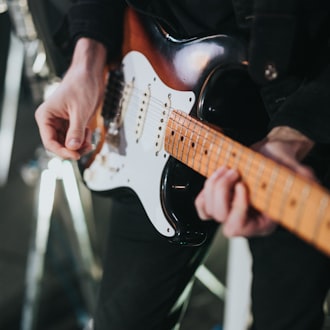
Buddy Guy's most recognizable guitar is his custom polka-dot Fender Stratocaster, a visually striking instrument that matches his flamboyant performance style. But beneath the showmanship, Guy is a serious student of the Stratocaster's tonal range, using the instrument's five pickup positions, tremolo arm, and single-coil pickups to produce everything from stinging lead tones to thick, distorted aggression. He has used various Stratocasters throughout his career, with Fender producing several signature models that reflect his preferences: higher-output pickups, smooth-playing neck, and a tremolo set up for moderate use. His picking technique, a combination of flat-picking aggression and occasional fingerstyle passages, extracts the full dynamic range from the instrument.
Fender Twin Reverb / Dumble Amplifiers
Guy's amplification has included Fender Twin Reverbs for their clean headroom and reliable projection, and in later years Dumble amplifiers, hand-built, highly regarded, and extraordinarily expensive instruments beloved by players who prioritize touch-sensitivity above all else. The Dumble suits Guy's dynamic playing perfectly: it responds to every nuance of his pick attack, compressing gently at moderate volumes and breaking into rich overdrive when pushed. His live setup on larger stages involves multiple amplifiers for volume and redundancy.
Wah Pedal / Fender Reverb / Feedback Technique
Buddy Guy was an early experimenter with feedback, deliberately causing the guitar to sustain and feed back by moving toward the amplifier, creating notes that seemed to sing independently of any physical action. He also used the wah pedal for vocal expression in his lead playing, a technique that influenced Jimi Hendrix, who cited Guy as one of his primary inspirations. Guy's most important 'effect,' however, is physical: he has been known to throw the guitar into the air, play behind his back, and walk into the audience while playing, treating the performance space itself as a sonic instrument.
Signature Technique
Signature Technique
Buddy Guy's guitar technique represents the outer limit of Chicago electric blues expressiveness, a playing style so physically committed and tonally extreme that it influenced Jimi Hendrix, Eric Clapton, and Stevie Ray Vaughan, all of whom cited Guy as a primary inspiration. His approach to the guitar is confrontational: he demands everything the instrument can give and then pushes further, using his body, the room, and the amplifier as extensions of the guitar itself.
Guy bends strings to intervals that most guitarists approach only theoretically, minor thirds and beyond, sustained and controlled with a grip that comes from decades of physical commitment to the blues. His bends are frequently multi-step: he bends to one pitch, pauses on it, then bends further to a second pitch, creating a two-stage expressiveness that amplifies the emotional impact of each phrase. The physical demand of these extreme bends is considerable, and Guy executes them with the ease of a player for whom the guitar has no boundaries.
Guy was among the first guitarists to deliberately cultivate amplifier feedback as a musical resource rather than a problem to be avoided. By manipulating his distance and angle relative to the amplifier, he could sustain notes indefinitely, control the feedback's pitch, and create harmonics that blended with the guitar's fundamental note. This technique, which Hendrix would later develop into a complete sonic vocabulary, requires a deep understanding of the physical relationship between guitar, amplifier, and room, as well as the reflexes to control feedback that can become chaotic in an instant.
Buddy Guy's most distinctive technique extends beyond the guitar itself into the performance space. He is famous for walking into the audience while playing, throwing the guitar over his shoulder, playing behind his back, and otherwise treating the concert environment as part of the instrument. This physical approach to performance, which Hendrix explicitly borrowed, is not merely showmanship; it changes the relationship between the guitar's resonant body and the amplifier, producing sounds unavailable to a stationary player. Guy's technique is inseparable from his body in motion.