
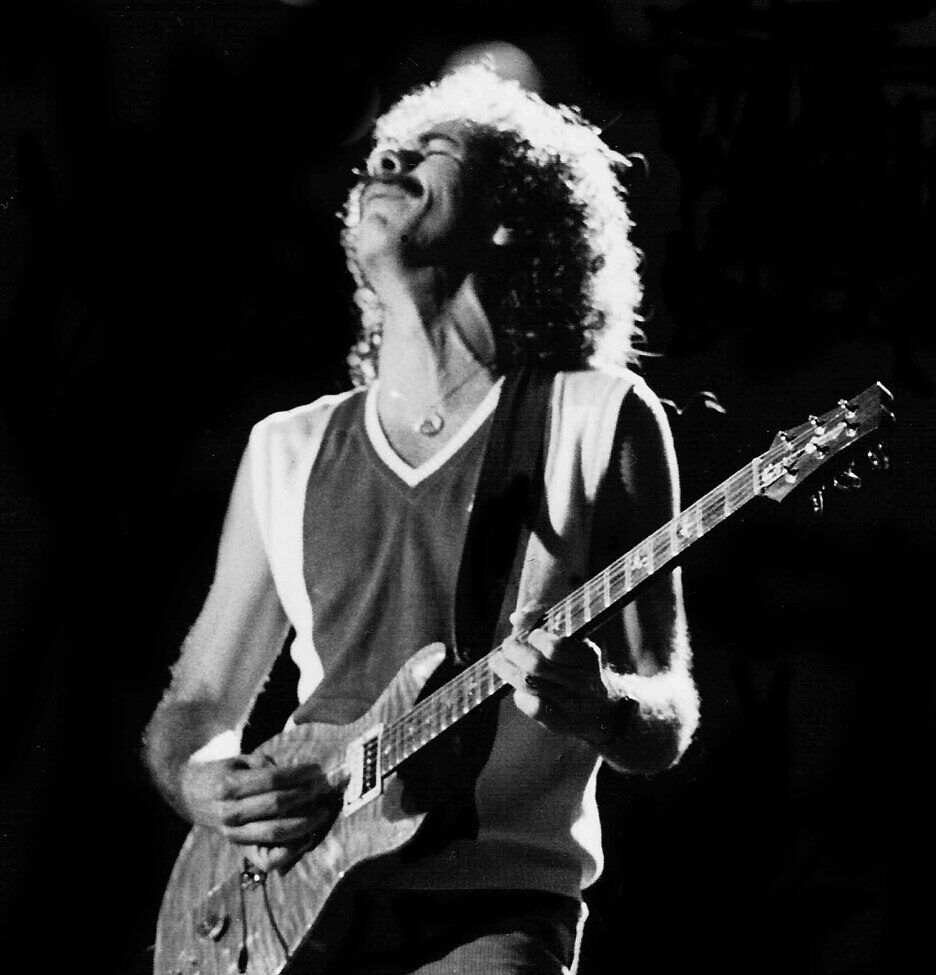

Carlos Santana
Current Ranking
Carlos Santana is ranked #23 of 162 guitarists on the Greatest Guitar Player fan leaderboard, based on 1 fan vote so far. On the classic rock leaderboard, Carlos Santana ranks #7 of 18. Agree? Rate Carlos Santana on 8 attributes at greatestguitarplayer.com/vote.
Biography
Carlos Santana, born in Autlan, Mexico in 1947 and raised partly in Tijuana before his family moved to San Francisco, created something genuinely new in rock: a fusion of blues-rock guitar with Afro-Cuban and Latin rhythms that no one had heard quite that way before. The son of a mariachi violinist, he came up loving B.B. King and the blues, then poured that feeling over conga-driven Latin grooves to invent the sound that bears his name.
Santana's guitar voice is one of the most recognizable on the planet. He plays with an endless, singing sustain, long notes that bloom and cry and seem to hang in the air forever, achieved through warm overdriven tone and an almost devotional sense of melody. He treats the guitar less like a rhythm instrument and more like a human voice soaring over the percussion. You can hear it on the slow-burning beauty of Samba Pa Ti and on his electrifying takes on Black Magic Woman, Oye Como Va, and Evil Ways, songs that made Latin rock a permanent part of the mainstream.
Here is the gem. The world first met Santana at the Woodstock festival in 1969, before his band had even released its debut album, and his blistering performance of Soul Sacrifice stole the show and launched his career on the spot. Santana has said he played that legendary set while peaking on a psychedelic, fighting to keep control as he hallucinated that his guitar neck was turning into an electric snake writhing in his hands, willing himself to stay in tune and in time. Out of that surreal struggle came one of the most galvanizing performances in the festival's history.
A second gem is one of the great comebacks in pop history. Decades after his initial fame, Santana released the 1999 album Supernatural, full of guest collaborations including the inescapable smash Smooth, which sold tens of millions of copies and swept the Grammys, winning a record-tying haul in a single night and introducing his sustaining, soulful tone to a whole new generation that had never heard of Woodstock. Few artists have ever bridged the generations so triumphantly.
A Rock and Roll Hall of Fame inductee and one of the best-selling guitarists ever, Santana has always framed his playing in spiritual terms, treating the instrument as a channel for something larger than himself and using his platform to promote peace, unity, and charitable causes. For all his commercial success, that is the heart of his legacy, the idea that an electric guitar, played with enough conviction, can sing like a prayer. His warm, weeping, unmistakable tone remains one of the most beloved and instantly identifiable sounds in all of music.
Legendary Performance
Santana at Woodstock
August 16, 1969 · Yasgur's Farm, Bethel, New York
Santana performed at Woodstock on August 16, 1969, at a moment when the band was almost entirely unknown outside the San Francisco Bay Area, they had not yet released their debut album, which would appear three weeks after the festival. Carlos Santana was 22 years old, had been awake for the majority of the preceding 24 hours, and by his own account was in a significantly altered state of mind when the band took the stage. What followed was a 45-minute set that changed his career entirely: the Latin percussion over blues guitar hybrid that Santana had been developing in the Mission District clubs of San Francisco was presented to an audience of 400,000 people who had no context for it and received it as something genuinely new, which it was.
The performance of "Soul Sacrifice", a long, percussion-driven instrumental that built to a collective frenzy, is the set's most discussed moment, but the guitar playing throughout demonstrated the qualities that would define Santana's musical identity for the following five decades: the violin-like sustain of a Gibson SG through a modified amplifier, the melodic phrasing rooted in blues but extended through Latin scales and modes, and the specific quality his playing has that makes individual notes sound like they are being held by a hand rather than produced by a machine. The Woodstock appearance made the debut album a bestseller before it was released, and established the musical approach that no subsequent guitarist has successfully replicated.
▶ Watch on YouTubeGear
PRS Santana Signature / Early Gibson SG (1969-present)
Known for: Woodstock 1969; "Black Magic Woman"
Carlos Santana's Woodstock performance was played on a Gibson SG, the guitar he used through most of the late 1960s and early 1970s. The SG's twin humbuckers, through the specific amplification setup he had at that period, produced the sustained, violin-like tone that was immediately recognisable as something different from the other electric guitars performing at the festival. From the 1970s onward, Santana transitioned through various guitars including Guild S-100s and other models before establishing his long-running relationship with Paul Reed Smith, whose company developed the Carlos Santana signature model in the 1990s.
The PRS Santana signature, a double-cutaway mahogany body with a figured maple top, designed around Santana's tonal preferences, has become his primary instrument for live and studio work. Its specific pickup configuration and construction produce the warm, sustaining tone that Santana's melodic approach requires: individual notes held through vibrato for extended durations need a guitar whose resonance sustains rather than decays, and the PRS mahogany construction provides exactly this.
Mesa/Boogie Mark I (early custom) & Dumble Overdrive Special
Known for: Defining the Santana clean-to-driven lead tone
Santana's amplification history is one of the most discussed in electric guitar circles because it connects two of the most sought-after and expensive amplifier lineages simultaneously. He was among the first artists to use Mesa/Boogie amplifiers, the company's founder Randall Smith built a custom modified Fender Princeton for Santana in 1969 that became the prototype for what Mesa/Boogie would subsequently develop as a commercial product. The Mesa/Boogie Mark series, which produces the high-gain lead tone associated with 1980s rock, grew directly from the work done for Santana.
He has also used Dumble Overdrive Special amplifiers, custom-built, extremely rare units whose clean headroom and driven character match his tonal requirements with a precision that no production amplifier has equalled. His combination of these two amplifier sources, the Mesa/Boogie for driven lead tones, the Dumble for cleaner, more open sounds, gives him a complete tonal palette within which the guitar's natural character remains audible rather than being replaced by the amplifier's.
Signature Technique
Legato Sustain & Tone Sculpting
Carlos Santana is identifiable in two notes. The quality he chases above all else is a sustained, vocal tone that sings rather than strikes, a note that keeps growing after the pick hits the string, shaped and guided by left-hand pressure, amplifier gain, and an almost meditative sensitivity to what the note is doing. He achieves this through a combination of heavy picking-hand attack, high gain, and a legato left-hand technique that links hammer-ons and pull-offs into smooth, continuous melodic lines with minimal pick interference.
His modal approach, particularly his use of the Dorian mode over minor chord vamps, gives his melodies their Latin-inflected, hypnotic quality. But it is the tone itself that people most often try and fail to imitate. Santana has described his goal as making the guitar sound like a human cry or a cello, and his signal chain, Mesa Boogie amplifiers driven hard into controlled saturation, is specifically engineered for that voice. "Oye Como Va" and "Europa" are the essential listening.