




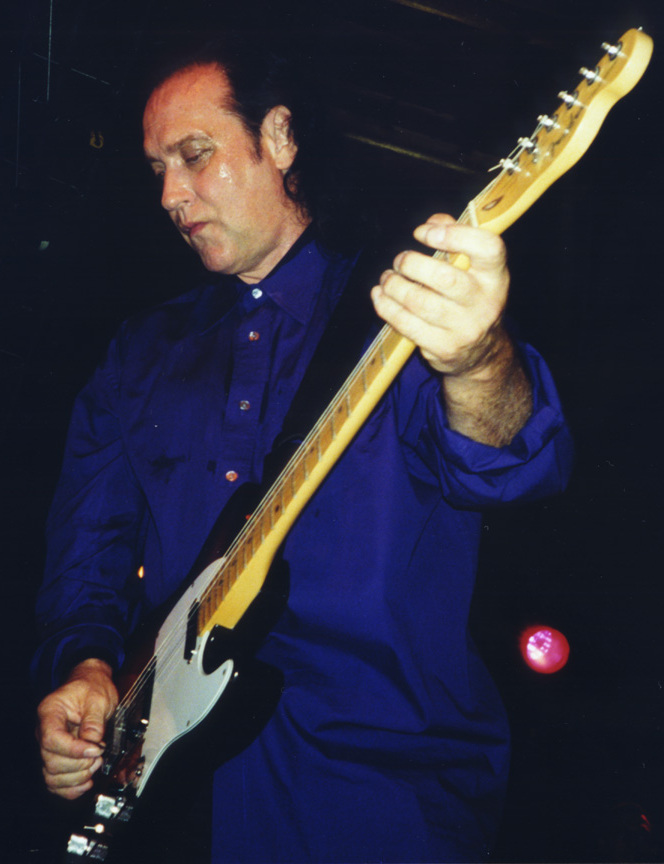

Dave Davies
Current Ranking
Dave Davies is ranked #147 of 162 guitarists on the Greatest Guitar Player leaderboard, based on our editorial score until fans weigh in. On the classic rock leaderboard, Dave Davies ranks #18 of 18. No fan votes yet, so be the first to rate Dave Davies on 8 attributes at greatestguitarplayer.com/vote.
Biography
Dave Davies, born in London in 1947, is the lead guitarist of the Kinks and, by a strong claim, the man who invented the sound of hard rock and punk guitar with a single act of teenage frustration. Younger brother to the band's songwriter Ray Davies, Dave was the wilder, more reckless half of one of rock's most volatile sibling partnerships, and his raw, distorted guitar gave the Kinks an edge that pointed straight toward the future.
In 1964 the Kinks released You Really Got Me, built on a primitive, snarling, distorted riff that hit like nothing else on the radio. That fuzzy, aggressive tone is often cited as the birth of the power chord as the engine of hard rock, the direct ancestor of heavy metal and punk. The riff is simple, but the sound was revolutionary, and bands have been chasing that nasty crunch ever since.
Here is the gem, one of the most famous pieces of gear lore in all of rock. Unable to get the dirty, overdriven sound he heard in his head from his equipment, the teenage Dave Davies took a razor blade to the speaker cone of a small green Elpico amplifier, slashing it so that it buzzed and tore when he played. He then ran that ruined little amp into a larger one, and the result was the ragged, distorted growl that powers You Really Got Me. He essentially invented guitar distortion as a deliberate musical tool by vandalizing his own equipment, and the entire history of heavy guitar flows out of that slashed speaker.
Beyond that landmark, Davies was a versatile and underrated player whose work ranged from the proto-metal of the early singles to the gentle, country-tinged textures of the Kinks' later, more pastoral records. He also weathered a famously stormy relationship with his brother that fueled and nearly destroyed the band many times over. Inducted into the Rock and Roll Hall of Fame with the Kinks, Dave Davies remains a guitar hero's guitar hero, the kid who wanted a dirtier sound so badly that he carved it into existence with a razor blade and changed rock and roll forever.
Legendary Performance
The Kinks at the Hollywood Bowl
The Kinks' 1965 tour of the United States, cut short by a touring ban that would keep them from American stages for four years, included a Hollywood Bowl appearance that captured Dave Davies at the peak of the band's early raw energy. Davies had recorded "You Really Got Me" the previous year using a technique of deliberate amplifier distortion, slashing the speaker cone of his Elpico amplifier with a razor blade and connecting it to a larger Vox AC30, that produced the sound widely credited as the first power chord-driven hard rock recording. Live, the song and its follow-ups acquired a ferocity that the studio recordings only approximated, Davies's guitar work combining the physicality of early American rock and roll with a British aggression that was entirely new.
The significance of the performance lies in its historical position: Davies was playing guitar that directly prefigured the heavy rock genre at a moment when that genre did not yet have a name, and the Hollywood Bowl setting, a venue associated with classical concerts and established pop stars, contextualised the disruption he represented. His rhythm and lead work throughout the set demonstrated that the techniques he had developed for recording could be reproduced and extended in live performance, establishing the template for electric guitar in rock that countless players would build upon in the following decade.
▶ Watch on YouTubeGear
Harmony Meteor & Framus Hootenanny
Dave Davies began his career on a Harmony Meteor, a budget American archtop, before the Kinks' early success allowed equipment upgrades. The recorded sound of "You Really Got Me", universally credited as one of the founding documents of hard rock, was produced through a technique of deliberate destruction: Davies slashed the speaker cone of his Elpico practice amplifier with a razor blade and pins, connecting its distorted output to the input of a Vox AC30, creating a cascaded gain stage that produced the fierce, harmonically saturated tone no commercially available pedal yet offered. This DIY approach to distortion, motivated by necessity rather than experimentation, accidentally defined the sound of hard rock guitar for the following fifty years.
Vox AC30
The Vox AC30 was central to the early Kinks sound and to Davies' development as a player, its characteristic chime and natural compression under drive suiting the rhythm and lead playing that defined the band's commercial peak. The AC30's top boost circuit, when driven hard, produces a bright, cutting saturation that differs fundamentally from the darker, more midrange-heavy distortion of Marshall amplification, and this tonal character is audible throughout the Kinks' mid-1960s catalogue as a signature of the British Invasion sound at its most aggressive.
Minimal Chain, Distortion Through Technique
Beyond the razor-blade speaker modification that created his first distortion, Davies' effects usage throughout the Kinks' classic period was minimal. His tone was shaped by amplifier settings and playing technique rather than external processing, a pragmatic approach that was standard for British bands of his era but that produced, in his case, one of the most influential electric guitar sounds in rock history. The lesson of his early career is that consequential tonal innovation can emerge from accident and limitation as readily as from deliberate research.
Signature Technique
Signature Technique
Dave Davies' contribution to guitar technique is foundational rather than elaborated: he created, through accident and adolescent experimentation, the distorted power chord sound that became the primary vocabulary of hard rock, heavy metal, and punk guitar. At seventeen, his razor blade modification of an Elpico amplifier speaker produced a distortion that no commercial equipment then offered, and the resulting sound, deployed on "You Really Got Me" in 1964, established the template that every subsequent distorted guitar recording builds upon. The technique is historically significant precisely because it was not the product of technical sophistication: it was the product of a teenager who wanted a sound that did not yet exist and improvised his way to creating it.
The power chord, a two or three note construction consisting of a root note and its fifth, without the third that determines major or minor quality, existed before Davies in country and jazz contexts, but his use of it through heavy distortion in a rock rhythm context invented the technique as it is now universally understood. The absence of the third creates harmonic ambiguity that suits distorted guitar: the dense overtones produced by distortion fill in the harmonic gaps, and the power chord's simplicity allows aggressive, precise rhythmic articulation without the muddiness that complex chords acquire under high gain. This discovery has shaped fifty years of guitar-based popular music.
Beyond the harmonic content of his playing, Davies developed a strumming technique of deliberate aggression, full-arm motion, hard pick attack, minimal damping, that translated the physicality of rock and roll performance directly into the guitar sound. Where many rhythm guitarists of his era used wrist motion and lighter contact, his whole-body approach to the instrument produced the raw, slightly out-of-control energy that "You Really Got Me" captures and that became the defining characteristic of British Invasion hard rock. The technique is learnable but not teachable: it requires the conviction to play harder than feels musically safe.