


Django Reinhardt
Current Ranking
Django Reinhardt is ranked #7 of 162 guitarists on the Greatest Guitar Player leaderboard, based on our editorial score until fans weigh in. On the jazz and fusion leaderboard, Django Reinhardt ranks #1 of 11. No fan votes yet, so be the first to rate Django Reinhardt on 8 attributes at greatestguitarplayer.com/vote.
Biography
Django Reinhardt, born in Belgium in 1910 into a traveling Romani family, is one of the most astonishing figures in the history of the guitar, the man who invented gypsy jazz and did it while overcoming an injury that should have ended his playing forever. Largely self-taught and unable to read music, he absorbed everything by ear, and he reshaped what a guitar could do in the hands of a soloist, all while living much of his life in caravans on the road.
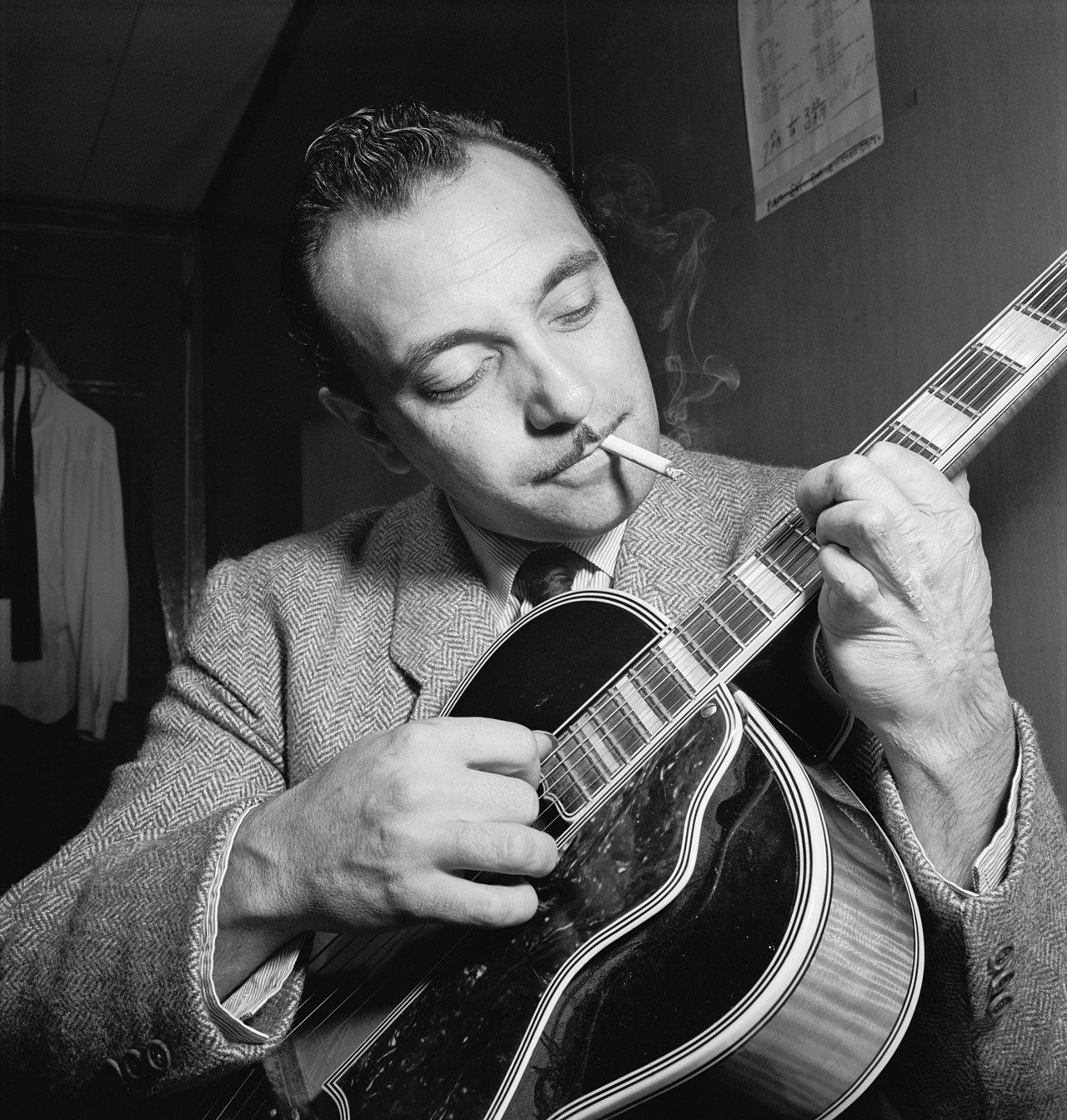
Here is the gem, the central, almost unbelievable fact of his life. When Django was eighteen, a fire swept through the caravan he shared with his wife, badly burning his left hand and leaving the third and fourth fingers paralyzed and curled, effectively useless for fretting. Doctors thought he would never play again. Instead, he completely reinvented his technique, learning to play dazzling, impossibly fast solos using only his index and middle fingers for the lead lines, with the two damaged fingers contributing only on certain chords. He turned a catastrophic disability into a wholly original style, and the limitation became part of his genius.
In the 1930s he co-founded the Quintette du Hot Club de France with the violinist Stephane Grappelli, an all-string group whose swinging, virtuosic, joyful music made Django an international star and proved that Europe could produce jazz to rival America's. His compositions, like Minor Swing, Djangology, and the gorgeous Nuages, became standards, and his fleet, lyrical, daringly inventive playing influenced generations of guitarists across jazz, rock, and beyond. Players as varied as Les Paul, Chet Atkins, B.B. King, Jerry Garcia, and Willie Nelson have cited him with awe.
A second gem captures his improbable cool. Django was famously unreliable and free-spirited, sometimes missing concerts because he had wandered off to fish, walk in the countryside, or simply do as he pleased, treating fame with a Romani traveler's indifference. Yet when he did play, he was untouchable, and during the dark years of the Second World War, when the Nazis were persecuting Roma people across Europe, he survived and kept making joyful, defiant music in occupied Paris, his very existence an act of resilience.
Django died young, of a stroke in 1953 at just forty-three, but his shadow only grew. An entire genre, gypsy jazz, exists to carry forward his style, with festivals and devoted players around the world still chasing the impossible fluidity he found with two working fingers. He remains the ultimate proof that creativity can triumph over any obstacle, and that genius sometimes blooms not in spite of limitation but because of how brilliantly a person answers it. There is simply no one else in guitar history quite like him.
Legendary Performance
Carnegie Hall Concert with Duke Ellington
Django Reinhardt's 1946 American tour culminated in a landmark Carnegie Hall appearance alongside Duke Ellington's orchestra, a collision of European gypsy jazz and American swing that produced one of the most unusual and exhilarating concerts of the era. Playing his Selmer Maccaferri with only two fully functional fingers on his fretting hand (the result of a 1928 caravan fire), Reinhardt improvised with a harmonic sophistication and melodic invention that left the New York jazz establishment speechless.
The concert was not without tension, Reinhardt's unpredictable nature had already frustrated Ellington during rehearsals, but on stage that night the chemistry was electric. His solos moved between lightning single-note runs and lush chord voicings that redefined what was possible on acoustic guitar. Reinhardt had essentially created an entire language for jazz guitar, and Carnegie Hall was where he demonstrated that language could hold its own against the greatest American big band of the age.
▶ Watch on YouTubeGear
Selmer Maccaferri (Various, 1930s-1940s)
Django Reinhardt played Selmer Maccaferri guitars, a type of acoustic archtop developed by Mario Maccaferri and manufactured by Henri Selmer in Paris, and his association with the instrument was so complete that 'gypsy jazz guitar' became virtually synonymous with the Selmer sound. The guitar's D-shaped sound hole (on earlier models) and oval sound hole (on later models), combined with its floating spruce top and distinctive internal resonator chamber, produced a crisp, cutting tone with rapid note decay, perfectly suited to the hot jazz idiom. Despite losing full use of two fingers on his fretting hand in the 1928 caravan fire, Reinhardt adapted his technique to the Selmer's relatively high action and stiff strings, developing a style that exploited his two functional fingers with astonishing agility.
Acoustic (Unamplified)
For most of his recording career, Reinhardt played entirely unamplified, the Selmer's projecting acoustic tone was sufficient for the small club and concert hall settings of 1930s and 1940s Paris. In his later years he experimented with electric guitar, notably a Gibson ES-300 and other archtops, and even recorded some bop-influenced sessions in a more American style. But his legacy rests entirely on the acoustic recordings made with the Quintette du Hot Club de France, where the Selmer's voice, percussive, singing, and immediately recognizable, defined an entire genre.
None (Pure Acoustic Technique)
Django Reinhardt's 'effects' were entirely self-generated: tremolo produced by rapid pick oscillation across the strings, harmonic ornamentation derived from the gypsy musical tradition, and an extraordinary melodic sense that allowed him to imply chord changes through single-note lines. He was one of the first guitarists to develop a fully realized personal language for jazz improvisation, and he did it with two fingers on his left hand and a plectrum in his right, no amplification, no processing, nothing between his fingers and the wood.
Signature Technique
Gypsy Jazz & Two-Finger Virtuosity
In 1928, a fire in Django Reinhardt's caravan left his left hand severely damaged, the ring and little fingers paralysed and fused together. He was told he would never play guitar again. He developed an entirely new technique using only his index and middle fingers for all lead lines, using the damaged fingers only to assist with chord shapes in the lower positions. With this two-finger fretting hand, he became arguably the most technically brilliant improviser in the history of the guitar, and did so on acoustic jazz guitar, with no amplification and no distortion to assist sustain.
His Gypsy Jazz style, characterised by rapid rest-stroke picking, chromatic approach notes, sweeping diminished and augmented arpeggios, and an almost conversation-like improvisational flow, became the foundation of an entire genre that persists today. "Minor Swing" and "Nuages" are the essential recordings. Every note of his playing carries the quality of someone speaking directly to you in a language they invented, with a precision and fluency that sounds impossible given the physical constraints he overcame.