



Warren Haynes
Current Ranking
Warren Haynes is ranked #103 of 162 guitarists on the Greatest Guitar Player leaderboard, based on our editorial score until fans weigh in. On the blues leaderboard, Warren Haynes ranks #21 of 32. No fan votes yet, so be the first to rate Warren Haynes on 8 attributes at greatestguitarplayer.com/vote.
Biography
Warren Haynes, born in Asheville, North Carolina in 1960, is one of the most respected and tirelessly hardworking guitarists in American music, a soulful master of blues, rock, and improvisation who has become a kind of connective tissue running through the worlds of Southern rock and the jam-band scene. A powerful singer and a gifted songwriter as well as a formidable guitarist, Haynes has lent his talents to an extraordinary range of legendary acts while building his own enduring band, earning deep respect everywhere he plays.
Haynes is perhaps best known for his long association with the Allman Brothers Band, which he joined in 1989 and helped lead through a celebrated late-career revival, stepping into the demanding role of carrying on the band's twin-guitar and slide traditions alongside its surviving members. His soulful, blues-drenched playing and his deep respect for the band's legacy made him central to one of the great comeback stories in rock, and he kept the Allman Brothers' flame burning brightly for decades.
Here is the gem that captures his unique standing. Haynes is the ultimate musical connector, a guitarist trusted by the royalty of multiple scenes. Beyond the Allman Brothers, he founded and leads his own acclaimed band Gov't Mule, a powerhouse of improvisational jam-rock, and he has performed extensively with the surviving members of the Grateful Dead, becoming one of the trusted few invited to help carry on that band's improvisational legacy. To be embraced as a key player by both the Allman Brothers and the Grateful Dead worlds, two of the most revered improvisational institutions in American music, is a singular honor that speaks to his taste, versatility, and deep musical knowledge.
Haynes is also a respected songwriter, having penned the beloved song Soulshine, and a generous community figure who has organized long-running charity concerts in his hometown. His guitar playing combines fiery technique with genuine soul and feel, equally at home on a slow blues, a roaring rock jam, or a tender ballad, and his rich singing voice makes him a complete performer. Endlessly busy and universally admired, Warren Haynes is a guitarist's guitarist and a musician's musician, the soulful, hardworking master who has woven himself into the fabric of American rock and roll and become an indispensable figure across some of its most cherished traditions.
Legendary Performance
Allman Brothers Band, Final Concert
October 28, 2014 · Beacon Theatre, New York City, NY
The Allman Brothers Band had been playing the Beacon Theatre every March for more than two decades, a residency so beloved that it had become one of New York's fixed astronomical events, as reliable and anticipated as the return of spring. But the final concert on October 28, 2014 was different in every way that mattered: not a residency show but a farewell, forty-five years after the band's founding in Macon, Georgia, in the autumn of 1969. Warren Haynes, who had rejoined the Allman Brothers for what became their final era, served as both performer and curator of a nearly thirty-song set that moved through the full arc of one of the greatest catalogues in American rock. The crowd knew they would not be there again. Haynes knew it too.
Haynes had first joined the Allman Brothers in 1989, reviving a band that had lost both of its founding guitarists to tragedy, Duane Allman in 1971 and Dickey Betts in the long attrition of lineup changes and personal conflict. What he brought to the role was not mimicry but translation: a blues vocabulary rooted in the same Southern tradition as the band's founders, filtered through a decade of his own development, and expressed with a soulfulness that made the question of authenticity irrelevant within minutes of his joining the stage. By 2014, his playing alongside Derek Trucks had produced some of the most celebrated guitar interplay in the band's history, two fully formed musical minds operating in a conversation so fluent it sounded improvised even when it wasn't.
The final night at the Beacon was everything a farewell should be and almost never is: joyful rather than elegiac, present rather than retrospective. Haynes played "Whipping Post," "Blue Sky," "Jessica," and "Melissa" with the focus of someone who understood that these songs had outlasted the people who wrote them and would outlast the night. His solo on "Statesboro Blues", the song Duane Allman had used to open countless concerts four decades earlier, was a quiet act of honoring: not an imitation but a response, one great guitarist speaking across time to another. When the last note sounded and the Allman Brothers Band walked off the Beacon stage for the final time, Warren Haynes was among the last of them to go. The music had demanded his full attention for three hours. He had given it.
▶ Watch on YouTubeGear
Gibson Les Paul Standard (1961) / Various Gibsons
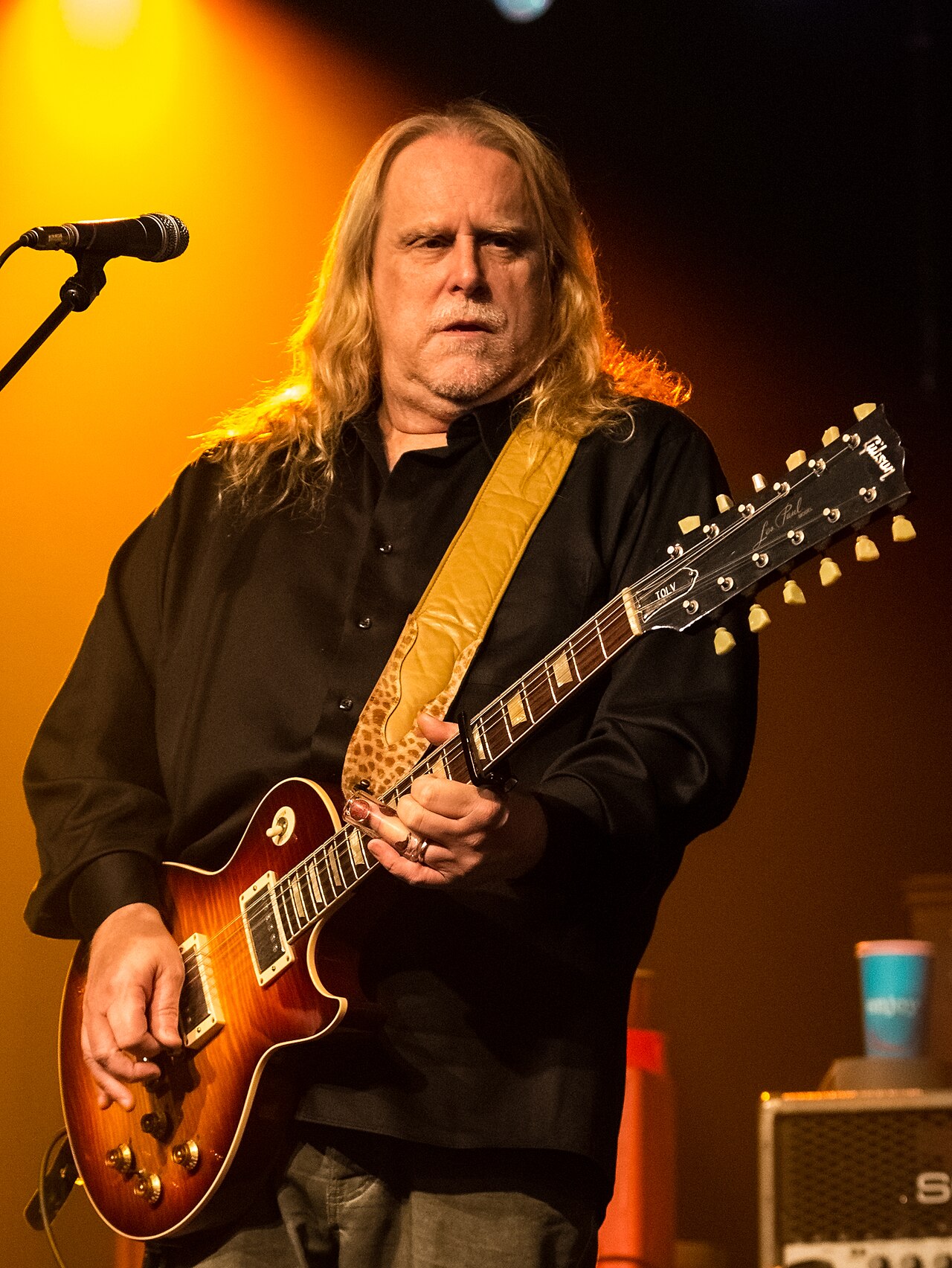
Warren Haynes' primary instrument is a 1961 Gibson Les Paul Standard, a guitar that predates the humbucker-equipped 1959 models often considered the pinnacle but which, in Haynes' hands, produces a tone of extraordinary warmth and depth. His collection of Gibsons, Les Pauls, ES-335s, SGs, all share a commitment to the warm, sustaining character of the brand's best instruments. For slide work, Haynes uses a variety of instruments including a National resonator and a Dobro, applying the same melodic intelligence and emotional depth to slide that characterizes his standard playing. His approach to the instrument is as rooted in soul and gospel as it is in blues and rock.
Two-Rock Custom Reverb / Marshall Vintage Modern
Haynes' amplification setup is built for tonal richness and dynamic response. The Two-Rock Custom Reverb, a boutique American amplifier designed for studio and stage use, provides warm, harmonically complex clean tones and a smooth, singing overdrive when pushed. He pairs it with a Marshall Vintage Modern for a British voice and additional gain structure. Running two amplifiers simultaneously gives him a tonal depth that neither alone could provide, and the blend between American warmth and British bite suits the breadth of his playing across Allman Brothers, Gov't Mule, and his solo work.
Tube Screamer / Analog Delay / Slide Technique
Haynes' effects chain is tasteful and purposeful. An Ibanez Tube Screamer is his primary gain pedal, pushing his amplifier into a smooth, touch-sensitive overdrive that responds dynamically to his playing. Analog delay adds depth to his lead lines without obscuring the note's natural decay. For slide work, he typically plays straight into the amp, allowing the slide's natural resonance and his vibrato technique to carry the expression. His right-hand articulation, varying between thumb-and-finger hybrid picking and flat-picking, is as important to his tone as any piece of equipment.
Signature Technique
Signature Technique
Warren Haynes occupies a rare position in American guitar playing: he is equally authoritative in the Southern rock, blues, and jam band traditions, and can move between them within a single performance. His technique is built on a foundation of deep blues vocabulary, string bending, vibrato, call-and-response phrasing, elevated by a harmonic sophistication drawn from jazz and R&B. He is a guitarist's guitarist, admired by peers for the combination of emotional depth and technical substance in his playing.
Haynes bends with the controlled authority of a player who has spent decades developing left-hand strength and intonation. His bends are melodically targeted, he bends to specific pitches rather than generically to 'somewhere above the root', and held with a vibrato that is wide enough to be expressive but controlled enough to stay in pitch. His vibrato technique varies with the emotional temperature of the phrase: narrow and precise for jazz-influenced passages, wide and dramatic for full blues expression.
Haynes' slide playing demonstrates the same melodic intelligence as his standard technique. He works in both standard and open tunings, adapting his slide placement and vibrato to the requirements of each tuning. His tone with the slide is singing and sustained, he allows individual notes to bloom rather than rushing through phrases, and his vibrato with the slide itself is smooth and controlled. The National resonator he uses for acoustic slide work gives him an additional tonal palette beyond his electric slide playing.
Beyond the technical foundations, Haynes' most important technique is his harmonic vocabulary: he routinely extends beyond the pentatonic scale into Mixolydian, Dorian, and blues scale combinations that give his improvisations a harmonic richness unavailable to pentatonic-only players. His chord vocabulary, particularly in jazz-influenced contexts, incorporates extensions and altered dominants that make his rhythm playing as sophisticated as his lead work. This harmonic depth, used expressively rather than academically, is what separates Haynes from technically comparable but musically less adventurous blues-rock players.