
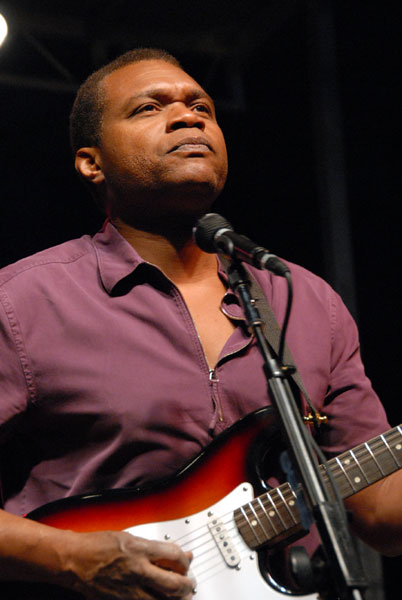

Robert Cray
Current Ranking
Robert Cray is ranked #153 of 162 guitarists on the Greatest Guitar Player leaderboard, based on our editorial score until fans weigh in. On the blues leaderboard, Robert Cray ranks #31 of 32. No fan votes yet, so be the first to rate Robert Cray on 8 attributes at greatestguitarplayer.com/vote.
Biography
Robert Cray, born in Columbus, Georgia in 1953 and raised in an Army family that moved between bases in the United States, Germany, and the Pacific Northwest, is one of the artists most responsible for keeping the blues vital and visible in the modern era. He formed the band that bears his name in Eugene, Oregon in 1974, and over the following decade he redefined what contemporary electric blues could sound like, bringing it to a mainstream audience that had largely tuned the genre out.
Cray's 1986 breakthrough album Strong Persuader, which produced the hit Smoking Gun and went on to sell enormously, introduced a new kind of blues record to mainstream radio. It featured soulful vocals, sophisticated harmonic vocabulary borrowed from R&B, and a guitar sound that broke sharply from the era's blues-rock conventions. Where most blues-rock leaned on thick, saturated overdrive, Cray emphasized clean Stratocaster tone, sparse, perfectly chosen phrasing, and precise execution, proving that restraint could be more powerful than distortion. His playing is all about tone, taste, and conversational interplay with his own singing, and his refusal to overplay became a master class in how much can be said with very little.
Here is the gem that shows the respect he earned from the masters. Cray toured extensively with Eric Clapton, appearing prominently in the celebrated 24 Nights residency at the Royal Albert Hall, and he recorded the Grammy-winning album Showdown alongside the blues legends Albert Collins and Johnny Copeland. That record, a summit meeting of generations, brought him to the attention of the older blues guitarists who had come before him, and they embraced him, opening doors to wider audiences and effectively anointing him as a worthy carrier of the tradition. For a younger player to earn the blessing of giants like Collins, his own mentor and friend, was a powerful validation of his artistry.
Cray has won multiple Grammy Awards and was inducted into the Blues Hall of Fame, but his deeper influence lies in how he expanded the blues without diluting it, marrying it to soul and R&B while keeping its emotional core intact. His clean, expressive, disciplined playing has made him a model for younger guitarists learning that feel and economy matter more than flash. Across decades of steady recording and touring, Robert Cray has remained a quietly authoritative figure, the elegant modern bluesman who proved that the genre could be both deeply traditional and thrillingly contemporary, and that the most expressive thing a guitarist can do is play exactly the right notes and nothing more.
Legendary Performance
Robert Cray Band, Cookin' in Mobile
August 25, 2010 · Saenger Theatre, Mobile, Alabama, USA
By the time the Robert Cray Band took the stage at the Saenger Theatre in Mobile, Alabama on August 25, 2010, the group had been performing together in various configurations for more than three decades, and Cray himself had grown into a mature performer with nothing left to prove. The concert was recorded for the live album and DVD Cookin' in Mobile, released the following year, and the resulting document captures a peak-form working band moving through material that spans his entire career, from the Strong Persuader-era hits that brought him to national attention through later compositions that demonstrated his ongoing growth as a songwriter and arranger.
The Mobile concert is particularly notable for the way it showcases Cray's restraint as a soloist. The performances of Phone Booth, Right Next Door (Because of Me), and Smoking Gun all feature solo passages that prize melodic construction over technical display, with every note placed precisely and given room to breathe. His Stratocaster tone (clean and bell-like, with just enough amp breakup to add warmth without saturating the signal) sits in the mix as a second vocal voice, trading lines with his actual singing in the conversational call-and-response that has become his trademark approach. The recording stands as a definitive demonstration of how electric blues can function at full theater-level intensity without needing to play loudly or aggressively, and it remains one of the most-cited modern blues live albums for guitarists studying how to construct solos that serve the song rather than the player's ego.
▶ Watch on YouTubeGear
Fender Robert Cray Signature Stratocaster (First introduced 1990s, current model in production)
Known for: Cray's primary instrument across his entire recorded career
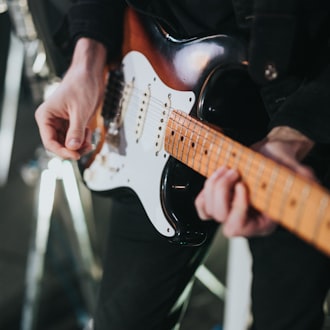
The Fender Robert Cray Signature Stratocaster has been one of the most consistently popular signature Stratocaster models since its introduction, and its specifications reflect exactly the design choices Cray made over years of refining his approach to the instrument. Unlike a standard Stratocaster, the Cray model uses a hardtail bridge rather than a tremolo, eliminating the floating-bridge complication and providing the rock-solid tuning stability that suits his clean-tone playing style. The body is slightly smaller and the contours less aggressive than a standard Strat, reflecting his comfort preferences from decades of nightly performance.
The pickups are Fender Custom Shop single-coils voiced for the bright, articulate clean tone that defines his sound. Cray runs them through his amps with very little effects coloration, and the pickups have enough output and harmonic detail to produce a singing quality on long sustained notes without needing high-gain overdrive to push them into harmonic complexity. He has owned several examples of the model over the decades, but his consistency in choice of instrument (matched only by his consistency in tone) is part of what makes his playing instantly recognizable across recordings spanning forty years. The signature model has also become popular with players who want a no-frills Stratocaster aimed at clean blues and soul-influenced playing rather than the rock-oriented configurations Fender produces for most of its other artist models.
Fender Vibro-King Custom and Fender Super Reverb
Known for: Cray's primary clean amplification across his career
Robert Cray's amp choices have always centered on Fender combos, beginning with various Super Reverb and Twin Reverb models in his earlier career and settling, by the 1990s, on the Fender Vibro-King as his primary touring amplifier. The Vibro-King is a sixty-watt all-tube head paired with a 3×10 speaker cabinet, designed to deliver the chiming clean tones of classic Fender amplifiers with substantial headroom and the warm spring reverb that has become inseparable from his guitar identity. He typically runs the amp at relatively moderate volumes, letting the Stratocaster's pickup output and his picking attack determine the tonal character rather than driving the amp into saturation.
What is distinctive about Cray's amp approach is his commitment to clean headroom in an era when most blues-rock players had moved toward heavily overdriven Marshall or Mesa Boogie rigs. The clean Fender tone became central to his sonic identity and gave his playing room to express dynamics through pick attack rather than through pedal-switched gain levels. When he wants additional warmth he relies on the amp's natural breakup at higher volumes or on subtle boost from his Strat's volume knob, never on stomp-box distortion. This discipline has produced one of the most enduringly recognizable amplifier tones in contemporary blues, and his consistency of choice over thirty years is itself a demonstration of how stable tonal identity comes from making a small set of choices and then refining them rather than constantly chasing new gear.
Minimalist Chain: Amp Reverb and Occasional Wah
Robert Cray's effects vocabulary is among the most restrained of any major contemporary guitarist. For most of his career the signal chain has been guitar straight into amplifier, with the Vibro-King's onboard spring reverb providing the only ambient processing. There is no overdrive pedal, no chorus, no delay rack, no compressor in the front end. The choice is deliberate and central to his sound: by removing intervening circuits between the pickup and the amp, he preserves the immediacy and dynamic response that makes the Stratocaster react directly to changes in his picking force and finger pressure on the strings.
A Dunlop Cry Baby wah pedal makes occasional appearances for specific lead passages, particularly on more aggressive funk-influenced material, but even there the effect is used sparingly and as a textural color rather than as a constant presence. When clean boost is needed for solos he rolls his guitar's volume knob from a slightly attenuated rhythm setting up to full output, using the natural compression of the amp to provide solo lift without any additional processing. The result is a guitar voice that sounds the same on any stage and through any house mix, because the tone is built into the instrument and amp themselves rather than constructed from a chain of processors that have to be adjusted for each venue. For guitarists trying to understand how to build a durable tonal identity, Cray's signal chain is one of the most instructive examples in modern blues.
Signature Technique
Clean Tone Discipline and Sparse Blues Phrasing
Robert Cray's technique is built around a discipline that runs counter to most blues-rock convention: he plays almost entirely with a clean amplifier tone and constructs his solos from spare, precisely placed phrases rather than from continuous streams of notes. The approach is harder than it sounds. Without the harmonic complexity that overdrive adds automatically to held notes, every pitch has to be intonated perfectly, every bend has to land exactly in tune, and every vibrato has to be controlled enough to function as a deliberate expressive choice rather than a hiding device for slightly out-of-pitch notes. His solo on Smoking Gun is a textbook example: short phrases with substantial silence between them, each note bent or vibrated with vocal precision, and a melodic logic that builds across the solo's eight or sixteen bars like a composed instrumental melody rather than an improvised lick collection.
His harmonic vocabulary draws as much from R&B and soul as from traditional blues. Where most blues guitarists work primarily from the pentatonic and blues scales, Cray frequently uses extended chord tones (sevenths, ninths, sixths) and chromatic passing notes that give his lines a more sophisticated harmonic flavor. This is partly a function of his vocal background (he is one of the few major blues guitarists who is also a lead vocalist of comparable stature, and his guitar lines often echo or harmonize his vocal melodies) and partly a function of his band arrangements, which tend toward soul-band horn-section voicings that he then weaves his guitar lines around.
His right-hand technique combines flatpicking with frequent finger use for chordal stabs and double-stops, particularly during rhythm passages where he comps behind his own vocals. The thumb-and-fingers approach gives him independent control over individual string voices, letting him play short syncopated rhythm figures that punctuate the vocals without competing with them. His left-hand vibrato is unusually subtle for a blues player, often delivered with the fingertip rather than the wrist, which produces a slightly slower and more controlled pitch wobble than the wider vibrato of most contemporaries. This subtle vibrato is part of what gives his playing its conversational, vocal-like quality.
The broader lesson of his technique is that restraint is itself an advanced skill. Younger guitarists studying his playing often discover that the parts they can transcribe note for note still do not sound like Cray when they play them, because the timing, dynamics, intonation, and tone are all carrying as much musical information as the note choices themselves. His career has been a sustained demonstration that taste and discipline can be more expressive than technical pyrotechnics, and his influence on the post-Strong Persuader generation of blues players (from John Mayer through Jonny Lang and into the current generation of soul-blues guitarists) is direct and audible whenever a younger player chooses sparse phrasing and clean tone over saturated rock-blues vocabulary.