


Billy Corgan
Current Ranking
Billy Corgan is ranked #145 of 162 guitarists on the Greatest Guitar Player leaderboard, based on our editorial score until fans weigh in. On the punk, grunge and alternative leaderboard, Billy Corgan ranks #12 of 17. No fan votes yet, so be the first to rate Billy Corgan on 8 attributes at greatestguitarplayer.com/vote.
Biography
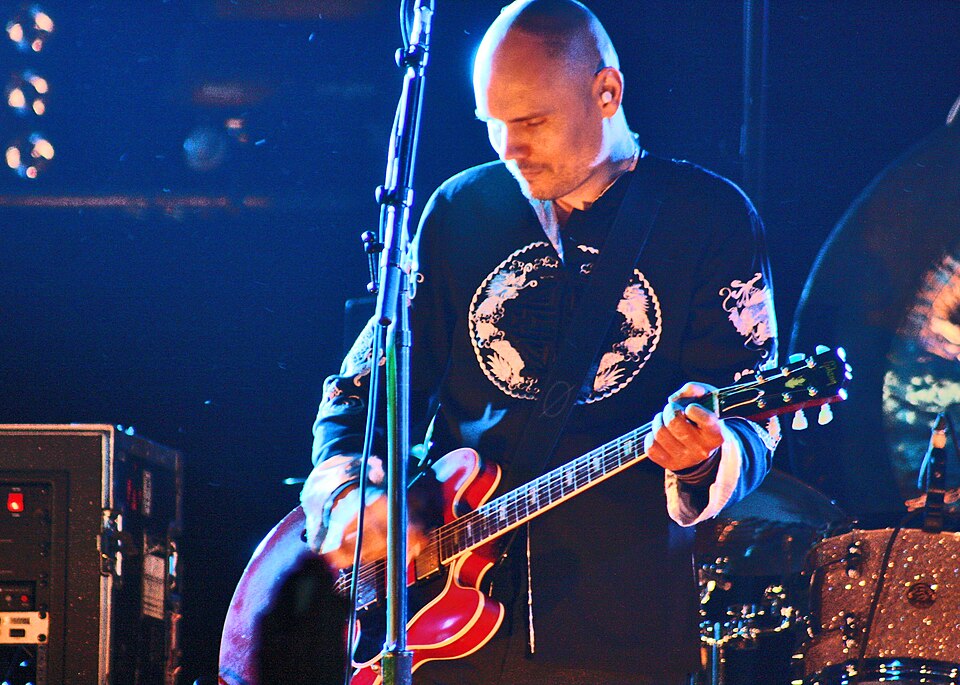
Billy Corgan, born in 1967 outside Chicago, is the driving force and guitar architect of the Smashing Pumpkins, the band that gave 1990s alternative rock some of its most ambitious and lushest guitar music. Where many of his grunge-era peers prized rawness, Corgan was an unapologetic maximalist, a perfectionist who treated the recording studio as an instrument and built cathedral-sized walls of guitar one painstaking layer at a time.
The Pumpkins' breakthrough, 1993's Siamese Dream, is the clearest statement of his vision. Chasing a sound that was simultaneously heavy, dreamy, and orchestral, Corgan layered take after take of guitar, reportedly stacking dozens of tracks to get the huge, shimmering, almost liquid tone on songs like Cherub Rock and Today. He pushed the sprawling double album Mellon Collie and the Infinite Sadness even further, swinging from delicate, music-box quiet to crushing distortion, often within the same song, on tracks like Bullet with Butterfly Wings and Tonight, Tonight.
Here is the gem for gear and studio nerds: Corgan was such a control freak about that sound that he famously played a large share of the guitar and bass parts himself in the studio, layering them obsessively rather than leaving them to the full band, and he built much of the Siamese Dream tone around a specific Stratocaster and a Big Muff fuzz pedal that became holy grail gear for a generation of players trying to reverse-engineer his wall of sound. He later had a line of guitars sprayed silver to match the era's aesthetic, but it was always about the layering more than any single instrument.
That combination of vulnerability and grandiosity is the heart of Corgan. His lyrics are raw and confessional, full of teenage rage and longing, but the music around them is meticulously constructed, almost symphonic. He sang in an unmistakable nasal whine that people either loved or hated, and he never seemed to care which. The Smashing Pumpkins sold tens of millions of records on the strength of that uncompromising vision, and Corgan has spent the decades since restlessly reinventing the band, feuding, breaking up, and reforming, always chasing the next big idea. For guitarists, his legacy is simple: he proved that alternative rock could be as lush, layered, and grand as anything in classic rock, without ever losing its bite.
Legendary Performance
Smashing Pumpkins: Lollapalooza Headliner
Summer 1994 · Various amphitheaters across North America
The summer 1994 Lollapalooza tour was the commercial peak of the alternative rock era: a travelling festival that had moved from curiosity to cultural institution, and in 1994 the Smashing Pumpkins were its headliners at the precise moment "Siamese Dream" had made them one of the most discussed guitar bands in the world. Billy Corgan's live presentation of "Siamese Dream" material required solving a particular problem: the album had been built from 40 or more guitar overdubs, and presenting it live with two guitarists meant making decisions about which layers were structural and which were decorative. The solution was not reduction but consolidation, Corgan and James Iha created a wall of guitar that captured the album's density in real time, driven by fuzz tones from vintage Electro-Harmonix Big Muffs run through Marshall stacks.
Songs like "Cherub Rock," "Soma," and "Rhinoceros" were built on guitar tones that had been painstakingly assembled in the studio and now had to be recreated night after night in changing outdoor acoustic conditions. That Corgan managed it, that the Lollapalooza sets were consistently praised as among the best live performances of the year, was evidence that the production approach of "Siamese Dream" had musical integrity beneath the layering, and that the songs could sustain the weight they carried even when the studio resources were removed. The 1994 tour established the Pumpkins as the definitive live act of the alternative rock generation.
▶ Watch on YouTubeGear
1969 Fender Stratocaster & Various Vintage Guitars (1969 (Stratocaster))
Known for: "Cherub Rock", Siamese Dream, 1993
The primary guitars on "Siamese Dream" were vintage Stratocasters and other vintage instruments chosen for tonal characteristics rather than playing comfort, Corgan and producer Butch Vig were after specific sounds rather than standardised professional instruments. A 1969 Fender Stratocaster appears prominently throughout the album, its single-coil pickups cutting through the Big Muff fuzz in a way that humbuckers would not have done. The Stratocaster's output is lower and brighter than a Les Paul, which means the Big Muff affects it differently, producing a distortion that retains definition even at extreme gain.
Corgan later developed the Reverend Billy Corgan signature model, a guitar designed around the sonic requirements his playing had established, with a Railhammer humbucker in the bridge position designed to produce clarity under distortion. He has also used Hamer USA guitars extensively in live and studio settings, and his guitar choices have always prioritised tone over visual consistency.
Marshall JCM 800 & JCM 900
Known for: "Soma", Siamese Dream, 1993
The Marshall JCM 800 and 900 heads used on "Siamese Dream" provided the amplified foundation into which the Big Muff signal was fed. The Marshall's preamp stage adds its own harmonic character to the distorted signal, and the combination of Big Muff compression with Marshall edge created the specific fuzz tone, dense but not muddy, saturated but retaining pick attack, that defined the Pumpkins' sound.
Multiple Marshall heads were run simultaneously on certain tracks, with the signals combined in mixing to produce the layered amplifier texture that contributes to "Siamese Dream"'s density. The JCM 900, with its higher gain preamp, was used for the heaviest sections; the 800 for passages requiring a cleaner foundation beneath the fuzz.
Electro-Harmonix Big Muff Pi
The Electro-Harmonix Big Muff Pi, specifically vintage 1970s models, not the later reissues, is the single piece of equipment most responsible for the Smashing Pumpkins' guitar sound. The Big Muff produces a sustained, compressed fuzz that is categorically different from the Marshall overdrive or the Tube Screamer boost: it flattens the dynamic range of the guitar into a sustained mass of harmonic content that sustains infinitely and changes character as it decays.
Corgan used multiple vintage Big Muffs throughout the recording of "Siamese Dream," running them slightly differently on different tracks to create the phase variations that contribute to the album's layered texture. The specific circuit variation of the 1970s Triangle and Ram's Head versions he used produces a mid-scoop that sits differently in a mix than later versions, a technical distinction that becomes audible at the scale of 40 layered guitar tracks.
Signature Technique
Fuzz Layering, Wall-of-Sound Architecture & Studio Density
Billy Corgan's technique for "Siamese Dream" was not a live guitar technique in any conventional sense, it was a recording technique, a method of building guitar texture through accumulated overdubbing that produced a density of sound that no single player could have achieved in performance. The album contains an estimated 40 or more guitar tracks on certain songs, all played by Corgan and all run through vintage Electro-Harmonix Big Muff Pi fuzz pedals into Marshall amplifiers. The Big Muff produces a particular kind of sustained, compressed distortion that blurs individual attack transients into a continuous mass of harmonic content; layered 40 times, it creates a wall of guitar texture that has its own internal movement, a breathing quality that comes from the slight phase differences between tracks recorded at different times.
The compositional intelligence behind the layering is as important as the technical execution. Each guitar part on "Siamese Dream" was placed with awareness of the others, some providing rhythmic support, some melodic counter-lines, some pure textural density. "Soma," "Thru the Eyes of Ruby," and "Rhinoceros" demonstrate this architecture at its most developed: songs in which the guitar is the atmosphere rather than the instrument, a medium through which the melodic content moves rather than the source of the melody itself. Corgan's approach influenced the production choices of nearly every alternative rock band that followed, establishing fuzz-heavy overdubbing as the defining texture of 1990s guitar music.