






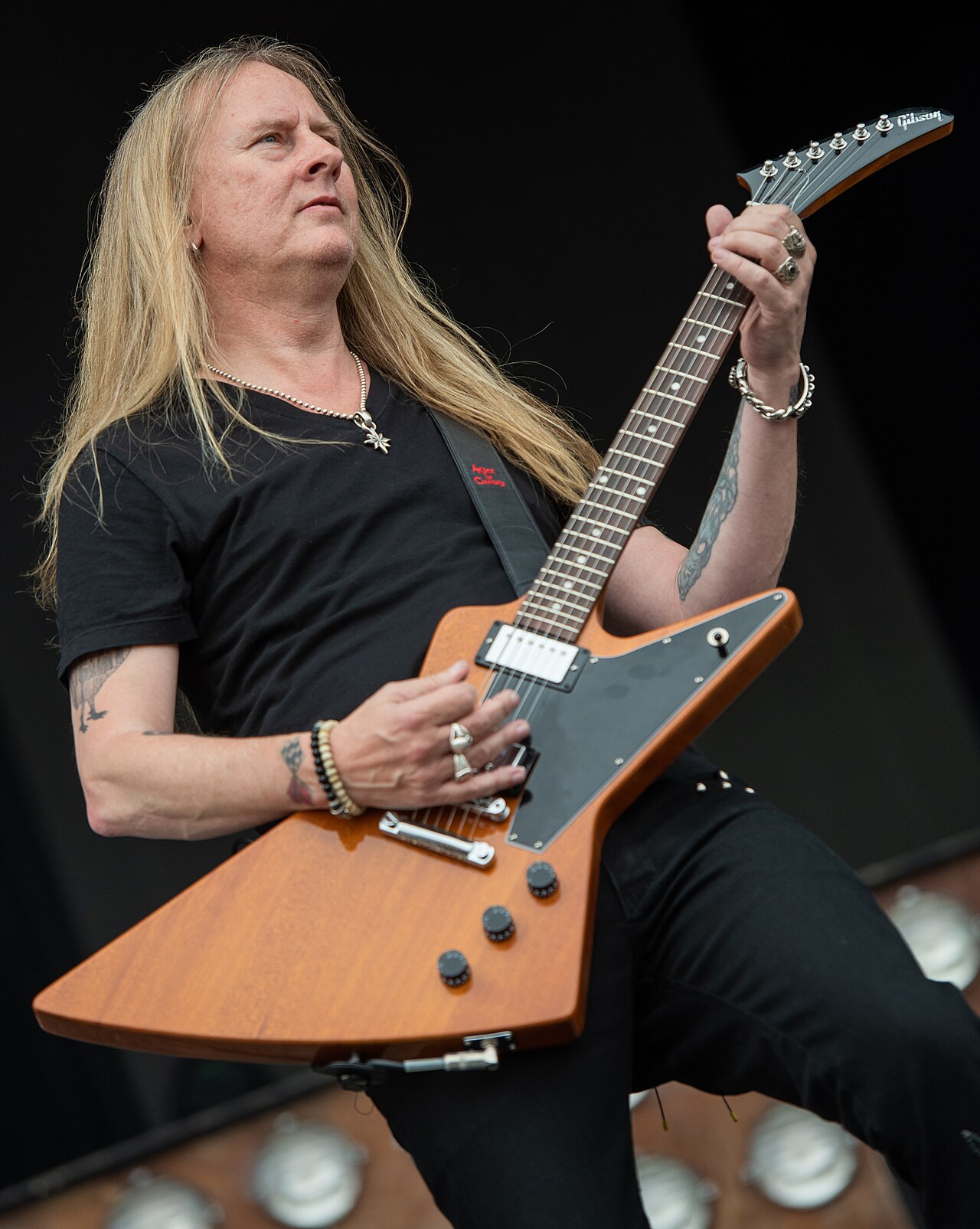

Jerry Cantrell
Current Ranking
Jerry Cantrell is ranked #75 of 162 guitarists on the Greatest Guitar Player leaderboard, based on our editorial score until fans weigh in. On the punk, grunge and alternative leaderboard, Jerry Cantrell ranks #5 of 17. No fan votes yet, so be the first to rate Jerry Cantrell on 8 attributes at greatestguitarplayer.com/vote.
Biography
Jerry Cantrell, born in Tacoma, Washington in 1966, is the guitarist, co-vocalist, and main songwriter of Alice in Chains, the band that brought a uniquely dark, heavy, and haunting voice to the Seattle scene of the early 1990s. While Alice in Chains is often grouped with grunge, Cantrell's playing has deeper roots in heavy metal and the blues, and the result is a sound far doomier and more sinister than most of their peers, built on his thick, sludgy riffs and eerie, mournful melodies.
Cantrell's signature is the way he uses harmony and dissonance to create dread. His guitar parts churn with heavy, downtuned riffs and slow, crushing grooves, but the real magic is in his vocal partnership with the late singer Layne Staley. The two would weave their voices into ghostly, dissonant harmonies, and Cantrell often doubled or answered those vocal lines on the guitar, creating a thick, layered, almost suffocating atmosphere. Songs like Would?, Rooster, and Down in a Hole show how he could be both bone-crushingly heavy and achingly melodic, sometimes within the same passage.
Here is the gem that produced one of his most famous moments. The breakthrough single Man in the Box features a strange, wailing, almost human vocal effect on the guitar, created by Cantrell using a talk box, the same device that lets a guitarist shape their guitar's sound with their mouth. That eerie, talking-guitar hook helped make the song a hit and remains one of the most recognizable guitar sounds of the era, a perfect example of how Cantrell used unusual textures to create mood rather than just showing off speed.
Cantrell has carried the band through almost unimaginable adversity, including the deaths of Staley and original bassist Mike Starr, eventually continuing Alice in Chains with a new co-vocalist while honoring the original sound. He has also built a respected solo career that showcases his songwriting and his warm, expressive lead playing. Through it all, his guitar work has remained the dark emotional center of the music, full of feel, atmosphere, and a heaviness that comes as much from sorrow as from volume. For guitarists drawn to mood and menace over flash, Jerry Cantrell is a master of making the instrument sound genuinely haunted.
Legendary Performance
Alice in Chains, MTV Unplugged
The Alice in Chains MTV Unplugged session of April 1996 took place against the backdrop of Layne Staley's deepening addiction and the band's near-dissolution, and the weight of those circumstances transformed what might have been a promotional exercise into one of rock music's most haunted performances. Jerry Cantrell anchored the acoustic set with a guitar playing of profound compositional authority, his drop-D tunings and minor-key harmonies translating the band's electric assault into something more intimate but no less crushing. Songs like "Rooster," "Down in a Hole," and "Would?" acquired new dimensions when stripped of distortion, revealing the quality of his writing beneath the production.
The performance remains a document of extraordinary musical resilience. Cantrell's guitar work throughout was simultaneously supportive and architecturally dominant, his harmony guitar parts with Staley's vocals creating the signature Alice in Chains interval relationships, tritones and minor seconds that suggested dissonance while remaining melodically coherent, in their most exposed form. The Unplugged recording has since been recognised as one of the finest documents of 1990s alternative rock, and Cantrell's playing at its centre stands as the work of a songwriter who understood that the most powerful guitar playing serves the song.
▶ Watch on YouTubeGear
G&L Rampage & Dean ML
Jerry Cantrell's early career and the recordings that defined Alice in Chains' sound were made with a G&L Rampage, a single-humbucker, through-neck instrument designed by Leo Fender that delivered the thick, sustain-rich tone required for the band's heavily down-tuned, distortion-saturated arrangements. The Rampage's construction provided the focused, harmonically compressed output that sits in the mix as a wall of sound without losing definition, a critical quality for a guitarist whose riffs are built on rhythmic precision as much as harmonic content. He later moved to a Dean ML, a V-shaped guitar whose longer scale length and construction characteristics contribute to the tighter string response needed for drop-D and lower tunings.
Mesa/Boogie Dual Rectifier
The amplifier most associated with Alice in Chains' heaviest material is the Mesa/Boogie Dual Rectifier, whose high-gain channels produce the saturated, harmonically dense distortion that became one of the defining sounds of 1990s heavy rock. Cantrell's use of the Rectifier emphasises the amplifier's ability to retain low-end punch under high gain, essential when the guitar is tuned a step or more below standard and the riffs depend on the bottom strings' clarity and weight. The Rectifier's scooped midrange character, combined with Cantrell's pick attack and string gauge preferences, produces the massive, slightly dark tone that runs through the Alice in Chains catalogue.
Dunlop Crybaby & Chorus
Cantrell's effects usage is characteristically purposeful. A Dunlop Crybaby wah appears throughout the Alice in Chains catalogue, used not for sustained filter sweeps but for precise, rhythmic accent, a technique that adds vocal expressiveness to single-note lines without dominating the arrangement. Chorus effects appear on cleaner passages, adding the shimmer and width that softens the band's heavier moments. His approach to effects mirrors his approach to arrangement: everything serves the song's emotional requirement rather than demonstrating technical possibility.
Signature Technique
Signature Technique
Jerry Cantrell's guitar playing is among the most compositionally sophisticated in heavy rock, built on a harmonic language that uses dissonance not as chaos but as emotional precision. His signature interval, the tritone, historically described as diabolus in musica and avoided in classical voice-leading, appears throughout Alice in Chains' catalogue not as an accident of heavy metal convention but as a deliberate expressive choice, creating the specific quality of unresolved tension that defines the band's emotional character. Combined with his use of drop-D tuning to create riffs of physical weight and architectural economy, his technique produces a sound that is immediately distinctive and has influenced a generation of heavy rock guitarists.
Cantrell's use of drop-D tuning, lowering the sixth string from E to D, allows him to play power chords on the three lowest strings with a single-finger barre, freeing the other fingers for melodic additions and extensions. More importantly, the dropped tuning shifts the guitar's overall resonance downward, producing the darker, heavier fundamental frequencies that give Alice in Chains their sonic weight. His riff writing exploits the tuning's intervallic possibilities systematically: the open strings produce drone notes that create sustained dissonance beneath moving melody notes, a technique that requires minimal left-hand movement while maximising harmonic tension.
One of Cantrell's most distinctive contributions is the harmony guitar lines he plays against Layne Staley's vocal melodies, creating the signature Alice in Chains sound through the specific intervals he chooses. Rather than harmonising in the conventional thirds or sixths of classic rock, he frequently selects minor seconds, tritones, and minor sevenths, intervals that produce discomfort rather than consonance, intensifying the emotional distress in the songs' subject matter. This approach requires a detailed understanding of the relationship between harmony and emotion that goes beyond simple technical execution, and it represents the defining characteristic of his compositional voice.