







Joe Satriani
Current Ranking
Joe Satriani is ranked #20 of 162 guitarists on the Greatest Guitar Player fan leaderboard, based on 2 fan votes so far. On the shred and virtuoso leaderboard, Joe Satriani ranks #1 of 19. Agree? Rate Joe Satriani on 8 attributes at greatestguitarplayer.com/vote.
Biography
Joe Satriani, born in New York in 1956, is one of the most successful and respected instrumental rock guitarists of all time, a virtuoso whose melodic, soaring style proved that guitar music with no singing at all could reach a huge audience. Equal parts technical master and gifted melodist, Satriani writes instrumentals that actually feel like songs, full of memorable themes and genuine emotion, which is why he became that rarest of things, an instrumental guitarist with real commercial success.
His 1987 album Surfing with the Alien was a landmark, a fully instrumental rock record that sold remarkably well and turned Satriani into a star purely on the strength of his playing. Tracks like the title song showed off his blistering technique, including fluid legato runs, two-handed tapping, and expressive whammy-bar work, while the tender Always With Me, Always With You revealed his gift for beautiful, vocal-like melody. He makes dazzling technical playing feel warm and accessible, never cold or merely showy.
Here is the gem that reveals his deepest influence on the guitar world. Before he was a star, Satriani was a guitar teacher in California, and his list of students reads like a hall of fame of modern guitar. He taught Steve Vai, Kirk Hammett of Metallica, Larry LaLonde of Primus, Alex Skolnick of Testament, and many others who went on to become major players in their own right. The fact that so many of the most important guitarists of the following generation passed through his lessons makes him not just a great player but one of the most influential guitar educators who has ever lived. His fingerprints are on an entire era of guitar through the students he shaped.
Satriani has remained prolific and beloved across decades, releasing a steady stream of acclaimed instrumental albums and touring constantly. He is also the founder of the G3 tours, package concerts that bring together three top guitarists to trade solos, which he has headlined alongside former students and peers like Steve Vai and Eric Johnson, celebrating the instrument and its community. Known affectionately to fans simply as Satch, he has even stepped in to tour with major rock bands when they needed a guitarist of the highest caliber. For anyone who loves the electric guitar as a lead voice, Joe Satriani is essential, the master player and teacher who proved an instrumental could sing, and who helped train the generation that followed him.
Legendary Performance
Surfing with the Alien Tour, Mick Jagger's Pathfinder Tour
Joe Satriani's 1988 was extraordinary by any measure. While his Surfing with the Alien album was turning the instrumental guitar world upside down, Satriani was simultaneously recruited by Mick Jagger as lead guitarist for Jagger's solo Pathfinder world tour, making him the only guitarist ever to headline with his own album while touring as lead guitarist for a Rolling Stone. Night after night, Satriani balanced his own identity with the demands of fronting one of rock's most charismatic performers.
But it was the Surfing with the Alien headline shows that cemented his legacy. Performing pieces like 'Satch Boogie,' 'Always with Me, Always with You,' and 'Echo' to sold-out theaters, Satriani proved that instrumental guitar music could command mass audiences without sacrificing technical ambition. His tone, thick, harmonically rich, and dynamically controlled, set a new standard for lead guitar playing that influenced virtually every shredder who followed.
▶ Watch on YouTubeGear
Ibanez JS Series (JS1, JS6, and variants)
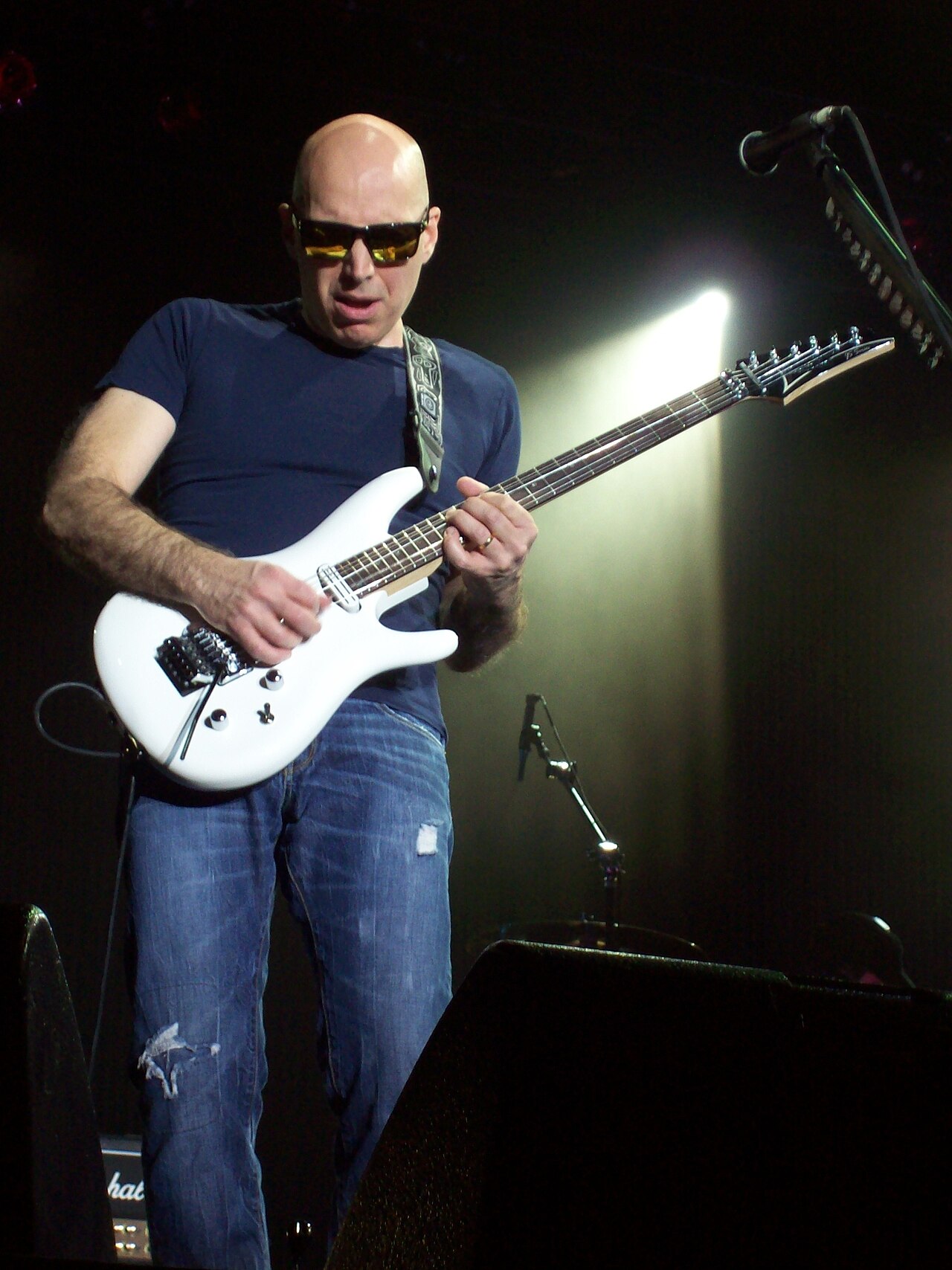
Joe Satriani's long-running collaboration with Ibanez produced the JS series, a line of signature guitars that became one of the most successful artist partnerships in guitar manufacturing history. The JS1 debuted in the early 1990s and refined over decades, features an alder body, maple neck, and Satriani's own DiMarzio pickup designs (the Mo' Joe and Fred pickups being the most associated). The guitar's fast neck profile, low action, and smooth fretboard suit Satriani's legato-heavy technique perfectly, allowing the rapid hammer-on/pull-off passages that define his instrumental style.
Marshall JCM 2000 / Peavey 5150
Satriani has used various high-gain amplifiers throughout his career, with Marshall and Peavey rigs central to his live and studio sound. The combination of his DiMarzio pickups with a high-gain British-voiced amplifier produces the thick, compressed lead tone that made Surfing with the Alien such a landmark record. He typically runs his amplifiers with the gain high enough for sustain but clean enough to retain note definition, a balance that requires as much skill to maintain as any guitar technique.
DigiTech Whammy / Boss Delay
Satriani was an early adopter of the DigiTech Whammy pedal, which he used to produce the dive-bomb harmonics and octave-shifted passages that appear throughout his recordings. Combined with digital delay for echo and a rack-mounted chorus for warmth, his effects chain is purpose-built for melodic expressiveness rather than sonic experimentation. Every element serves the song, and his setup has remained recognizably consistent across thirty-plus years of recording and touring.
Signature Technique
Legato & Pitch Axis Theory
Joe Satriani's legato technique, long sequences of hammer-ons and pull-offs executed without pick strokes, produces a fluid, seamless quality that has become his melodic signature. Where alternate picking produces a note-by-note percussiveness, legato playing blurs the articulations between pitches into a continuous stream. The phrase becomes a shape rather than a series of distinct events. Satriani developed this into extended runs that cover the full range of the neck, linking scale patterns and arpeggios into unbroken melodic arcs that feel weightless even at high speed.
His conceptual contribution, "pitch axis theory", involves keeping a single root note constant while rotating through different modes built on that root. This technique creates dramatic emotional shifts within a single tonal centre, cycling from major to Phrygian to Lydian modes while the bass holds the same pitch. "Flying in a Blue Dream" and "Always with Me, Always with You" demonstrate how this harmonic approach gives his instrumentals their distinctive sense of emotional journey without the anchor of lyrics to carry the narrative.