


Kirk Hammett
Current Ranking
Kirk Hammett is ranked #50 of 162 guitarists on the Greatest Guitar Player fan leaderboard, based on 1 fan vote so far. On the heavy metal leaderboard, Kirk Hammett ranks #6 of 14. Agree? Rate Kirk Hammett on 8 attributes at greatestguitarplayer.com/vote.
Biography
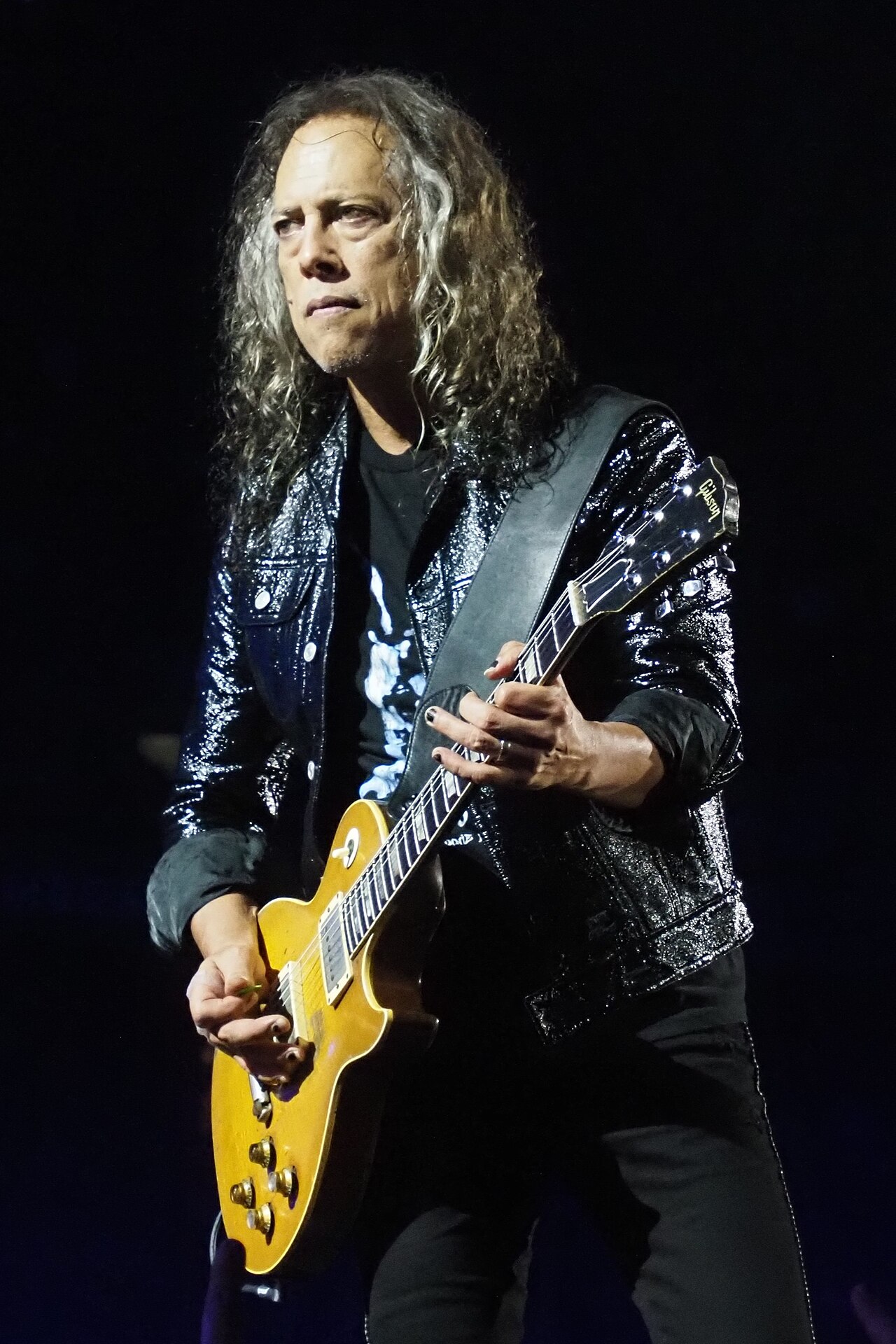
Kirk Hammett, born in San Francisco in 1962, is the lead guitarist of Metallica, the biggest heavy metal band in the world, and the player responsible for some of the most famous and widely learned solos in the entire metal canon. With his fluid, melodic lead style and his instantly recognizable use of the wah pedal, Hammett has spent four decades providing the soaring, expressive counterpoint to Metallica's crushing rhythm attack.
Hammett studied early on with the great guitar teacher Joe Satriani, and that foundation shows in the musicality of his playing. His solos on classics like Master of Puppets, One, Fade to Black, and Enter Sandman are models of how to build a memorable lead, full of singing bends, fast runs, exotic scales, and dramatic phrasing that serves the song. His heavy reliance on the wah pedal, rocking it back and forth to give his solos a vocal, crying quality, became such a trademark that the sound is almost synonymous with his name. For countless young metal guitarists, learning a Kirk Hammett solo is a rite of passage.
Here is the gem that reveals the person behind the player. Hammett is one of the world's most passionate collectors of classic horror and monster memorabilia, amassing an enormous, museum-quality collection of vintage horror-movie posters, props, and artwork that he has exhibited publicly and published in books. His love of the macabre runs straight into his music and gear, from his famously spooky guitars adorned with horror imagery to his own horror-themed events. That lifelong obsession gives a window into the imagination that fuels his playing, a fan's pure enthusiasm channeled into both art collecting and guitar.
There is a second gem for guitar lovers: Hammett is the proud owner of Greeny, the legendary 1959 Les Paul once played by Peter Green and Gary Moore, one of the most storied guitars in rock history, which he treasures and continues to play. Across Metallica's monumental career, through thrash landmarks and stadium-conquering hits alike, Kirk Hammett has remained the band's lead voice, the player whose wah-soaked, melodic solos are burned into the memory of every metal fan. A Rock and Roll Hall of Fame inductee, he is one of the most recognizable and beloved lead guitarists in heavy music.
Legendary Performance
Monsters of Rock, Tushino Airfield
September 28, 1991 · Tushino Airfield, Moscow, Russia
No rock concert in history had ever assembled an audience quite like the one that gathered at Tushino Airfield on the outskirts of Moscow on September 28, 1991. Estimates of the crowd's size ranged from 150,000 to 500,000, a figure that, at its upper bound, would make it the largest ticketed rock concert ever held. The Soviet Union would cease to exist in less than three months. Mikhail Gorbachev was still technically in power. And Metallica, headlining the Monsters of Rock bill above AC/DC, Pantera, and the Black Crowes, were in the middle of the most successful period of their career, touring an album, the self-titled Black Album, that had debuted at number one in a dozen countries. Kirk Hammett walked onto a stage that faced an ocean of Russian faces and understood, in a way that cannot be fully expressed in language, what the moment required.
Hammett's guitar work that day was a distillation of everything that had made Metallica the largest heavy metal band in the world: the wah-drenched lead lines he had developed under the tutelage of Joe Satriani, the precise right-hand gallop of the rhythm playing that drove songs like "Enter Sandman" and "Battery," and a solo vocabulary that drew equally from blues tradition and classical melodic structure. He played his ESP Explorer through a Mesa/Boogie amplifier stack, the tone cutting through the outdoor air with a clarity that the cameras, filming for what would become the concert film A Year and a Half in the Life of Metallica , could only approximate. When the band launched into "For Whom the Bell Tolls," the opening riff moving through a crowd of half a million people who had spent decades behind the Iron Curtain, the effect was something beyond music.
The Moscow concert has since been described as "the first free outdoor Western rock concert in Soviet history", a designation that, accurate or not, captures something true about what the occasion felt like. The footage from Tushino Airfield shows Hammett and the rest of Metallica playing with a controlled urgency that comes from understanding, at least instinctively, that this is not an ordinary night. The crowd stretched past the horizon. The history stretched further. Hammett stood in front of it with a guitar and delivered exactly what the moment asked for: music big enough to fill the space.
▶ Watch on YouTubeGear
ESP KH-2 / Gibson Flying V
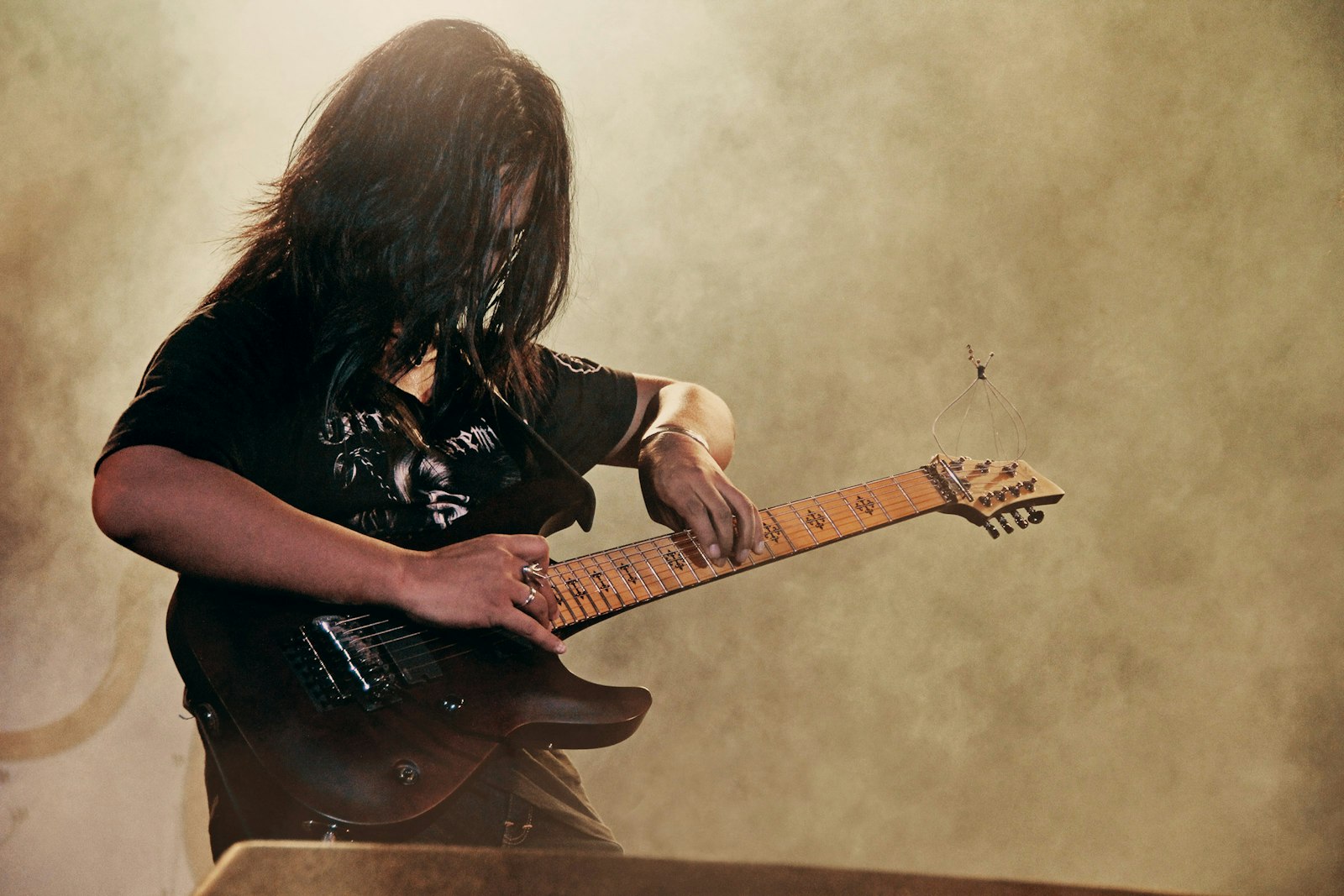
Kirk Hammett's signature ESP KH-2, derived from the Explorer body shape with modifications, is purpose-built for the demands of Metallica's live and studio performance. Its mahogany body and through-neck construction provide sustain and warmth that grounds the high-gain tones of the band's aggressive riffing, while its EMG 81/60 active pickup combination delivers the high-output, low-noise signal that high-gain amplification requires. Hammett worked closely with ESP to refine the instrument over decades of touring, and the KH-2 has appeared on every Metallica album since Master of Puppets . He also maintains a significant vintage guitar collection, including classic Flying Vs and Les Pauls, some of which appear on studio recordings.
Mesa/Boogie Dual Rectifier
Hammett's primary amplifier, the Mesa/Boogie Dual Rectifier, provides the saturated, tight-low-end distortion that is the foundation of Metallica's rhythm guitar sound. The Dual Rectifier's aggressive gain structure suits thrash metal perfectly: it tightens the low end under heavy palm-muting while providing enough midrange presence to cut through the mix alongside two bass-heavy rhythm guitar tracks. For leads, Hammett typically engages additional gain to push the amp further into saturation, providing the long-sustaining tone his melodic solo playing requires.
Dunlop Cry Baby Wah / Boss NS-2 Noise Suppressor
Kirk Hammett is defined in the effects world by one pedal above all others: the Dunlop Cry Baby wah, which he engages on the majority of his lead guitar solos. His wah technique is a signature element of Metallica's sonic identity, the vocal, expressive quality it adds to his lead lines creates a counterpoint to the aggression of the rhythm playing below. The Boss NS-2 Noise Suppressor keeps his high-gain chain quiet between notes and during rests. His approach to effects has occasionally drawn criticism for over-reliance on the wah, but few guitarists have used a single effect with such consistent expressiveness across a decades-long recording career.
Signature Technique
Signature Technique
Kirk Hammett's guitar technique has two distinct modes that together define Metallica's sonic identity. In rhythm mode, he executes the tight, aggressive downstroke picking that drives thrash metal's relentless groove, palm-muted, precisely timed, with an attack that transforms power chords into rhythmic weapons. In lead mode, he deploys a wah-heavy melodic vocabulary built on blues scales and pentatonic patterns, with a lyrical quality that provides emotional contrast to the aggression beneath.
Hammett's rhythm guitar technique requires a very specific right-hand discipline: consistent downstroke picking at thrash metal tempos (typically 160-200 BPM), with precise palm muting applied and released at exact rhythmic moments. The picking motion is wrist-driven rather than arm-driven, allowing the speed required while maintaining accuracy. The tight, controlled quality of Metallica's rhythm guitar, particularly on Master of Puppets and …And Justice for All , comes from this precision: each note's attack, sustain, and muting is deliberate.
Hammett's wah pedal use is so consistent that it has become his sonic signature, and also, occasionally, his critical lightning rod. He engages the Dunlop Cry Baby on the majority of his lead solos, using it to add a vocal, sweeping quality to his pentatonic and blues-scale phrases. His wah technique involves slow, deliberate sweep through the pedal's frequency range coordinated with the phrasing of his lines, creating a sense of harmonic movement even over static backing chords. At his best, the 'One' solo, 'Fade to Black', the wah becomes a voice singing alongside the notes.
For his faster lead passages, Hammett employs economy picking, a technique that minimizes pick strokes by sweeping through adjacent strings in one motion rather than alternating up and down. Combined with legato hammer-ons and pull-offs, this allows him to execute rapid scale runs at thrash tempos without the mechanical sound of pure alternate picking. His position shifts across the fretboard during solos are planned for efficiency, the route through a scale is chosen as much for physical convenience as for melodic interest.