


Ritchie Blackmore
Current Ranking
Ritchie Blackmore is ranked #56 of 162 guitarists on the Greatest Guitar Player fan leaderboard, based on 1 fan vote so far. On the hard rock leaderboard, Ritchie Blackmore ranks #6 of 12. Agree? Rate Ritchie Blackmore on 8 attributes at greatestguitarplayer.com/vote.
Biography
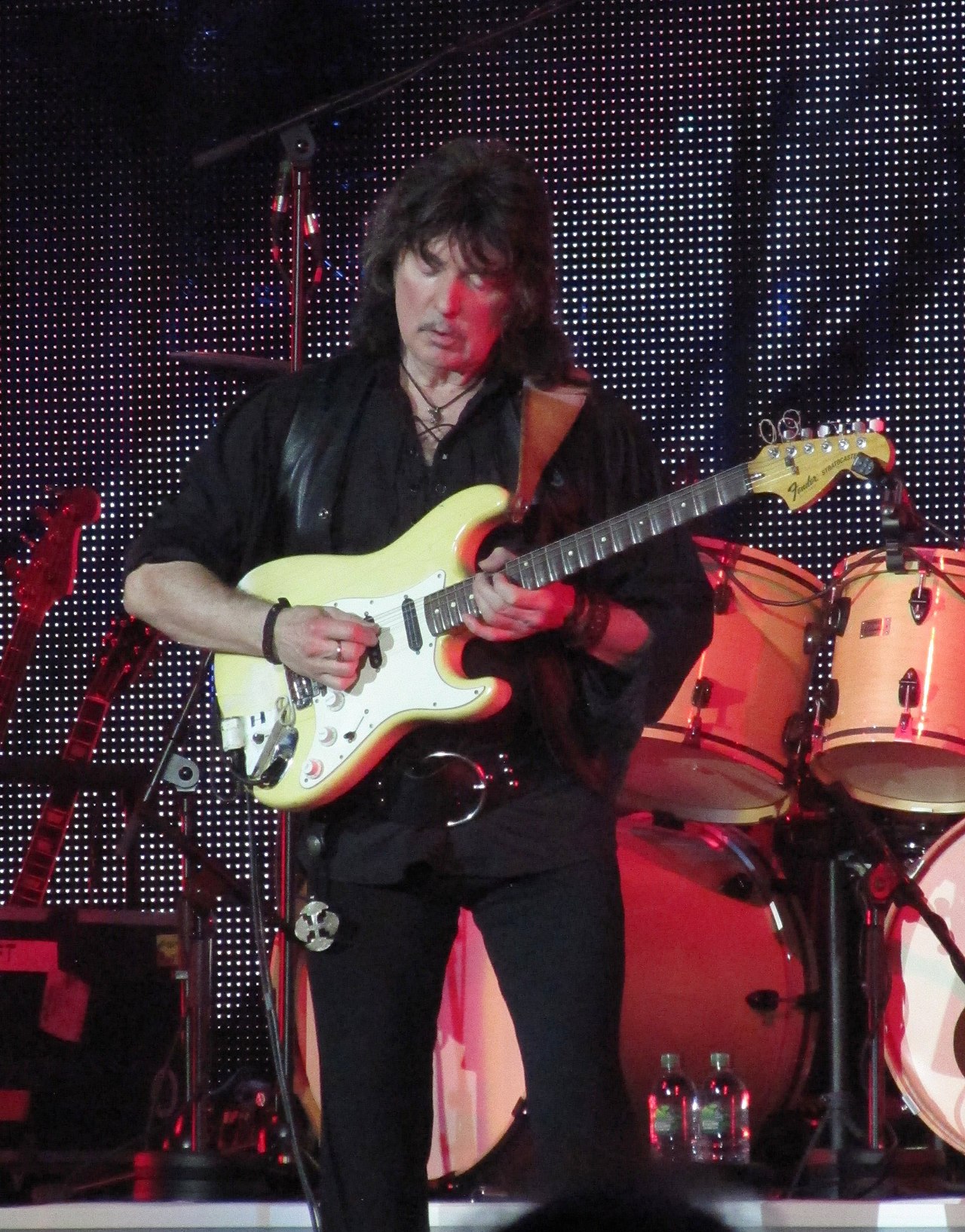
Ritchie Blackmore, born in England in 1945, is one of the most influential and distinctive guitarists in the history of hard rock and heavy metal, a virtuoso whose neoclassical flair and fierce, dramatic playing helped define the sound of the genre. As the guitarist of Deep Purple and later the founder of Rainbow, Blackmore wrote some of the most famous riffs in rock and pioneered a fusion of rock power with classical music influences that would shape generations of guitarists.
Blackmore's playing combined blues-rock foundations with the harmonic and melodic ideas of European classical music, full of fast, precise runs, dramatic phrasing, and a fiery intensity. With Deep Purple he helped create the template for hard rock and heavy metal on albums like Machine Head and In Rock, and his Stratocaster tone and aggressive, virtuosic soloing influenced countless players. He could be both thunderously heavy and elegantly melodic, and his neoclassical approach directly inspired the shred and neoclassical metal movements that followed.
Here is the gem that nearly every guitarist on earth knows, whether they realize its origin or not. Blackmore wrote the riff to Smoke on the Water, a simple, monumental four-note figure that has become the single most famous and most-played beginner guitar riff in the world. Walk into any guitar shop anywhere and you will hear someone playing it. That one riff has launched more guitar journeys than perhaps any other, an entry point into the instrument for millions of aspiring players, and it remains an instantly recognizable piece of rock history. To have written the riff that so many people learn first is a kind of immortality all its own.
Here is a second, stranger gem. After decades as a hard-rock and metal guitar god, Blackmore made one of the most surprising career turns in music, largely abandoning rock to form Blackmore's Night with his partner Candice Night, a group devoted to gentle, acoustic Renaissance and medieval-inspired folk music. He traded his Stratocaster and stacks of amplifiers for acoustic instruments and tales of old castles, following his muse completely away from the genre he helped build. That fearless individualism is pure Blackmore. A pioneer of hard rock, a writer of the world's most famous riff, and ultimately a restless artist who went his own way entirely, Ritchie Blackmore remains one of the most important and singular guitarists rock has ever produced.
Legendary Performance
Deep Purple at the California Jam
The California Jam of April 1974 drew 200,000 people to the Ontario Motor Speedway and was filmed for television broadcast, making it one of the most widely seen rock concerts of the decade. Deep Purple's headlining set that afternoon stands as Ritchie Blackmore's definitive live document: a masterclass in how to combine classical discipline with rock's most elemental physicality. Opening with a ferocious "Burn," Blackmore commanded the stage with a focused aggression that drew on Bach and Paganini as readily as it drew on the blues, his 1968 Fender Stratocaster through a modified Marshall Major producing a tone simultaneously sharp and orchestral.
The performance climaxed with Blackmore smashing his guitar into a camera rig and setting amplifiers alight, a theatrical destruction that, unlike similar gestures by contemporaries, felt earned by two hours of playing that had left the audience in no doubt of his mastery. The footage captured a guitarist at the precise intersection of technical command and rock theatre, a combination that defined an era of British hard rock and provided the blueprint for every classically influenced metal guitarist who followed.
▶ Watch on YouTubeGear
1968 Fender Stratocaster
Ritchie Blackmore's relationship with the Fender Stratocaster defines his sound as completely as Hendrix's relationship with the same instrument defines a different one. His preference was for late-1960s models with maple necks and ash bodies, instruments he modified extensively: scalloped fretboards, a technique he pioneered independently and which Yngwie Malmsteen later adopted, allowed his vibrato to operate without fret-to-finger contact, producing the wide, operatic pitch fluctuations that characterise his playing. He has also used custom instruments made to his specifications, but the original Stratocaster's single-coil brightness filtered through his modified amplifiers produces the cutting, harmonically complex tone identifiable from the opening notes of "Smoke on the Water."
Marshall Major 200-Watt (Modified)
Blackmore's amplifier of choice was the Marshall Major, a 200-watt head designed for bass applications that he repurposed for guitar. The Major's extreme headroom and clean foundation allowed him to push the preamp into controlled saturation without the output stage compression of lower-wattage Marshalls, producing a tone simultaneously clean in attack and harmonically saturated in sustain. His technicians modified the circuits further to tailor the response to his single-coil pickups, creating an amplifier that delivered the tight, articulate low-end and cutting treble response essential to his classically influenced lead lines at the volumes required to fill arenas.
Hornby-Skewes Treble Booster
The component that completes Blackmore's historic tone is the Hornby-Skewes Treble Booster, a germanium-transistor pedal that preceded the modern overdrive category and functioned by boosting the upper-midrange frequencies that the Stratocaster's single-coil pickups naturally emphasise. Placed before the Marshall, the treble booster drove the amp's input stage into harmonically rich saturation while preserving the pick attack and articulation that define his playing. The interaction between the Strat's single coils, the treble booster, and the modified Major is one of the most distinctive signal chains in rock guitar history.
Signature Technique
Signature Technique
Ritchie Blackmore is the architect of what became known as neoclassical rock guitar, the systematic application of European classical music structures, particularly the harmonic minor scale and baroque counterpoint, to the electric guitar within a hard rock context. His influence on this approach predates and encompasses every guitarist who followed in the genre, from Uli Jon Roth to Yngwie Malmsteen, and his playing with Deep Purple and Rainbow established the vocabulary that defined two decades of guitar-driven heavy music. What distinguished Blackmore from his contemporaries was not speed, though he could play quickly, but the architectural intelligence of his solos, which have beginnings, developments, and resolutions that owe as much to Bach as to the blues.
Blackmore's most defining theoretical contribution is his systematic use of the harmonic minor scale, a natural minor scale with a raised seventh degree, as a primary improvisational language in rock music. The raised seventh creates an augmented second interval between the sixth and seventh scale degrees that gives harmonic minor its characteristic tension and exotic flavour, a sound Blackmore heard in the classical repertoire he studied and translated into rock lead playing. This scale choice gives his solos their distinctive European quality, separating them from the pentatonic-based blues vocabulary that dominated British rock at the time he was developing his style.
Blackmore pioneered the practice of having his guitar necks scalloped, the wood between frets routed away so the fretting finger contacts only the string rather than the fretboard surface. This modification, borrowed from renaissance lute construction, transforms the feel of vibrato and bending: without wood contact to resist lateral movement, the finger can oscillate with far greater width and control than on a conventional neck. The result is Blackmore's signature vibrato, wide, operatic, and precisely controlled, which gives his sustained notes the vocal expressiveness that distinguishes melodic rock guitar from its blues predecessors.