



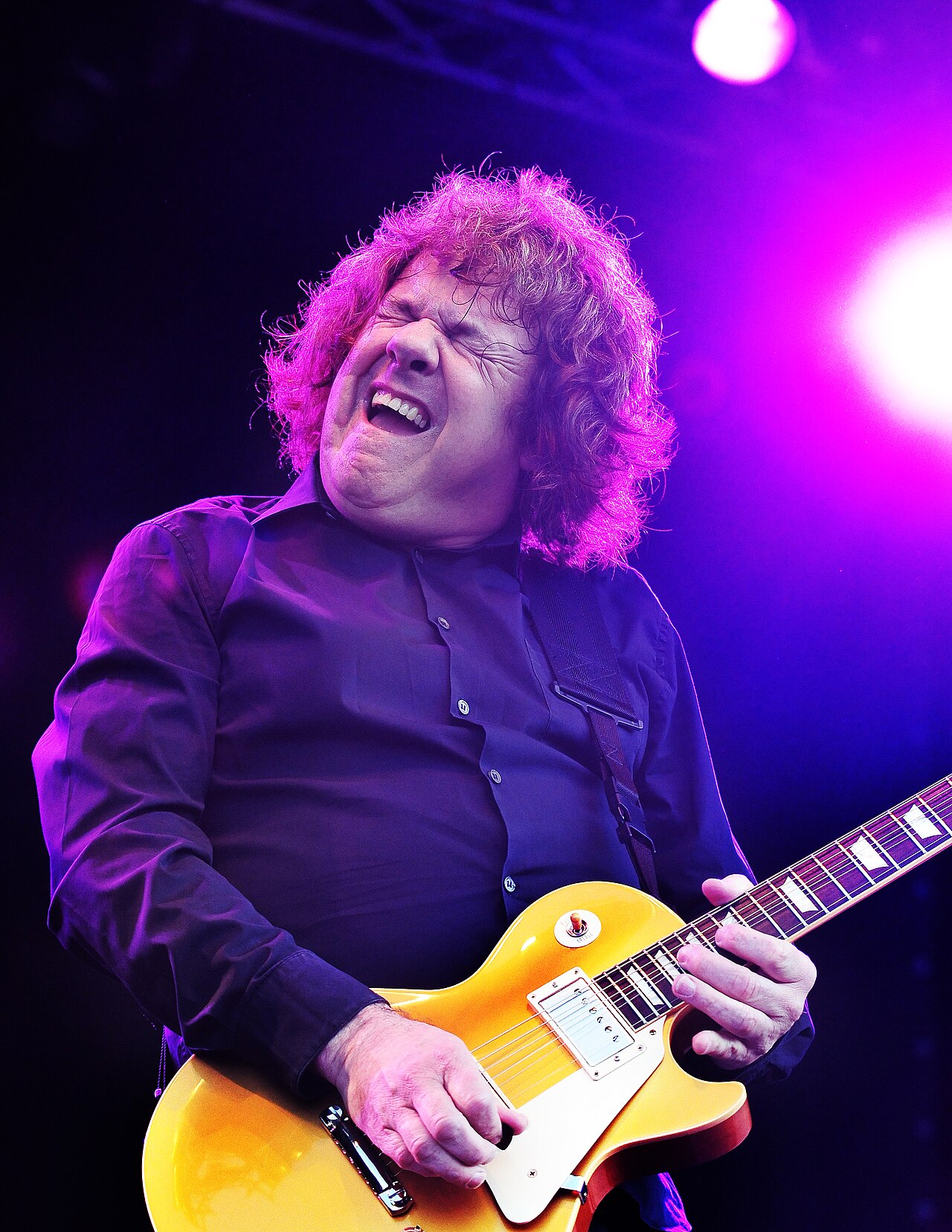

Gary Moore
Current Ranking
Gary Moore is ranked #42 of 162 guitarists on the Greatest Guitar Player leaderboard, based on our editorial score until fans weigh in. On the hard rock leaderboard, Gary Moore ranks #5 of 12. No fan votes yet, so be the first to rate Gary Moore on 8 attributes at greatestguitarplayer.com/vote.
Biography
Gary Moore, born in Belfast, Northern Ireland in 1952, was a guitarist of ferocious intensity and deep emotion, a player who could shred with the best hard-rock virtuosos and then break your heart with a single sustained blues note. Across a restless, genre-hopping career he moved from blues-rock to hard rock to Celtic-tinged metal and finally back to the pure blues that was always his first love, and through all of it he played with a fire and a feel that few could match.
Moore came up fast, joining the Irish band Skid Row as a teenager and forging a lifelong friendship and musical partnership with Thin Lizzy's Phil Lynott, with whom he played on and off for years. He pursued a hard-rock and even metal direction through the 1980s, dazzling audiences with his blistering technique, before making the pivotal move that defined his legacy. In 1990 he released Still Got the Blues, returning to his blues roots, and the album and its aching title track became a huge success, reintroducing him as one of the most soulful and powerful blues-rock guitarists alive.
Here is the gem that links him to guitar royalty. For decades Moore was the owner and player of one of the most famous guitars in the world, the 1959 Les Paul known as Greeny, which had originally belonged to Peter Green of Fleetwood Mac. The guitar had a unique, slightly out-of-phase neck pickup that gave it an unmistakable, vocal, nasal tone, and Moore treasured it, using it to make some of his most memorable recordings. He effectively became the guardian of Peter Green's legendary sound, and the instrument later passed, for a small fortune, to Metallica's Kirk Hammett, who reveres both men.
Moore's playing was always about emotion above all else, enormous, singing bends, dramatic vibrato, and a tone that could be tender or savage as the song demanded. He died suddenly in 2011 at just fifty-eight, a loss mourned across the rock and blues worlds. He left behind a body of work that captures a rare combination, the technical command of a hard-rock hero married to the raw, bleeding feel of a true bluesman. For many guitarists, Gary Moore remains the gold standard for emotional intensity, the man who could make a guitar weep and scream in the same phrase.
Legendary Performance
Montreux Jazz Festival
July 17, 1990 · Stravinski Auditorium, Montreux, Switzerland
Gary Moore's 1990 Montreux appearance came at the moment of his most unexpected commercial success: "Still Got the Blues," released that year, had introduced him to an audience that had not followed his work with Thin Lizzy or his heavy metal solo career. The album's approach, slow blues structures, Les Paul lead tone built around the neck pickup, vibrato that could sustain a single note for longer than most guitarists could hold their listener's attention, was a deliberate simplification that revealed the blues at the core of playing that had always contained it. The Montreux performance brought this material to a jazz festival audience that took the blues tradition seriously, and Moore's playing that night matched the occasion's seriousness.
His vibrato technique, the element most discussed by guitarists who have studied his work, was audible across the Stravinski Auditorium in a way that made the technical discussion concrete: the notes he held seemed to be actively expressive rather than merely sustained, as though the pitch variation of his vibrato was language rather than decoration. The guitar he used was a Les Paul, but for much of his work from this period it was a specific one: the 1959 Les Paul Standard previously owned by Peter Green, known as "Greeny," whose unusual out-of-phase pickup wiring gave it a tone so distinctive that it has never been successfully duplicated.
▶ Watch on YouTubeGear
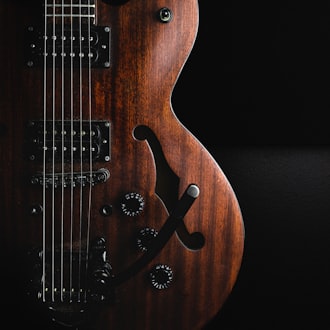
"Greeny", 1959 Gibson Les Paul Standard (1959)
Known for: "Still Got the Blues", Still Got the Blues, 1990
"Greeny" is one of the most storied guitars in rock history. The 1959 Gibson Les Paul Standard was originally owned by Peter Green, who named it and used it to record the early Fleetwood Mac albums, including "Albatross" and "The Green Manalishi." Green sold the guitar to Gary Moore in 1973, who used it extensively throughout his solo career, particularly on the blues recordings from the late 1980s and 1990s that brought his playing to its widest audience. The guitar has an unusual tonal characteristic: one of its pickups was accidentally installed out of phase during a repair, and the resulting out-of-phase sound between the neck and bridge pickups gives it a thin, cutting, almost vocal quality that is unlike any other Les Paul.
Moore paid £100 for Greeny from Peter Green in 1973. After Moore's death in 2011, the guitar was purchased by Metallica's Kirk Hammett at auction for a reported $2 million, returning it to active use as a working musician's instrument. Its provenance, Green to Moore to Hammett, three of the most distinctive Les Paul players in rock, makes it a unique object, but its tonal character is the reason for its value: the out-of-phase sound is a property of this specific guitar and cannot be found in any other instrument.
Marshall Super Lead 1959 & Soldano SLO-100
Known for: "Parisienne Walkways", Back on the Streets, 1978
Moore ran vintage Marshall Super Lead amplifiers through most of his career, with the 100-watt Plexi-era heads providing the clean-to-mildly-driven headroom that his vibrato-intensive playing required. He needed an amplifier that would sustain a note expressively under bend and vibrato pressure without compressing it into a flat sustain, the Marshall's interaction between the preamp and power amp at high volume provided exactly this.
From the late 1980s onward, Moore incorporated Soldano SLO-100 amplifiers into his setup for higher-gain lead tones, the Soldano's tighter, more modern high-gain character complementing the Marshall's vintage warmth. The combination allowed him to access a wider tonal range within performances than either amplifier alone could have provided.
Signature Technique
Extended Vibrato & Les Paul Lead Expression
Gary Moore's vibrato is the most discussed single element of his technique, specifically its width, its consistency, and its duration. He could sustain a vibrato on a single note for longer than most guitarists can maintain listener attention, and the pitch variation was wide enough to be clearly audible without being so extreme as to sound out of control. This vibrato was produced primarily through the classical violin approach, rotating the wrist rather than bending the string, applied to an electric guitar in a way that extended the note's apparent emotional content rather than simply adding pitch modulation. The neck pickup of a Les Paul, with its warm, sustained output, suited this technique exactly: it gave the vibrato time and space to develop within each note.
His string bending complemented the vibrato: wide bends executed with the precision of a player who had internalised the target pitch so thoroughly that the bend arrived at it rather than searching for it. The combination of wide vibrato, wide bends, and the Les Paul's natural sustain produced a lead tone that sits in the continuum from Peter Green and Paul Kossoff through to the most expressive blues-rock playing of the 1990s. His playing on "Still Got the Blues," "Parisienne Walkways," and "The Loner" is the fullest demonstration of this technique: a guitarist for whom every note is an argument rather than a statement, always developing, never at rest.