

Tosin Abasi
Current Ranking
Tosin Abasi is ranked #102 of 162 guitarists on the Greatest Guitar Player leaderboard, based on our editorial score until fans weigh in. On the shred and virtuoso leaderboard, Tosin Abasi ranks #12 of 19. No fan votes yet, so be the first to rate Tosin Abasi on 8 attributes at greatestguitarplayer.com/vote.
Biography
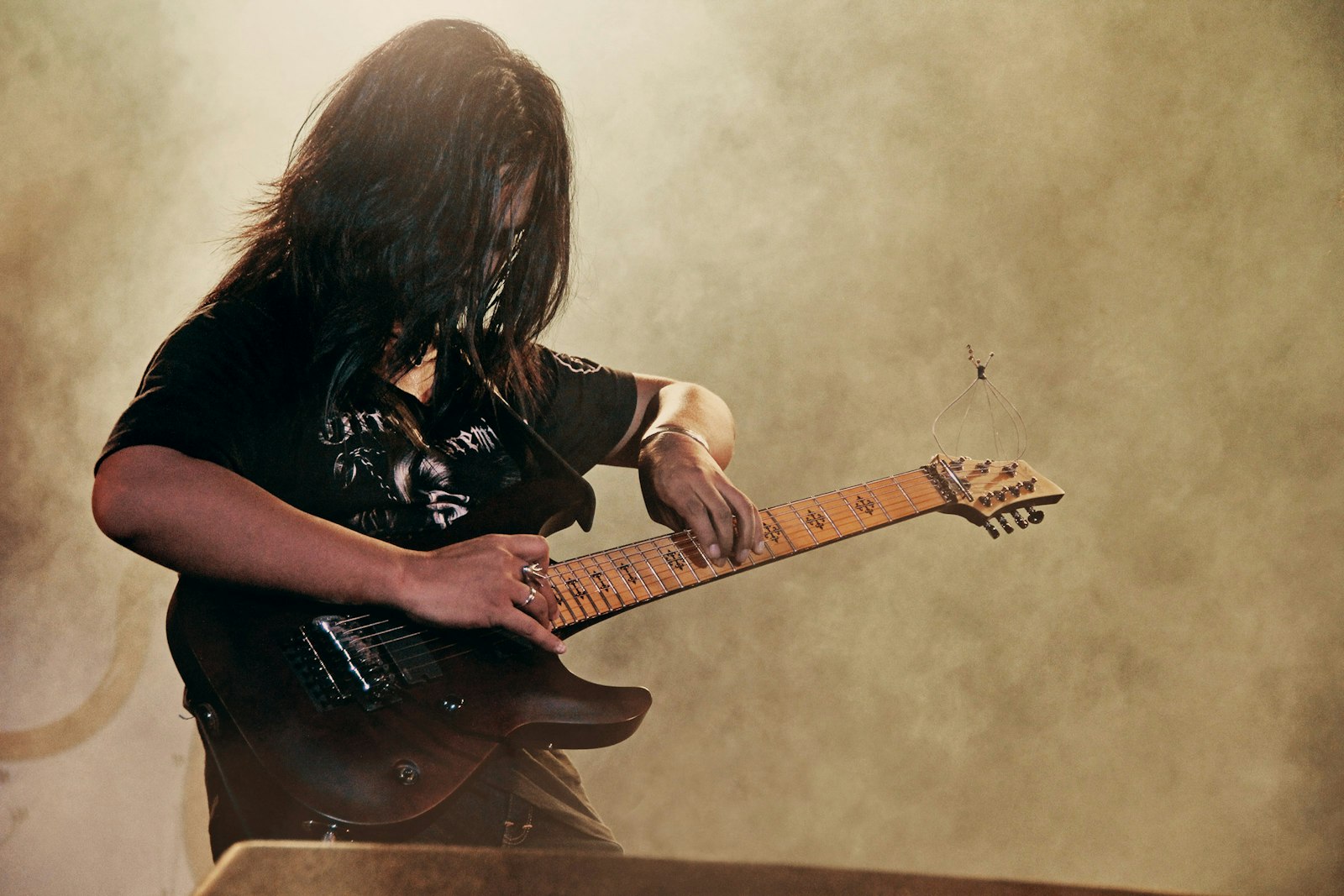
Tosin Abasi is the guitarist who made the eight-string guitar a serious instrument. As the founder and lead voice of Animals as Leaders, the instrumental progressive metal trio from Washington, D.C., he took an extended-range guitar that most players treated as a novelty for low chugging and turned it into something closer to a piano, with bass lines, chords and melodies happening at once under one pair of hands. Born January 7, 1983, in Washington to Nigerian immigrant parents, he grew up in the Maryland suburbs, played clarinet in elementary school, and taught himself guitar from instructional videos by hair-metal shredders he has joked you did not want to be caught watching.
His first real band was the metalcore group Reflux, whose 2004 album The Illusion of Democracy caught the ear of Prosthetic Records. The label offered him a solo deal on the spot and he turned it down, saying he was not good enough yet. Instead he enrolled at the Atlanta Institute of Music, spent a year absorbing jazz harmony and technique, and came back with a plan. The 2009 Animals as Leaders debut was recorded almost alone, with Periphery's Misha Mansoor programming drums, and it quietly rewired what a modern metal guitar record could be. Javier Reyes joined on second guitar and, from 2012, drummer Matt Garstka completed the lineup. Weightless (2011), The Joy of Motion (2014, number 23 on the Billboard 200), The Madness of Many (2016) and Parrhesia (2022) followed, each one pushing further into jazz, electronic and even flamenco territory without a single vocal.
The band's name comes from Daniel Quinn's novel Ishmael, a reminder, as Abasi puts it, that we are all animals. His technique vocabulary is just as distinctive: the "thump" he borrowed from slap bass and bounced across guitar strings, selective picking that mixes pick strokes with plucked fingers, and chord voicings that only make sense with eight strings and a fanned fretboard. Ibanez built him the TAM100 signature in 2013, and in 2017 he walked away to start Abasi Concepts, designing the ergonomic Larada guitar from scratch with a teardrop neck, multi-scale frets and tight string spacing tailored to his hands.
The gem: he spent the 2016 Generation Axe tour standing between Steve Vai, Yngwie Malmsteen, Zakk Wylde and Nuno Bettencourt, the very players whose videos he once studied, and closed each night trading solos with them on "Highway Star". Four years later he turned up in Bill and Ted Face the Music, shredding air guitar on screen. He practices Transcendental Meditation, collects cars, and once sold off more than a hundred guitars in a single purge. In 2026 Animals as Leaders are back on the road supporting Joe Satriani and Steve Vai, which says everything about where his generation's guitar heroes have placed him.
Legendary Performance
Generation Axe opening night
April 5, 2016 · Paramount Theatre, Seattle, Washington
Generation Axe was Steve Vai's idea: five guitarists from different eras and schools sharing one band and one stage for a full night of instrumental guitar. Vai, Yngwie Malmsteen, Zakk Wylde and Nuno Bettencourt were established names. The fifth chair went to Tosin Abasi, who at 33 was the only one on the bill playing an eight-string and the only one whose fame had been built on the internet rather than on MTV. The tour opened on April 5, 2016, at the Paramount Theatre in Seattle, and Abasi went on first, in front of an audience that had bought tickets for the legends after him.
He played "Tempting Time", "Air Chrysalis" and "CAFO" with the touring band, then stayed on for the collaborative pieces that defined the show, "Physical Education" with Bettencourt and "Building the Church" with Vai, before all five lined up for "Foreplay", "Frankenstein" and "Highway Star". The point of the night was the contrast. Next to Malmsteen's neoclassical runs and Wylde's pinch harmonics, Abasi's thumping, chordal, oddly quiet approach sounded like a different instrument, and the crowd response made it clear that a new school had arrived. The tour ran through 2017 and Asia in 2019, but that first Seattle night, with the older masters watching from the wings, was the moment Abasi was formally handed a place among them.
▶ Watch on YouTubeGear
Abasi Concepts Larada 8-string (and the Ibanez TAM100 before it) (2013 to present)
Known for: Animals as Leaders records and tours, Parrhesia, the yellow Larada live
Abasi's sound starts with the eight-string. His early Animals as Leaders records were cut on Ibanez RG eight-strings, which led to the TAM100 signature unveiled at NAMM in 2013: a 27-inch scale, a thin Wizard neck, DiMarzio Ionizer pickups voiced to stay clear on the lowest strings, and a white finish that became his visual trademark. It was the first eight-string signature model from a major brand built for a player who used the whole range rather than only the bottom.
In 2017 he left Ibanez to design his own instrument. The Abasi Concepts Larada is built around ergonomics: a teardrop neck carve, a multi-scale fanned fretboard so the low strings get length while the high strings stay easy to bend, tighter string spacing for his thump technique, and Fishman Fluence Tosin Abasi pickups with switchable voicings. It comes in six, seven and eight-string versions and, since 2022, the double-cut Emi. Parrhesia and the recent tours are played almost entirely on Laradas, including the yellow eight-string he favors live.
Fractal Axe-Fx and Neural DSP Quad Cortex (direct, no amps)
Known for: the clean, compressed djent tone on every Animals as Leaders album
Abasi went digital early. Animals as Leaders were among the first bands to tour on Fractal Audio Axe-Fx units instead of amps, running direct to the front of house with cabinet simulations, and later moving to Neural DSP's Quad Cortex. The clean, compressed, almost hi-fi clarity of his tone is a product of that approach: no stage volume, no cabinet bleed, every note of an eight-string chord audible. Fractal's collaboration with the band produced the Animals as Leaders presets that a generation of djent players started from, and Neural DSP's Archetype: Abasi plugin bottled the same rig for home recording.
In-modeler gating, compression, delay, reverb, pitch and filter effects
Everything lives inside the modeler: tight gates and compression for the thump parts, a clean channel with reverb and delay for the chordal passages, pitch and filter effects for the electronic textures on The Madness of Many and Parrhesia, and MIDI switching from a floor controller. He strings the Larada with custom gauges to keep the low F sharp tight at multi-scale length and plays with a small, pointed pick that he tucks away when a passage calls for fingers.
Signature Technique
Thump, Selective Picking & Eight-String Polyphony
The core of Abasi's playing is treating the guitar as a polyphonic instrument. On an eight-string he assigns the low strings to bass lines and the upper strings to chords and melody, then plays them simultaneously with a mix of pick, fingers and thumb. The signature move is the "thump": his thumb slaps the low string against the frets like a slap bassist, then flicks upward to sound a higher string, producing a percussive attack and a note in one motion. "Physical Education" and "Tempting Time" are built on it, and it gives Animals as Leaders their trademark clicking, bouncing groove.
Selective picking is the second pillar. Instead of alternate picking everything or sweeping arpeggios, he picks some notes and plucks others with the middle and ring fingers, choosing whichever is closest at hand, which lets him outline wide intervals and string skips at speed without the pick crossing strings. On "CAFO" this turns a fast sixteenth-note line into something that sounds like two guitarists. He combines it with two-hand tapping to extend chord voicings across the fanned fretboard, often tapping chord tones with the right hand while the left holds a bass note.
Harmonically he draws from jazz and fusion, particularly Allan Holdsworth and Kurt Rosenwinkel: extended chords, quartal voicings and modal melodies over odd meters and polyrhythms that lean on Meshuggah's rhythmic ideas. "Monomyth" and "Arithmophobia" layer displaced accents over steady pulses, the kind of grooves fans literally chart out to understand. Yet the lines themselves are singable, which is why the records reach beyond the technical-metal audience.
His influence is everywhere in modern progressive and instrumental guitar. The eight-string, multi-scale, thump-and-tap approach that was unique to him in 2009 is now standard equipment for a whole scene, from djent bands to solo YouTube players, and the Larada design has shaped what a modern ergonomic guitar looks like. Steve Vai calling him to the Generation Axe stage confirmed what younger players already knew: Abasi expanded the instrument's vocabulary rather than just its range.