






Jake E. Lee
Current Ranking
Jake E. Lee is ranked #112 of 162 guitarists on the Greatest Guitar Player leaderboard, based on our editorial score until fans weigh in. On the heavy metal leaderboard, Jake E. Lee ranks #13 of 14. No fan votes yet, so be the first to rate Jake E. Lee on 8 attributes at greatestguitarplayer.com/vote.
Biography
Jake E. Lee, born Jakey Lou Williams on February 15, 1957 in Norfolk, Virginia, is the guitarist who had to follow Randy Rhoads and somehow did it. He took the Ozzy Osbourne chair in 1982 and held it across two multi-platinum albums, Bark at the Moon in 1983 and The Ultimate Sin in 1986, then walked away from the machine and largely stayed away for fifteen years. His father Kenneth was a Navy man who met his mother Shizu while stationed in Japan, and the family moved to California before Jake turned one. He started piano lessons at five, switched to guitar after hearing Hendrix, and by eighteen was fronting a San Diego covers band called Teaser with a local reputation he has never undersold: he figured he was the best guitar player in town.
Los Angeles came next, and with it a run of near misses that reads like a list of other people's famous bands. He played in an early version of Ratt alongside Stephen Pearcy, then joined Rough Cutt in part to get close to Wendy and Ronnie James Dio, auditioned for Dio in 1982, and was let go after a month and replaced by Vivian Campbell. Three months of heavy drinking followed. Then Ozzy's management pulled his demo tape and photo out of the pile. At the LA rehearsal-studio audition, with George Lynch waiting his turn, Ozzy reportedly turned to Lynch and told him the gig was already gone. Lee was 25 years old.
Bark at the Moon sold three million copies in the United States on the back of riffs Lee wrote, and he got no writing credit for any of it. By his account he was handed a contract after the recording was finished stating that he had no claim to the writing or the publishing, and he signed it under the threat of being replaced. For The Ultimate Sin he insisted on the credit guarantees up front. Sharon Osbourne let him go in 1987 and he heard about it second hand. What followed was Badlands, the bluesy, Zeppelin-shaped band he built with singer Ray Gillen and drummer Eric Singer, whose 1989 debut is still the record his defenders reach for when they want to argue he was never just a metal gunslinger. Gillen died of AIDS-related complications in 1993, at 33.
Then came the disappearing act. After his ex-wife's overdose, Gillen's death and the loss of both parents, Lee simply stopped, living off Ultimate Sin royalties and selling gear, and he is careful to correct the legend that grew around it: he did not own a home, but he was never homeless. Red Dragon Cartel brought him back in 2013 with a self-titled debut and 2018's Patina. Two more chapters landed after that. In October 2024 he was shot multiple times outside his Las Vegas home after confronting masked men trying to take his neighbor's motorcycle, and he recovered. Nine months later, on July 5, 2025, he walked onto the stage at Villa Park for Ozzy's farewell show and played his own Ozzy-era material in front of a sold-out stadium. Ozzy died seventeen days after that.
Legendary Performance
"The Ultimate Sin" and "Shot in the Dark", Back to the Beginning
July 5, 2025 · Villa Park, Birmingham, England
For nearly four decades Jake E. Lee was the Ozzy guitarist nobody expected to see on an Ozzy stage again. He had been fired by phone in 1987, had never spoken to Ozzy or Sharon since, and had spent most of the intervening years deliberately out of the business. So when the lineup for Back to the Beginning was announced, Ozzy and Black Sabbath's farewell show at Villa Park in their home city of Birmingham, his name in the running order carried a weight none of the younger players on the bill could match.
He came out with the all-star band the show billed as Supergroup A, a rotating cast that included Nuno Bettencourt and Scott Ian on guitars, David Ellefson and Frank Bello on bass, Mike Bordin on drums and Adam Wakeman on keys, with Lzzy Hale, David Draiman, Whitfield Crane and Yungblud trading vocals. Lee played "The Ultimate Sin" and "Shot in the Dark", the two songs from the album he had fought to get his name on, in front of a sold-out stadium and a global pay-per-view audience. He was 68, nine months removed from being shot multiple times in Las Vegas, and he played them with the same dry, staccato bite he had put on the records in 1986.
It was closure in public, and it turned out to be the last chance for it. Ozzy Osbourne died on July 22, 2025, seventeen days after the show. Whatever the paperwork said about who wrote what, the performance settled the other question for good: the Ultimate Sin material is Jake E. Lee's music, and for one night in Birmingham it was played the way he meant it.
▶ Watch on YouTubeGear
Charvel San Dimas, the Ozzy-era number one (1983)
Known for: Bark at the Moon and The Ultimate Sin, 1983 to 1987
Lee's Ozzy-era number one was a Charvel San Dimas, a bolt-on superstrat built the way the Californian shop built everything in the early eighties, alder body, maple neck, one humbucker doing the heavy lifting. He has been blunt about how he got it: Charvel were sending him the leftovers that other players had passed on. A friend at the company resprayed one as a birthday present, and the finish came out with the lavender sheen that shows up in the Bark at the Moon footage. After The Ultimate Sin he finally asked for something built for him, and the blue burst he settled on is the look Charvel went back to in 2018 for his Pro-Mod San Dimas signature, a hardtail (his request, for sustain and tuning stability) with a Seymour Duncan JB at the bridge and slanted DiMarzio SDS-1 single-coils in the middle and neck.
What tends to surprise people is how little of a shredder's collection sits behind him. His first serious guitar was a 1967 Gibson SG Standard bought with six months of newspaper-route money, and he still owns more SGs than anything else, with a stated weakness for P-90s. In recent years he has added oddities for the fun of it, including a white 1971 Ovation Breadwinner he bought on a whim after a few drinks because he had admired it in seventies magazine ads and never owned one.
Mid-1960s Marshall 45-watt combo, and a JCM800 2203
Known for: the sixty-pound junk-shop find he calls his greatest
The amp that mattered most to Lee cost him about sixty pounds. Touring northern England during the Bark at the Moon run, he walked into a small shop and found a mid-sixties Marshall 45-watt combo that had been sitting untouched for more than twenty years. He has called it his greatest find and described the sound as creamy, sweet and compressed, with a little sag under the note. On the bigger stages he ran Marshalls of the era's standard issue, including a JCM800 2203 at the 1983 US Festival, often with a Kasha modification unit attached to the head by duct tape, which tells you something about how the eighties actually worked behind the gear photos.
His stated priorities have not changed since. A bad amp, he has said, will make any guitar sound bad, while a good amp will make almost any guitar sound good. Friedman eventually built him the JEL-50, the signature head he leans on now, and Red Dragon Cartel rigs have run through Friedman Small Box and EVH 5150III heads.
Boss SD-1 Super Overdrive, Ibanez SF10 Swell Flanger, Vox wah
Lee's signal chain has always been short, which is a large part of why the Ozzy records sound so dry and present next to the wetter productions around them. A Boss SD-1 Super Overdrive pushed the front end from the Bark at the Moon sessions right through the Ultimate Sin tour, and it was doing tone-shaping work rather than supplying the distortion, which came from the amp.
The one effect everybody can name is the Ibanez SF10 Swell Flanger that smears the back half of the "Bark at the Moon" solo, a sound that has launched a thousand forum threads from players who assumed it was a studio trick. A Vox wah, an MXR stereo chorus and a Carbon Copy analog delay round out the modern board, with a Boss tuner in front. No racks, no switching systems, nothing that needs a technician.
Signature Technique
Staccato Attack and Off-Kilter Phrasing
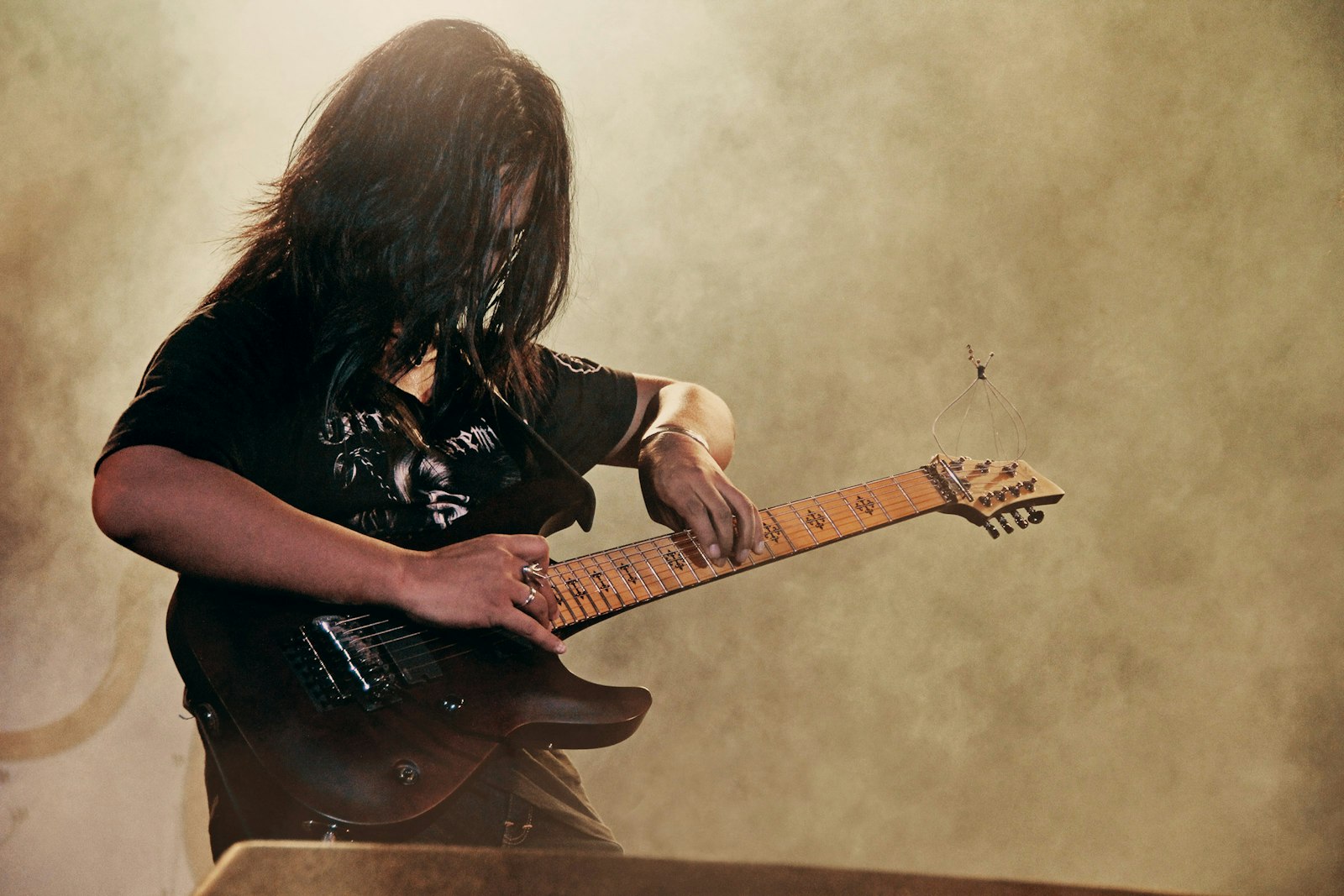
Lee's signature is attack. Where most of his eighties peers were chasing legato fluidity, he played in short, clipped, palm-muted bursts, notes cut off before they could ring into each other, so the phrases land like Morse code rather than a smooth run. Guitar World has taught the approach as staccato licks for a reason: the picking hand is doing as much rhythmic work as the fretting hand, and the silence between the notes is part of the lick.
The second thing that sets him apart is note choice. He came up on Hendrix and the blues, not on Bach and the European classical line that shaped Rhoads and Malmsteen, so his solos wander into intervals that sound wrong for a beat and then resolve somewhere unexpected. The "Bark at the Moon" solo is the case study, a chromatic, off-kilter run that has no obvious model in the metal vocabulary of 1983 and still trips up players who learn it note for note without understanding where the phrasing breathes.
Underneath that he is a riff writer first. "Bark at the Moon", "The Ultimate Sin", "Shot in the Dark" and "Killer of Giants" are all built on figures that work as songs before any solo arrives, and the Badlands records pushed the same instinct toward open, bluesy, Page-adjacent territory with slide, open tunings and a much looser feel.
He also refused, then and now, to enter the speed race. He is fast when the song wants it and he can bend and vibrato with anyone, but his reputation rests on phrasing, on a dry unprocessed tone, and on a willingness to leave space where a competitor would have filled it. That is why players who came up in the eighties still name him as the under-celebrated one, and why the Bark at the Moon guitar parts have aged better than most of what surrounded them.