






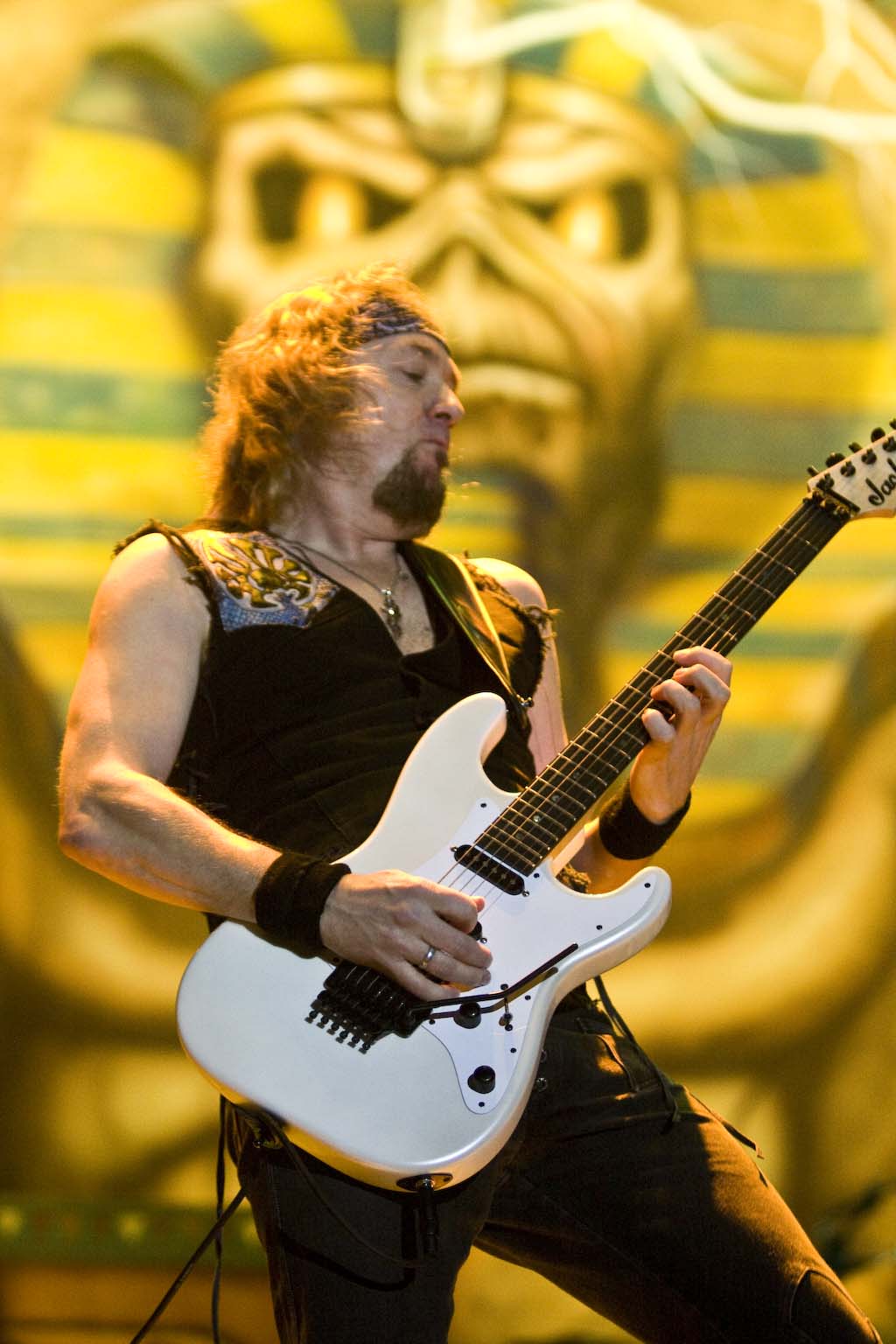

Adrian Smith
Current Ranking
Adrian Smith is ranked #87 of 162 guitarists on the Greatest Guitar Player fan leaderboard, based on 2 fan votes so far. On the heavy metal leaderboard, Adrian Smith ranks #9 of 14. Agree? Rate Adrian Smith on 8 attributes at greatestguitarplayer.com/vote.
Biography
Born in Hackney in 1957 and raised across East London, Adrian Smith is the quiet craftsman of Iron Maiden, the player whose melodic instincts and pop sense gave one of metal's most relentless bands its hooks. He cut his teeth in a local outfit called Urchin before joining Maiden in late 1980, right as they were about to record their second album Killers. His arrival completed the classic-era lineup that produced the run of records, The Number of the Beast, Piece of Mind, Powerslave, Live After Death, Somewhere in Time, and Seventh Son of a Seventh Son, that many fans consider one of the most consistent stretches in the history of the genre.
The heart of Maiden's guitar sound is its harmonies, and the template for that twin-guitar attack came largely from Smith's partnership with Dave Murray. Where Murray leans into fast, fluid, legato runs, Smith plays with a more melodic, blues-rooted touch, building solos that you can actually hum. That contrast, two guitarists who hear lead playing completely differently, is a big part of why the band's arrangements have so much light and shade. Smith also became a major songwriter in the ranks, writing or co-writing some of the era's most enduring tracks, including Wasted Years, 2 Minutes to Midnight, and Stranger in a Strange Land, songs whose choruses owe as much to his pop instincts as to Maiden's signature gallop.
Then he walked away. Smith left Maiden in 1990 amid creative tension during the Bruce Dickinson years and spent the decade chasing his own muse in bands like ASAP and Psycho Motel before reuniting with Dickinson for the solo albums Accident of Birth and Chemical Wedding, two of the most acclaimed metal records of the late 1990s. In 1999 he came home, rejoining Iron Maiden alongside Dickinson and forming the three-guitar lineup with Murray and Janick Gers that has defined the band's modern era. From Brave New World in 2000 onward he has kept writing key tracks and delivering the kind of memorable, hook-driven lead breaks that age extremely well.
Here is the gem that surprises people: away from the stadiums, Adrian Smith is a seriously dedicated angler, an obsessive sport fisherman who has written about it and filmed it, and who is as likely to talk your ear off about fly rods as about guitars. There is something perfectly on-brand about that. The most patient, understated, detail-focused guitarist in one of the loudest bands on earth spends his downtime standing quietly in a river. He has carried that same low-key curiosity back into music too, exploring heavier and bluesier ground in projects like Primal Rock Rebellion and the Smith/Kotzen duo with Richie Kotzen. Across more than four decades, Smith has never been the flashiest or most famous name in Iron Maiden, and he has never seemed to want to be. He is the guy who writes the part you end up singing, lands the solo that fits the song, and lets the music do the talking.
Legendary Performance
Iron Maiden, Live After Death at the Long Beach Arena
March 14, 1985 · Long Beach Arena, Long Beach, California, USA
When Iron Maiden played four nights at the Long Beach Arena in mid-March 1985 during the World Slavery Tour, they had already become arena-level headliners and were near the absolute peak of their classic-era powers. The shows were filmed and recorded for the Live After Death album and concert film, which became one of the defining live releases of 1980s metal and remains the canonical document of the Powerslave-era lineup. Adrian Smith's performances on those nights demonstrated what made him distinct from almost every other lead guitarist in the genre: a melodic sensibility rooted as much in blues phrasing and 1970s rock as in the neoclassical or speed-metal vocabulary that dominated thrash.
His solos on 2 Minutes to Midnight, Aces High, Powerslave, and The Trooper (shared with Murray in the band's signature harmonized passages) became reference recordings for a generation of metal guitarists. The 2 Minutes to Midnight solo in particular, with its carefully constructed melodic arc and unhurried phrasing, illustrated his belief that a lead passage should function as a composed instrumental break rather than as an opportunity for extended improvisation. The album captured the chemistry between Smith and Murray at full intensity, with the harmonized lead passages locked tightly and the call-and-response solo trades demonstrating two players who had spent four years on the road learning each other's phrasing instincts. The Long Beach recordings are the reason countless guitarists in the decades since have studied Smith's playing as a textbook example of how to construct memorable lead lines within the framework of a heavy metal song.
▶ Watch on YouTubeGear
Jackson San Dimas SDK Adrian Smith Signature (First introduced 2009, current SDK in production)
Known for: Smith's primary instrument since his return to Iron Maiden in 1999
Adrian Smith's gear history has tracked his career arc carefully. During his first tenure with Iron Maiden he was associated primarily with Gibson Les Paul Standards and modified Fender Stratocasters fitted with humbuckers, instruments that gave him the rich harmonic content for his melodic lead voice while keeping enough Stratocaster cut for the harmonized lines with Dave Murray. His move to Jackson came during the late 1980s and intensified after his Maiden return, eventually leading to the development of his signature San Dimas SDK model in collaboration with Jackson's design team.
The SDK is a Stratocaster-shaped instrument built around a single bridge humbucker and two single-coil neck and middle pickups, configured to deliver both the percussive attack needed for Maiden's heavier material and the cleaner, more articulate tones for the band's atmospheric passages. The 24-fret neck, compound-radius fretboard, and locking tremolo give Smith the playability and tuning stability required for arena-length sets, and the body's comfortable contours support the marathon two-and-a-half-hour shows that Maiden has played consistently since 1999. The Jackson SDK has remained Smith's primary touring and recording instrument across multiple Maiden albums and tours, and its design choices reflect his longstanding preference for instruments that serve the song's melodic and harmonic demands rather than calling attention to themselves as showpieces.
Marshall JCM800 and Modern Marshall Heads
Known for: Smith's defining amplifier voice across his Iron Maiden career
Adrian Smith's amplifier choices have been remarkably consistent across his entire career, centered on the Marshall heads that defined British heavy metal in the 1980s and beyond. The JCM800 2203 100-watt head provided the foundation for his tone throughout the classic Maiden years, paired with standard Marshall 4×12 cabinets loaded with Celestion speakers. The amp's tight, articulate distortion at moderate gain settings suited his preference for lead lines that retain pitch clarity and harmonic detail even at high stage volumes, and his picking attack provided most of the saturation that gives his solo passages their characteristic edge.
In the modern Maiden era Smith has updated his touring rig to incorporate more recent Marshall designs (including JVM-series heads and JMP-1 preamps with separate power amplifiers) for the channel switching and MIDI integration that modern arena production demands, but the tonal philosophy has remained the same: Marshall character, controlled gain, and the natural tube response that lets the guitar's volume knob function as the primary dynamic control. The continuity of his amp choices over four decades is part of what has made his tone instantly identifiable on Iron Maiden records spanning from 1981 through the present, a consistency that few of his metal contemporaries have maintained with the same discipline.
Delay, Chorus, Wah, and the Iron Maiden Stereo Rig
Smith's effects vocabulary is moderate by metal standards, focused on the textural enhancers that suit Iron Maiden's expansive song arrangements rather than on heavy distortion or novelty effects. A digital delay (variously TC Electronic, Boss, or Eventide depending on the era) appears throughout his work, often set to short slapback for thickening lead lines and occasionally to longer settings for the atmospheric introductions Maiden favors on epic-length tracks. A chorus pedal provides the shimmering quality heard on the cleaner passages of Wasted Years and similar songs, where the spread between his rhythm tone and Murray's creates the stereo-wide guitar image that has become a Maiden signature.
A Dunlop Cry Baby wah pedal appears on specific solo passages where vocal-like vowel shifts are part of the melodic effect, used sparingly rather than as a continuous textural element. On stage the entire Maiden guitar rig (three guitarists, each with their own setup) is carefully balanced through a stereo monitoring system that places each player's instrument in a specific position in the soundscape, and Smith's signal chain is tuned to occupy his particular sonic territory without overlapping with Murray's or Gers's. The overall approach reflects his band-first orientation: effects exist to serve the arrangement and the song, not to showcase his individual playing.
Signature Technique
Melodic Lead Voice and Harmonized Twin-Guitar Architecture
Adrian Smith's technical signature is the construction of lead lines that function as composed instrumental melodies, with the kind of arc and resolution typically associated with vocal lines rather than with improvised guitar solos. His Wasted Years solo is the textbook example: a four-phrase melodic statement that builds across its sixteen bars, each phrase developing the previous one and the whole resolving in a way that the listener could hum back after a single hearing. The discipline behind this approach is harder than it appears. Most lead guitarists improvise from a vocabulary of memorized licks, while Smith composes his solos in advance, refining them across rehearsals and early performances until every note serves the structural arc.
His harmonized twin-guitar work with Dave Murray established what became one of the defining sounds of British heavy metal. The harmonized passages on The Trooper, Aces High, and countless other Maiden tracks use thirds and sixths above and below the main melody, voiced in a way that creates the full chordal motion of an arrangement while still functioning as a single-line melody. The technical challenge is coordination: both players have to articulate the melody identically (same pick attack, same vibrato width, same bending intonation) for the harmonized line to lock as a unified voice rather than as two guitars playing similar parts. Smith and Murray achieved this through years of co-rehearsal and on-stage listening, and the resulting twin-guitar texture became the blueprint that almost every later metal band with two guitarists has emulated.
His right-hand technique combines flatpicking with occasional finger use for arpeggiated passages, and his picking attack is deliberately forceful, producing the percussive transient that gives his lead lines their cutting articulation. His left-hand vibrato is wider and slower than that of most metal players, more in the manner of 1970s rock and blues guitarists, which is one of the qualities that makes his lead voice immediately identifiable on Iron Maiden recordings. He bends notes with precise intonation, and his phrasing leaves substantial space between melodic statements, the breathing room that allows each phrase to be heard as a complete idea.
His songwriting contributions to Iron Maiden also illustrate the compositional mindset behind his playing. Tracks like Wasted Years, 2 Minutes to Midnight, and Stranger in a Strange Land are built around guitar-line motifs that he developed before the lyrics or rhythm parts, and the melodic logic of those motifs carries through the entire song arrangement. This integration of writing and playing is rare among lead guitarists at his level, and it is part of why his contributions to Iron Maiden have endured as listening favorites long after the trends of 1980s and 1990s metal that surrounded the band's career have faded into nostalgia. For aspiring metal lead guitarists, Smith remains a definitive demonstration that melody and composition are not opposed to virtuosity but are themselves the foundation of the most enduring lead playing.