
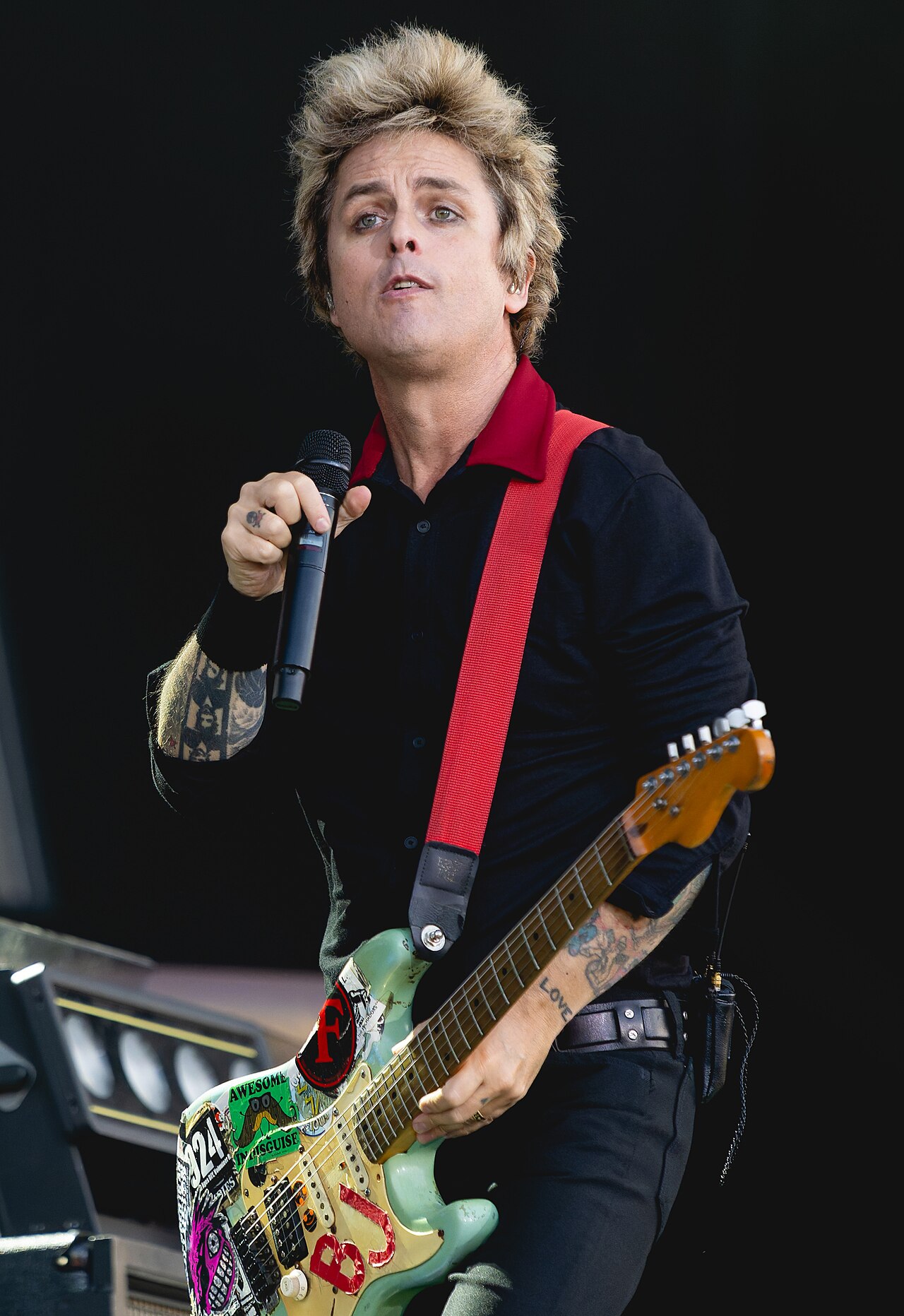

Billie Joe Armstrong
Current Ranking
Billie Joe Armstrong is ranked #144 of 162 guitarists on the Greatest Guitar Player leaderboard, based on our editorial score until fans weigh in. On the punk, grunge and alternative leaderboard, Billie Joe Armstrong ranks #11 of 17. No fan votes yet, so be the first to rate Billie Joe Armstrong on 8 attributes at greatestguitarplayer.com/vote.
Biography
Billie Joe Armstrong, born in 1972 in the working-class East Bay of California, is the frontman and guitarist of Green Day, the band that took the scrappy energy of punk rock out of the basements and onto the biggest stages in the world. He grew up in Rodeo, near the Berkeley punk scene that incubated the band at the legendary all-ages club 924 Gilman Street, and he built a career on the idea that three chords and an honest hook can say everything that needs saying.
Armstrong is not a flashy lead player, and that is entirely the point. His genius is in the rhythm guitar, the relentless, downstroke-driven power chords that make songs like Basket Case, Longview, and American Idiot feel like they are sprinting. When 1994's Dookie turned Green Day into superstars, he became the face of a whole generation of pop-punk, and a decade later the rock opera American Idiot proved he could stretch that simple toolkit into something genuinely ambitious, full of suites, mood swings, and one nine-minute epic, while still sounding like a punk band.
Here is the gem that says everything about him: his main guitar, a beat-up blue Fernandes copy of a Stratocaster that he affectionately calls Blue, was given to him as a kid by his guitar teacher, and he has played it through nearly his entire career, from tiny clubs to stadiums and Hall of Fame inductions. In an era when stars rotate through racks of expensive instruments, Armstrong kept faith with one cheap, sentimental guitar, and you can hear that loyalty in how lived-in his playing sounds.
That working-class authenticity is the throughline of his whole story. He writes about anxiety, boredom, alienation, and political anger in plain, catchy language, and he plays guitar the same way he writes, direct, urgent, and built for the crowd to shout along. Green Day were inducted into the Rock and Roll Hall of Fame in 2015, and Armstrong has kept the band vital across three decades by never overcomplicating the formula. He is living proof that taste, attitude, and a great right hand can matter more than technical fireworks, and that the most powerful thing a guitar can do is make a stadium full of strangers feel like they are in on the same secret.
Legendary Performance
Woodstock '94
August 14, 1994 · Winston Farm, Saugerties, NY
Nobody planned for Woodstock '94 to be Green Day's coming-out party. But then, nobody planned for it to rain for three straight days and turn 350,000 people into a mud-soaked, restless mob either. By the time Billie Joe Armstrong hit the stage on a Sunday afternoon, the crowd was already past the point of polite participation. They were feral. And Armstrong, barely 22 years old, clutching a battered Fernandes Stratocaster, met them exactly where they were.
The mud started flying almost immediately. Rather than retreat or plead for calm, Armstrong waded in. He grabbed clumps from the stage and flung them back. He screamed, he mugged, he turned his set into a two-way brawl between a punk band and the elements. When bassist Mike Dirnt was mistaken for a stage invader and tackled by security, losing a tooth in the process, Armstrong barely broke stride. The chaos was the performance.
What made it legendary wasn't the anarchy alone, but what it signaled. Dookie , Green Day's major-label debut, had dropped just six months earlier and was slowly catching fire. Woodstock '94 detonated it. Within weeks, the album was everywhere. Armstrong's guitar style, deceptively simple three-chord punk with a melodic ear that disguised genuine sophistication, suddenly had an audience of millions. The kid who once played for gas money in Bay Area clubs had arrived, covered in mud and grinning like it was the best day of his life. Because it probably was.
▶ Watch on YouTubeGear
Gibson Les Paul Junior / 'Blue' Stratocaster
Billie Joe Armstrong's two most iconic guitars tell the story of Green Day's evolution. His battered 1956 Gibson Les Paul Junior, with its single P-90 pickup, mahogany slab body, and deliberately unpretentious appearance, became the visual symbol of punk-inflected rock for a generation. Armstrong has used it on virtually every Green Day record, including Dookie and American Idiot , cherishing its raw, midrange-heavy tone that cuts through distortion without losing note definition. Alongside it sits 'Blue,' a custom shop Stratocaster built by Fernandes that he has used since the early 1990s, a guitar that provides more tonal range for the band's more melodic material. He also has a Gibson ES-135 for cleaner passages.
Marshall JCM 800 / Marshall Plexi
Armstrong's amp setup is the classic British-stack approach taken to its punk-logical extreme: Marshall JCM 800s run with the gain high enough for snarling rhythm crunch, clean enough to retain the chord articulation that makes Green Day's songwriting so clear in the mix. He uses multiple Marshalls simultaneously for a wall-of-sound approach on stadium shows. The amp does most of the distortion work, his pedal chain is minimal by rock standards, reflecting the punk ethos that tone should be loud and direct rather than elaborately sculpted.
Boss DS-1 / MXR Carbon Copy
Armstrong's effects setup is deliberately lean. The Boss DS-1 Distortion adds extra gain on leads and heavier passages. An MXR Carbon Copy delay provides depth for solos. That's essentially it, no wah, no elaborate modulation, no multi-effects. The simplicity is intentional: punk rock's emotional directness translates to signal chains that don't get between the player and the amp. His tone comes from his right hand, the Les Paul Junior's P-90, and a pushed Marshall, a setup that has shifted millions of records and remains one of the most effective punk-rock rigs ever assembled.
Signature Technique
Signature Technique
Billie Joe Armstrong's guitar technique is frequently underestimated precisely because it sounds effortless. The driving power chords, the locked-in downstroke rhythm, the melodic single-note leads, these are executed with a precision and consistency that only comes from thousands of hours of playing. His technique is the perfect expression of punk's philosophy: maximum impact from minimum complexity, every note intentional, every rhythmic accent deliberate.
Armstrong's primary rhythmic weapon is the downstroke power chord, a two- or three-note chord built on the root and fifth, struck exclusively downward with a flat pick. This technique, inherited from the Ramones and refined through years of high-energy performance, produces a harder, more percussive attack than alternating up-and-down strokes. On tracks like 'Basket Case' and 'American Idiot,' the relentless downstroke drive is as important to the song's energy as the chord progressions themselves. It is physically demanding at tempo, and Armstrong maintains the technique across entire sets without visible fatigue.
Beneath the punk rhythm foundation, Armstrong is a gifted melodic lead player whose single-note lines on tracks like 'Good Riddance (Time of Your Life)' and 'Boulevard of Broken Dreams' demonstrate genuine compositional intelligence. His leads serve the song's emotional arc rather than displaying technique, and they are consistently memorable, a standard that many technically superior players fail to meet. His lead tone, produced from the Les Paul Junior's P-90 through a pushed Marshall, has a midrange presence that carries over backing tracks without sounding harsh.
Armstrong's songwriting guitar technique includes a sophisticated understanding of how to create rhythmic interest within simple harmonic frameworks. His use of syncopated accents, striking chords on the offbeat or delaying the expected hit, gives Green Day's music a rhythmic complexity that pure downstroke playing would lack. This syncopation is most audible on 'Longview' and 'When I Come Around,' where the rhythm guitar creates a push-pull tension against the kick drum that is the hallmark of great rock arrangement.