


Billy Gibbons
Current Ranking
Billy Gibbons is ranked #67 of 162 guitarists on the Greatest Guitar Player fan leaderboard, based on 1 fan vote so far. On the blues leaderboard, Billy Gibbons ranks #12 of 32. Agree? Rate Billy Gibbons on 8 attributes at greatestguitarplayer.com/vote.
Biography
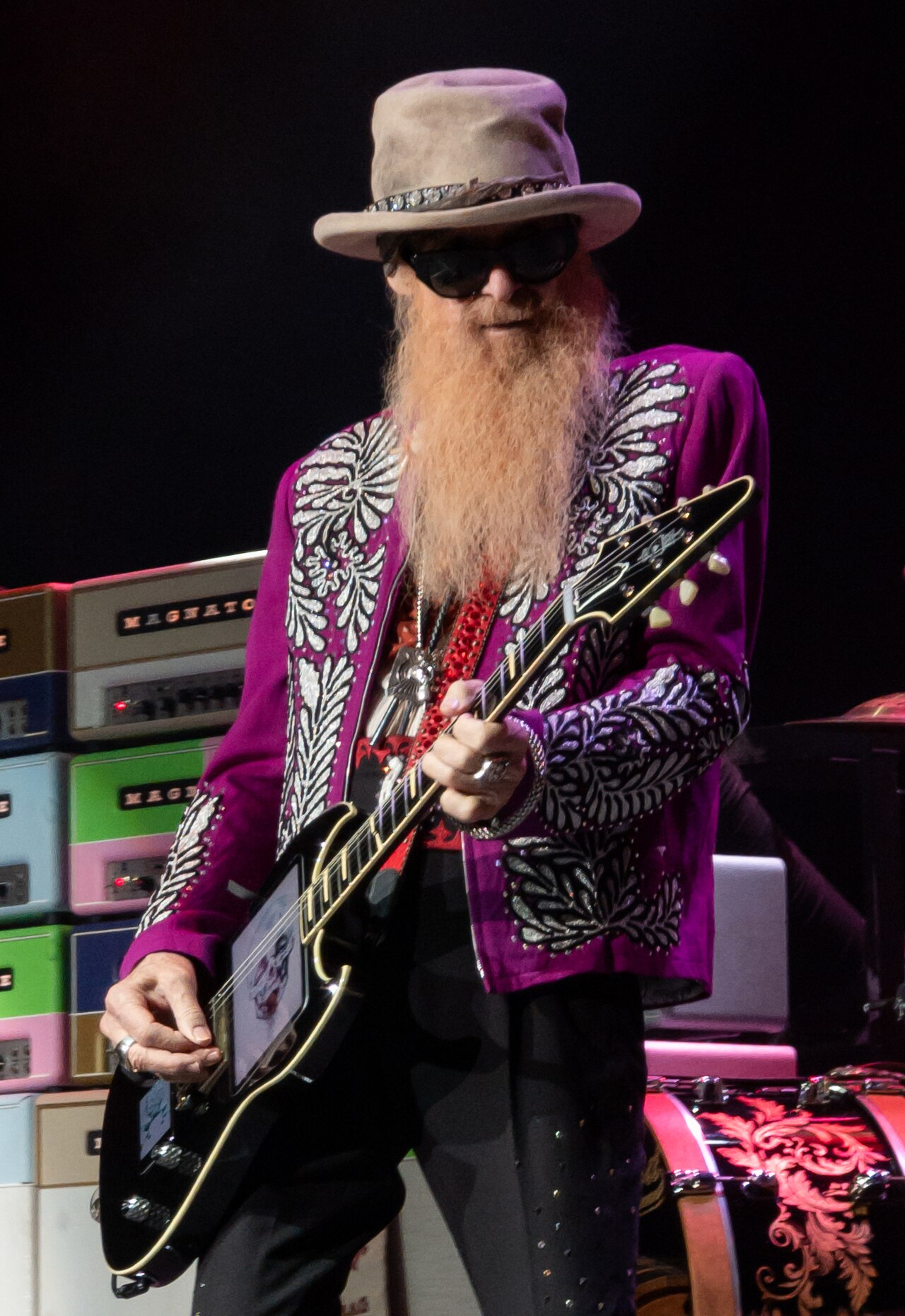
Billy Gibbons, born in Houston in 1949, is the bearded, sunglasses-wearing guitarist and frontman of ZZ Top, and one of the great tone chasers in all of rock. For more than half a century he has played a deceptively simple style of Texas blues-rock, all greasy grooves, sly humor, and fat, fuzzy tone, and made it sound like the coolest thing a human being could possibly do with an electric guitar.
Gibbons came up in the psychedelic 1960s with a band called the Moving Sidewalks before forming ZZ Top, the little ol' band from Texas, which spent the 1970s building a reputation as a fearsome live act on the strength of songs like La Grange and Tush. Then, in the 1980s, the band reinvented itself for the MTV age with the blockbuster Eliminator, pairing Gibbons' bluesy riffs with synthesizers, drum machines, hot rods, and music videos full of the band's now-iconic chest-length beards. Hits like Gimme All Your Lovin and Sharp Dressed Man made them superstars without ever sanding off the grit of his playing.
His tone is the stuff of legend, built around a 1959 Les Paul he calls Pearly Gates, an instrument he treats with near-religious reverence, plus a signature squeal of pinch harmonics that became his calling card. He has experimented endlessly with picks, strings, and unorthodox techniques, including using a Mexican peso as a pick to get a sharper attack, and he is as obsessed with the texture of a note as any player alive.
Here is the gem: when Gibbons was barely out of his teens, his band the Moving Sidewalks opened for the Jimi Hendrix Experience, and Hendrix took a real shine to the young Texan. The story goes that Hendrix later praised Gibbons on national television as a guitarist to watch, and gave him a pink Stratocaster, an endorsement from the master himself before Gibbons had even made his name. He has spent the decades since living up to it, anchoring ZZ Top through the death of bassist Dusty Hill, releasing gritty solo records, and remaining one of rock's most quotable, charismatic, and instantly recognizable guitar personalities. Few players have ever made doing less sound so unmistakably like themselves.
Legendary Performance
The Worldwide Texas Tour
1976-1977 · Arenas across the United States and beyond
The Worldwide Texas Tour of 1976 and 1977 was, by any reasonable measure, the most audacious thing a rock band had ever attempted to bring to an arena stage, and Billy Gibbons was at the center of all of it. ZZ Top erected a 75-foot-wide stage set designed to evoke the state of Texas, populated it with live longhorn cattle, rattlesnakes, vultures, a buffalo named Dopalicious, and an assortment of other livestock that made every night a small exercise in ecological chaos, then played two to three hours of tightly wound Texas boogie in front of all of it. The tour ran for eighteen months and crossed three continents. An estimated ten million people attended. Nothing remotely like it had been done before, and nothing remotely like it has been done since.
What elevated the spectacle into something genuinely legendary was that Gibbons' guitar playing matched it. He was thirty years old and operating at the peak of his first great creative period, playing his beloved "Pearly Gates", a 1959 Gibson Les Paul Standard he has described as the finest guitar he has ever owned, through a wall of Marshall amplifiers at volumes that required custom hearing protection for the stage crew. His tone was fat, slightly fuzzy, and utterly authoritative: the sound of Texas blues translated into something that could fill a 20,000-seat arena without losing a molecule of its specificity. On "La Grange," the band's signature number built on a John Lee Hooker riff, Gibbons extended the guitar break until the crowd had been brought to a state of near-religious transport, then snapped the whole thing back into the groove with a precision that revealed exactly how well he understood the relationship between tension and release.
The Worldwide Texas Tour made ZZ Top one of the biggest live acts in the world and established a template for large-scale rock touring that every subsequent arena band has, consciously or not, borrowed from. But it also demonstrated something about Gibbons specifically: that he was a guitarist whose fundamental allegiance was always to the blues, no matter how much spectacle surrounded him. The longhorns and the snakes and the 75-foot stage were window dressing. The Pearly Gates and the Marshall stacks and the riff from "La Grange" were the point. Gibbons has always known the difference, and his audiences, even in the largest arenas, even with the livestock, have always known it too.
▶ Watch on YouTubeGear
1959 Gibson Les Paul Standard, "Pearly Gates" (1959)
Known for: "La Grange", Tres Hombres, 1973
Billy Gibbons acquired Pearly Gates in 1969. The guitar is a 1959 Gibson Les Paul Standard, the most sought-after electric guitar ever manufactured, and it became the instrument through which Gibbons developed the sound that defined ZZ Top's greatest creative period. Its tone, fat, warm, slightly compressed, possessed of a sustain that seems to come from somewhere inside the wood, has never been fully replicated, even by Gibbons himself using other instruments.
"La Grange" opens with four unaccompanied bars of Gibbons alone before the band enters. The tone on those bars, recorded through a Marshall in the summer of 1973, is Pearly Gates at its most completely itself: fat without being muddy, warm without losing articulation. Gibbons has declined all offers to sell the guitar.
Marshall 1959SLP Super Lead 100W, "Plexi"
Known for: "Tush", Fandango!, 1975
Gibbons drove Pearly Gates through Marshall Super Lead amplifiers across ZZ Top's peak recording years. The Marshall's natural compression tightened the Les Paul's fat humbucker tone into something simultaneously dense and defined.
At medium volume through a Marshall stack, Pearly Gates produced what Gibbons has described as "the woman tone", a rounded, warm, slightly dark character associated with Gibson humbuckers at the edge of amp saturation. No outboard processing. Guitar into amp, amp into cabinet, and within that simple chain Gibbons found everything he needed.
Signature Technique
Coin Pick & Texas Tone Architecture
Billy Gibbons uses a Mexican peso as a pick, a metal coin rounded off at the edges, in place of a conventional plectrum. The coin's hardness and mass produce a fundamentally different attack than plastic: the string contact is stiffer, the initial transient sharper, and the harmonic content of each note richer because the coin grips and releases the string with different physics than a flexible pick. This single equipment decision cascades through his entire sound: his pinch harmonics (produced when the pick-hand thumb grazes the string immediately after the coin strikes) are louder, sharper, and easier to trigger than they would be with a standard pick. His trademark controlled squeal on the high strings is inseparable from the coin.
Beyond the pick, Gibbons approaches tone as the primary creative material. His Les Paul through a Marshall or Magnatone produces a density and bloom, a note that swells slightly after its initial attack, that he uses as a melodic tool. His solo vocabulary is deliberately economical: wide, deliberate bends, long-held notes shaped with slow vibrato, and sudden pinch harmonic punctuation. "La Grange" demonstrates both faces of his playing: the boogie riff is pure Chuck Berry DNA translated into a Texas accent, and the solo is Gibbons at maximum expressiveness, few notes, each one enormous.