


.jpg)
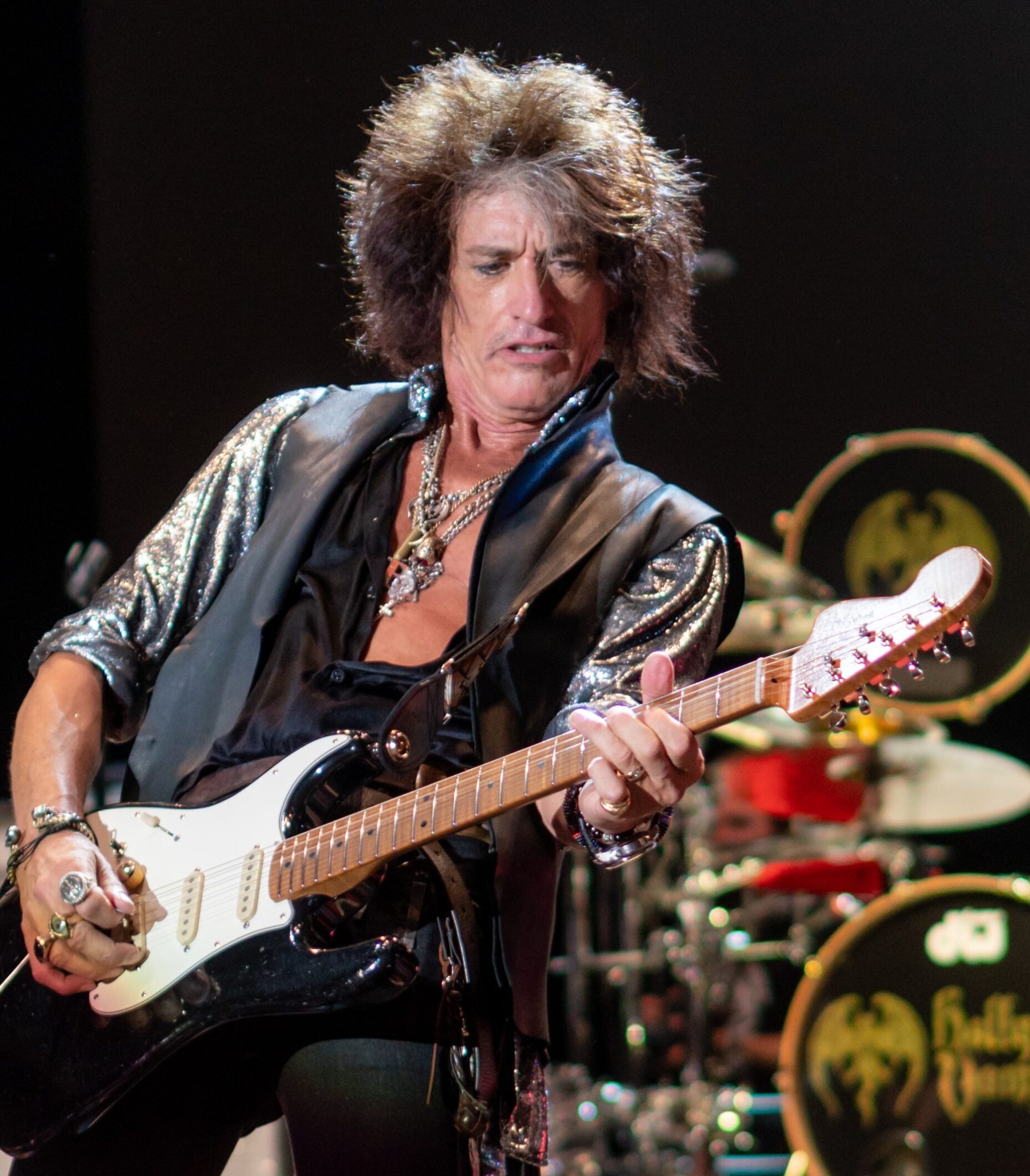
Joe Perry
Current Ranking
Joe Perry is ranked #96 of 162 guitarists on the Greatest Guitar Player leaderboard, based on our editorial score until fans weigh in. On the hard rock leaderboard, Joe Perry ranks #10 of 12. No fan votes yet, so be the first to rate Joe Perry on 8 attributes at greatestguitarplayer.com/vote.
Biography
Joe Perry, born in Massachusetts in 1950, is the lead guitarist and riff-slinging cool of Aerosmith, America's greatest hard-rock band, and one half of the songwriting and onstage partnership with singer Steven Tyler that the world came to call the Toxic Twins. Perry is the embodiment of bluesy, swaggering rock guitar, all attitude, groove, and greasy tone, the lean, dark-haired foil whose riffs gave Aerosmith its strut.
Perry's playing is rooted in the blues and in the British blues-rock of the Rolling Stones and the Yardbirds, and he brings a loose, dangerous, slightly sloppy-in-the-best-way feel to everything he plays. His riffs are the backbone of Aerosmith classics like Sweet Emotion, where his slide guitar and that famous bass-and-talkbox intro set the mood, and the band's other enduring anthems. He never overplays, favoring feel and groove over technical excess, and his swaggering, bluesy solos always serve the song's swagger.
Here is the gem with the biggest cultural ripple. Perry's instantly recognizable riff for Walk This Way did not just become an Aerosmith staple. In the mid-1980s the pioneering hip-hop group Run-DMC, with producer Rick Rubin, recorded a rap version of the song that featured Perry and Tyler themselves, and the resulting collaboration became a landmark crossover hit. It helped break down the wall between rock and hip-hop, brought both genres to new audiences, and revived Aerosmith's career at a moment when it had stalled. That single riff, reborn as a rap-rock fusion, became one of the most important records in bridging two musical worlds.
Perry's story with Aerosmith has had all the drama of a great rock saga, including a period in the late 1970s when tensions and substance abuse led him to leave the band, before a triumphant reunion and one of the great comebacks in rock history, with the band reaching even greater heights in the 1980s and 1990s. Through it all, his cool, bluesy guitar presence remained the visual and sonic heart of the group. A Rock and Roll Hall of Fame inductee, Joe Perry is the quintessential American rock guitarist, the riff machine whose greasy, swaggering style defined a band and, in one famous moment, helped two genres collide.
Legendary Performance
Aerosmith at the Texxas World Music Festival
July 1, 1978 · Cotton Bowl, Dallas, Texas
The Texxas World Music Festival of 1978, known as the Texxas Jam, drew 80,000 people to the Cotton Bowl in Dallas and served as the largest single-date audience that American hard rock had presented to that point. Aerosmith headlined, performing material from "Rocks" and "Draw the Line" at the peak of their first commercial period, and Joe Perry's dual guitar work with Brad Whitford established the sonic architecture that defined what two-guitar hard rock sounded like: the interlocking rhythm parts, the shared lead work, the sense that the two guitars were a single instrument played by two people who had learned to think simultaneously. Perry's slide guitar on "Draw the Line" and his rhythm playing on "Back in the Saddle" were the set's most discussed guitar moments.
The Texxas Jam recordings circulated among the band's following and among guitarists who recognised that Perry's approach, equal parts Keith Richards rhythm guitar and Joe Walsh lead sensibility, was something original being developed in real time. His tone, built on vintage Les Pauls through Marshalls, had the specific warmth of a player who understood that distortion was an additive to tone rather than a substitute for it. Aerosmith's late-1970s work represents Perry at his most uninhibited, before the band's subsequent dissolution and recovery, and the Texxas Jam performance is the most fully documented concert of that period.
▶ Watch on YouTubeGear
1959 Gibson Les Paul Standard "Billie" & Joe Perry Boneyard Signature (1959)
Known for: "Back in the Saddle", Rocks, 1976
Joe Perry's primary vintage guitar is a 1959 Gibson Les Paul Standard, one of the most sought-after guitar years, when Gibson's production methods produced an instrument with specific resonance and pickup characteristics that have never been precisely replicated. His Les Paul, nicknamed "Billie," has been used on Aerosmith recordings and live performances throughout his career. The 1959 Les Paul's PAF humbuckers, Patent Applied For pickups wound by hand during Gibson's pre-CNC production era, produce a warmth and harmonic complexity that subsequent machine-wound pickups approach but do not equal.
Perry collaborated with Gibson on his Boneyard series signature guitars, named for the Boneyard, his personal collection of vintage instruments, which attempt to reproduce the tonal characteristics of his vintage Les Paul in a new production instrument. The signature features aged finishes, historically accurate hardware, and hand-wound pickups calibrated to approximate the 1959 originals. He also plays vintage Stratocasters for certain recordings and live sections requiring single-coil clarity rather than humbucker warmth.
Marshall JCM 800 & Vintage Plexi
Known for: "Rocks" album tone throughout Aerosmith's classic period
Perry's amplification is built around Marshall stacks, specifically vintage Plexi-era heads for the warm, responsive breakup of the early 1970s recordings, and JCM 800 heads for higher-gain applications from the mid-1980s onward. The Marshall's interaction with a Les Paul at moderate-to-high volume produces the specific combination of warmth, sustain, and controlled distortion that defines the Aerosmith rhythm guitar sound: not the compressed saturation of a modern high-gain amplifier but the natural power-amp clipping of a pushed vintage Marshall.
His live setup over the decades has grown to include an extensive rack system, but the fundamental Marshall-Les Paul combination has remained the foundation. Perry's tone philosophy is consistent with the classic rock approach: tube amplifiers worked into natural saturation, vintage guitars with original hardware, minimal processing between the guitar and the speaker. The result is a live tone that matches the studio recordings closely enough to be immediately recognisable.
Signature Technique
Twin-Guitar Riffing & Aerosmith's Interlocking Attack
Joe Perry's primary contribution to guitar technique is not a single approach but a structural one: the interlocking two-guitar system he developed with Brad Whitford that defined Aerosmith's rhythm guitar sound. The two-guitar approach in rock typically assigns one guitarist to rhythm and one to lead; Perry and Whitford developed a method in which both players share both functions simultaneously, weaving parts that are individually incomplete but collectively self-sufficient. A Perry riff typically contains a melodic element and a rhythmic element that Whitford's part complements from a different angle, the two lines producing, in combination, a density that neither could generate alone.
His lead playing draws on the British blues tradition, Clapton-era Bluesbreakers, early Fleetwood Mac, filtered through the American hard rock that emerged from it, with slide guitar work that owes a specific debt to early Stones and Humble Pie. His tone, built on vintage Les Pauls through Marshall stacks with minimal effects, prioritises the guitar and amplifier's natural interaction over processing, the distortion is the amplifier working hard rather than a pedal simulating that condition. His slide work, particularly on slower blues-influenced material in Aerosmith's catalogue, demonstrates that his playing has a second register beyond the riff-oriented hard rock he is most associated with.