


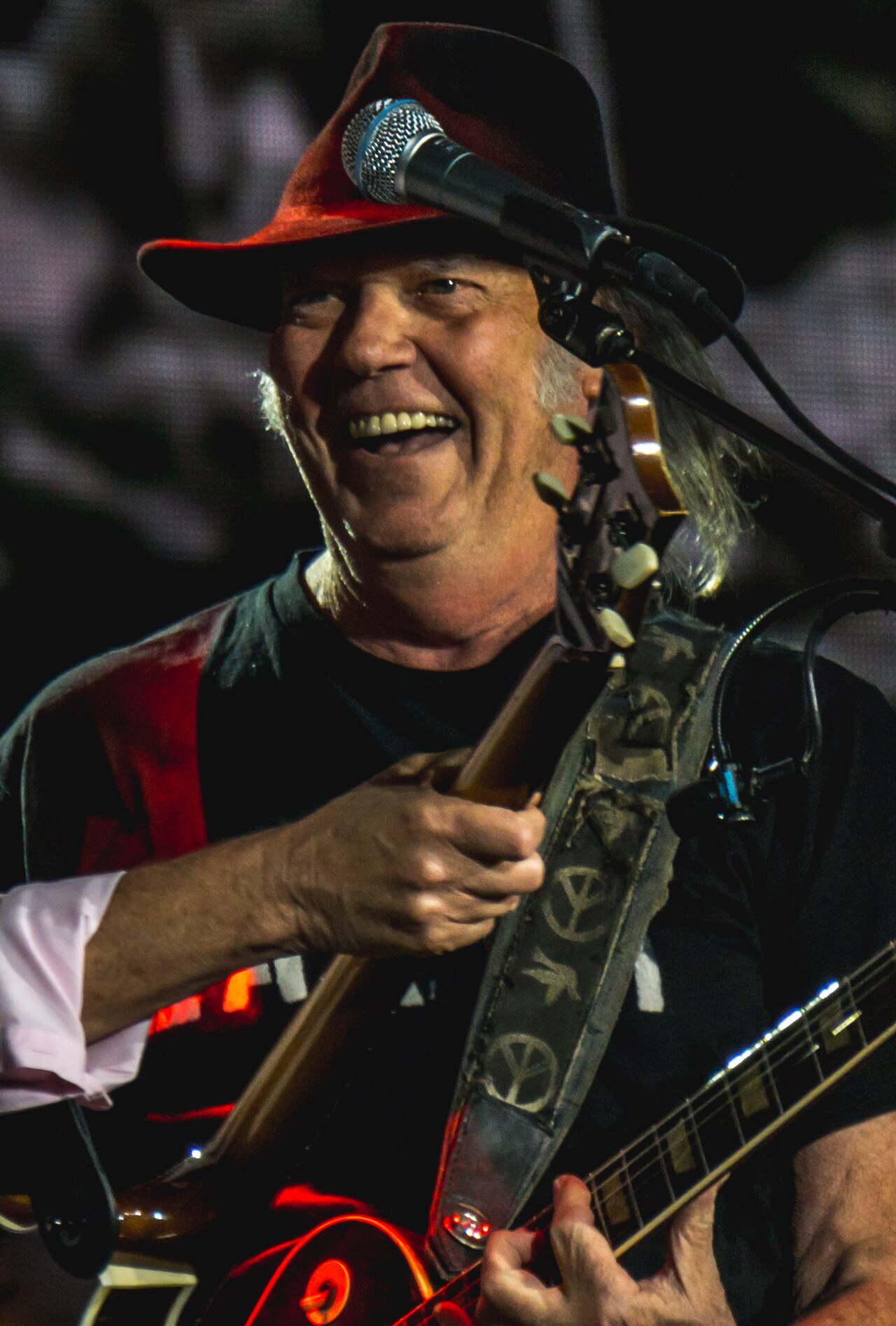

Neil Young
Current Ranking
Neil Young is ranked #63 of 162 guitarists on the Greatest Guitar Player leaderboard, based on our editorial score until fans weigh in. On the classic rock leaderboard, Neil Young ranks #12 of 18. No fan votes yet, so be the first to rate Neil Young on 8 attributes at greatestguitarplayer.com/vote.
Biography
Neil Young, born in Toronto, Canada in 1945, is one of the most influential and uncompromising guitarists in rock, a player who proved that raw emotion and feel can matter infinitely more than technical polish. Across a long and famously unpredictable career, Young has moved between fragile acoustic folk and ferocious, feedback-drenched electric rock, and in both modes his guitar playing is unmistakably, defiantly his own, valuing honesty and intensity over precision.
With his band Crazy Horse, Young creates some of the rawest, most cathartic electric guitar music ever made, long, loud, loose jams full of distortion, feedback, and emotional abandon, played on his battered Gibson Les Paul known as Old Black. His soloing is the opposite of slick. He hammers at a few notes, lets the amp howl, and plays with a primal urgency that channels pure feeling rather than showing off. This approach made him a towering influence on the alternative and grunge movements, earning him the affectionate title of the godfather of grunge from the very musicians he inspired.
Here is the gem that perfectly captures his philosophy. Young's solo on the song Cinnamon Girl is famously built around a single repeated note, a defiantly simple choice that should not work and yet is utterly riveting, all tension and release and raw feeling. He proved that one note, played with enough conviction and the right tone, could be more powerful than a hundred fast ones. That fearless minimalism is the essence of his guitar genius, the willingness to strip a solo down to its rawest emotional core and trust feeling over flash.
Young's acoustic side is just as important, producing tender, beautiful songs that reveal his gentler gifts, and his restless career has seen him follow his muse into folk, country, grunge-precursing noise, and beyond, often baffling his record label but always staying true to himself. A two-time Rock and Roll Hall of Fame inductee, he remains a fierce artistic individualist who refuses to repeat himself or play it safe. For guitarists, Neil Young is liberating proof that you do not need blazing technique to be a great and important player, that what truly matters is honesty, emotion, and the courage to make exactly the music you feel, no matter how raw.
Legendary Performance
Live at Massey Hall
January 19, 1971 · Massey Hall, Toronto, Canada
Neil Young's solo concert at Massey Hall on January 19, 1971, recorded and eventually released as a live album in 2007, is considered among the finest acoustic concert recordings in the rock canon. Young performed alone with a guitar and piano, between "After the Gold Rush" and "Harvest," at a moment when his songwriting was at its most concentrated and the performances were still intimate enough to carry the weight of the material without production amplification. The concert included "The Needle and the Damage Done," "Old Man," "Heart of Gold," and "A Man Needs a Maid," songs that were in the process of being written or recently finished, performed for the first time with the fragility of things not yet settled.
Young's guitar playing at Massey Hall is the opposite of technical display: open tunings, minimal ornamentation, fingerpicking patterns that support the voice rather than competing with it. The quality that makes the recording enduring is not the guitar playing in isolation but the way the guitar and vocal work together, each phrase left open, each resolution slightly withheld, creating the sense of something unfinished in the best possible meaning of that word. Pete Townshend, who was in the audience that night, described it as the most affecting solo concert he had ever attended. The recording, made available 36 years after the performance, confirmed that assessment for anyone who had not been there.
▶ Watch on YouTubeGear
"Old Black", 1953 Gibson Les Paul Goldtop (refinished) (1953)
Known for: "Cortez the Killer", Zuma, 1975; live with Crazy Horse throughout
"Old Black", Neil Young's primary electric guitar for over fifty years, is a 1953 Gibson Les Paul Goldtop that has been extensively modified from its original configuration. Young refinished the body in black at some point in the 1960s, hence the name; he also installed a Bigsby vibrato tailpiece and replaced the original pickups with a single Firebird-style mini-humbucker in the bridge position paired with a Gretsch FilterTron at the neck. The pickup combination is unusual, the modifications are numerous, and the guitar looks nothing like a stock 1953 Les Paul. It also sounds nothing like one.
"Old Black"'s tone, the sound on "Cowgirl in the Sand," "Like a Hurricane," and "Cortez the Killer", is the result of the specific interaction between those non-standard pickups, the aged mahogany body, and the Bigsby's effect on string tension and sustain. Young has described the guitar as having a voice of its own, a personality accumulated through decades of use, and while that description is romantically appealing rather than technically verifiable, the guitar does produce a tone that is immediately identifiable and has never been replicated despite decades of attempts.
Fender Tweed Deluxe, "Deluxe Reverb" Era
Known for: "Like a Hurricane", American Stars 'n Bars, 1977
Young has used vintage Fender tweed amplifiers, particularly Deluxe models from the late 1950s, throughout his career, running them at volumes that push the small amplifiers into the natural breakup that produces his driven lead tone. The tweed Fender at high volume produces a specific kind of distortion, warm, even-harmonic, with a compression that sustains notes without the sharpness of modern high-gain designs, that interacts with Old Black's unusual pickup configuration to produce the combined Young tone.
His system, which he calls "the horse," is a custom-built switching and routing setup that allows him to blend signal from Old Black with other guitars and effects sources in real time. The system was developed with his long-time guitar technician Larry Cragg and is complex enough that it is essentially unreproducible from description, it exists specifically to serve the way Young plays, which does not follow any conventional guitar signal-chain logic.
Signature Technique
Melodic Feedback, Open Tunings & Emotionally Driven Soloing
Neil Young's guitar technique is the most discussed case in rock music of a player whose apparent technical limitations are inseparable from his musical strengths. His lead playing, slow, repetitive, built on a small vocabulary of blues-derived bends and phrases, does not demonstrate the fluency that is normally associated with guitar virtuosity. It demonstrates something harder to categorise: a relationship between the player and the note being played that communicates emotional commitment so directly that the technical vehicle becomes irrelevant. His solos on songs like "Cowgirl in the Sand," "Like a Hurricane," and "Cortez the Killer" are extended and repetitive by design, they cycle through the same figures multiple times because Young understands that emotional meaning requires time to accumulate, not speed to demonstrate.
His feedback experiments, documented on the albums "Arc," "Weld," and various live recordings with Crazy Horse, represent a separate technical practice in which the guitar and amplifier are used as an acoustic system rather than a playback device. The feedback pitches, controlled by the guitar's position relative to the speakers, become the melodic material itself, a set of sustained tones that he shapes through movement rather than fretting. His open tunings, particularly open E and open G, extend this approach by allowing full-chord resonance from minimal left-hand input. Young's most significant technical contribution is the demonstration that emotional authority and technical virtuosity are independent variables.