
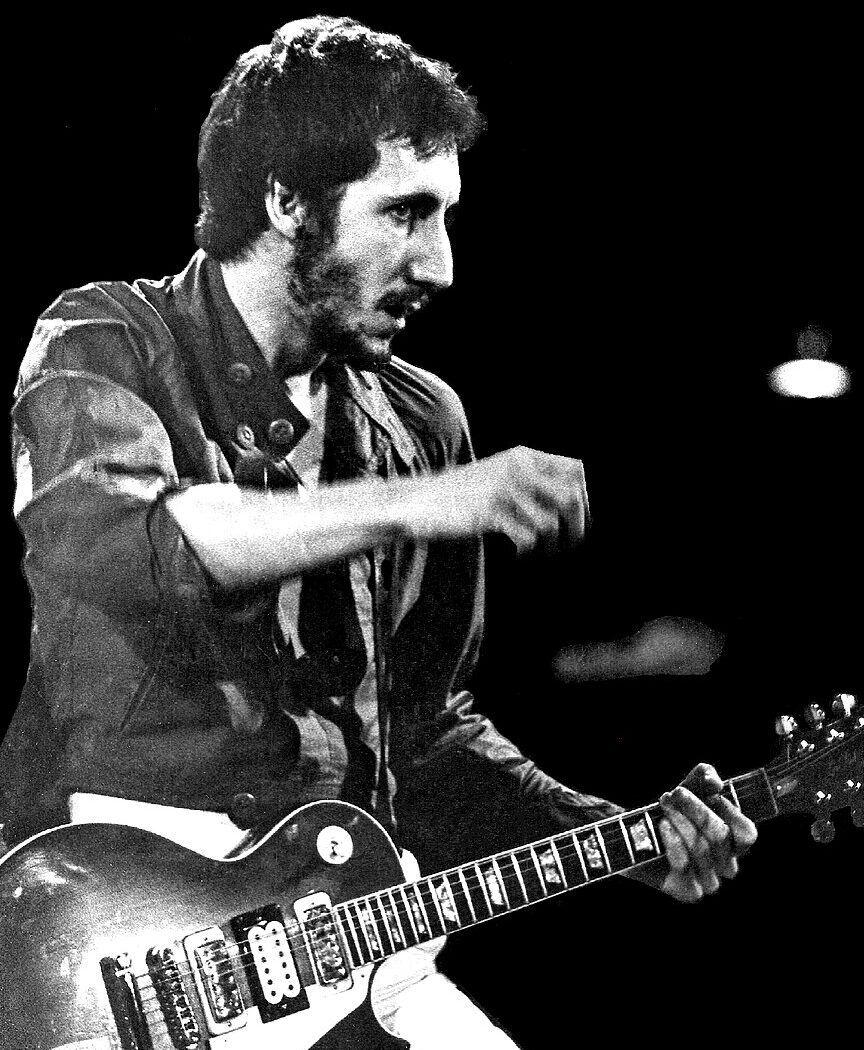

Pete Townshend
Current Ranking
Pete Townshend is ranked #8 of 162 guitarists on the Greatest Guitar Player fan leaderboard, based on 1 fan vote so far. On the classic rock leaderboard, Pete Townshend ranks #3 of 18. Agree? Rate Pete Townshend on 8 attributes at greatestguitarplayer.com/vote.
Biography
Pete Townshend, born in London in 1945, is the guitarist, primary songwriter, and conceptual mastermind of the Who, and one of the most explosive and influential figures in the history of rock guitar. More than perhaps any other player, Townshend defined the idea of the guitar as an instrument of raw power and theatrical violence, while simultaneously elevating rock to new artistic heights through ambitious, sophisticated songwriting. He is a study in thrilling contradictions, a furious showman who was also a thoughtful, even philosophical, composer.
Townshend's playing is built on power and drama rather than flashy solos. He pioneered a muscular, chord-driven rhythm style full of crashing power chords, suspended and ringing voicings, and aggressive strumming that made the Who sound enormous, with songs like My Generation, Won't Get Fooled Again, Pinball Wizard, and Baba O'Riley showcasing his command of dynamics and his early integration of synthesizers with guitar. He also helped invent the rock opera, conceiving the ambitious, full-length narrative works Tommy and Quadrophenia that proved rock could tell sweeping, serious stories.
Here is the gem, or really a pair of them, that made him an icon of rock spectacle. Townshend developed his signature windmill, swinging his right arm in a huge circular motion to crash down on the strings, a move so dramatic it became one of the most recognizable images in rock, supposedly inspired by watching Keith Richards warm up. And he became famous, even infamous, for the auto-destruction of his instruments, smashing his guitars to pieces at the end of performances in violent acts of theatrical catharsis. What began partly by accident, when he broke a guitar on a low ceiling and then leaned into the crowd's reaction, became a defining piece of performance art and influenced countless musicians who followed.
A second gem reveals the serious artist beneath the spectacle. Townshend was deeply influenced by art-school ideas about auto-destructive art, and he framed the guitar smashing not as a random tantrum but as a genuine artistic statement about energy, rebellion, and the disposable nature of pop, even as it cost him a small fortune in instruments night after night. His songwriting grappled with adolescence, identity, spirituality, and alienation with unusual depth, and his guitar always served those big ideas.
A Rock and Roll Hall of Fame inductee with the Who, Townshend remains one of rock's true visionaries, the player who fused brute force with genuine artistry. He showed the world that rock guitar could be both a weapon and a vehicle for ambitious art, smashing his instrument one moment and composing a rock opera the next, and the music has never been the same since. Few guitarists have ever combined such physical power with such conceptual ambition.
Legendary Performance
The Who at Monterey Pop, 1967
Pete Townshend's performance at Monterey Pop in June 1967 is one of the defining moments of rock guitar history. The Who played a set of controlled aggression that climaxed in the systematic destruction of Townshend's guitar, an act that by 1967 had become part of the band's theatrical language but which still stunned an audience that included the leading musicians of the era.
Before the destruction, there was the playing. Townshend wielded a Fender Stratocaster with a windmill strumming technique that generated enormous rhythmic force, his right arm sweeping in wide arcs across the strings for maximum attack. His feedback work, using the guitar's proximity to the amplifier to sustain notes electronically, turned noise into composition.
The Monterey performance established Townshend as more than a rhythm guitarist. He was a conceptualist who understood that rock music could accommodate ideas about performance, destruction, and the relationship between sound and violence. The guitar wasn't just the instrument; it was the argument.
▶ Watch on YouTubeGear
Hiwatt DR103 • Fane Speakers • Gretsch Anniversary • Fender Stratocaster • Feedback Control
Pete Townshend's gear evolved from the cheap guitars he could afford in the early 1960s to a carefully specified rig designed to produce the maximum volume and controlled feedback that his playing required. His amplification of choice from the late 1960s onward has been Hiwatt, specifically the DR103 100-watt head driving 4×12 cabinets loaded with Fane speakers.
The Hiwatt's extremely clean headroom, capable of producing enormous volume without distorting, gave Townshend's feedback technique its particular character. He could control the pitch of sustained feedback tones by adjusting his distance from the speakers, a technique he developed into a genuine compositional vocabulary on recordings like My Generation .
His guitars have included various Fender Stratocasters, Gibson SGs, and custom instruments. He is associated with a particular Gretsch Anniversary model from the early Who years, and later with a variety of Les Pauls. The guitar smashing required a steady supply of replacements, and Townshend has been pragmatic about instruments as a result.
Signature Technique
Windmill Strumming, Feedback & Power Chords
Pete Townshend's technique is built on three elements that he largely invented or significantly developed: the windmill strum, controlled feedback, and the use of power chords as the primary harmonic language of hard rock. Each of these has been absorbed so thoroughly into rock guitar vocabulary that it is now difficult to imagine the music without them.
The windmill strum, a full-arm circular motion that brings the pick into contact with the strings at the bottom of the arc, generates an impact force on the strings that no conventional strumming motion can match. It also creates a visual spectacle that Townshend understood as part of the total performance, but the musical purpose is entirely functional: it produces a harder attack and a more percussive sound.
His feedback technique, developed in the era before guitar effects units existed commercially, involved positioning the guitar at specific angles and distances from the amplifier speaker to sustain notes electronically. He could control the pitch and character of the feedback by adjusting these variables, turning what other guitarists considered noise into a compositional resource.