

_(5257559786).jpg)
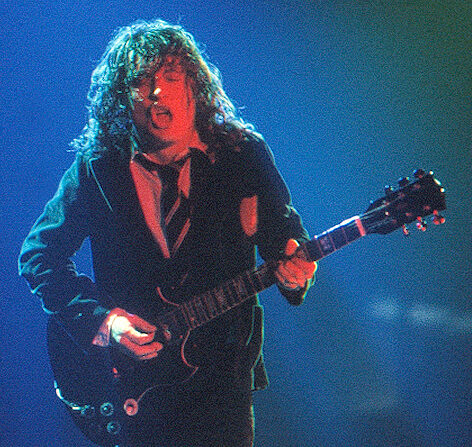
Angus Young
Current Ranking
Angus Young is ranked #26 of 162 guitarists on the Greatest Guitar Player fan leaderboard, based on 1 fan vote so far. On the hard rock leaderboard, Angus Young ranks #4 of 12. Agree? Rate Angus Young on 8 attributes at greatestguitarplayer.com/vote.
Biography
Angus Young was born in Glasgow in 1955 and emigrated with his family to Sydney, Australia as a boy, and somewhere between those two cities he became the most recognizable hard-rock guitarist on the planet, the schoolboy-suited bundle of energy who, with his brother Malcolm, built AC/DC into one of the best-selling bands in history. Where other guitar heroes of the 1970s chased complexity, Angus went the opposite way, doubling down on the raw, three-chord joy of rock and roll and playing it harder and tighter than anyone else.
His style is pure blues filtered through a Gibson SG and a wall of Marshalls, all attitude and groove and instantly hummable riffs. He never wasted a note. The catalog speaks for itself, from Whole Lotta Rosie and Highway to Hell to the all-conquering Back in Black album and later anthems like Thunderstruck and You Shook Me All Night Long. Malcolm's rock-solid rhythm guitar was the engine and Angus was the spark plug on top, and their interplay is one of the great rhythm-and-lead partnerships in rock. On stage he is a perpetual-motion machine, duck-walking across the boards, dropping to the floor mid-solo, and sweating through several costumes a night.
Which brings us to the gem. The schoolboy uniform, the single most famous costume in rock, was not Angus' idea at all. It came from his older sister Margaret, who suggested he wear his actual school clothes on stage back when he was still a teenager. The look stuck so hard that he has worn some version of it for more than fifty years, gleefully bounding around stadiums in shorts and a cap well into his sixties. There is even a long-running bit where, during Bad Boy Boogie, he strips off the uniform piece by piece.
A second gem reveals just how physical his performances are. Angus plays with such relentless, sweat-drenched intensity, running, spinning, and convulsing across enormous stages for two hours straight while soloing, that his live show is as much an athletic feat as a musical one, and he has long been known to lose pounds of water weight every night. That total, joyful commitment is a huge part of AC/DC's enduring live legend.
That blend of cartoon showmanship and absolutely no-nonsense playing is the whole secret. AC/DC songs look simple on paper, but getting them to swing and breathe and hit that hard is its own kind of mastery, and Angus has spent a lifetime proving that feel beats flash. A Rock and Roll Hall of Fame inductee, he is living evidence that you can build an immortal career on a great riff, a school cap, and the refusal to ever overthink it.
Legendary Performance
AC/DC at the Monsters of Rock
August 17, 1991 · Castle Donington, Leicestershire, England
AC/DC's headline performance at the 1991 Monsters of Rock was their first major European festival appearance following the death of vocalist Bon Scott and the subsequent departure and return of various lineup changes, and their first with Brian Johnson settled into the front man role across a full decade of touring. By 1991 the "Back in Black" and "For Those About to Rock" material had established them as one of the highest-grossing live acts in the world, and Donington, the flagship British metal festival, gave Angus Young the platform that matched the scale of what the band had become. His performance that day, in his school uniform and beneath the stage cannon fire that punctuated "For Those About to Rock," was the most widely seen demonstration to a European audience of what AC/DC's live performance entailed.
Young's guitar playing in this context is performance as much as music, the duck walk, the headbanging, the apparent physical abandonment to the riff, but the playing itself is precise enough to sustain all of it without loss of musical integrity. His Gibson SG, run directly into modified Marshall amplifiers with no effects between them, produces the sound that has defined AC/DC for five decades: the mid-forward crunch of a humbucker through a British power amp at the edge of breakup, simple enough to be understood immediately by any listener and difficult enough to replicate authentically that no other band has successfully reproduced it.
▶ Watch on YouTubeGear
Gibson SG Standard (1968-present)
Known for: "Highway to Hell", "Back in Black", "Thunderstruck"
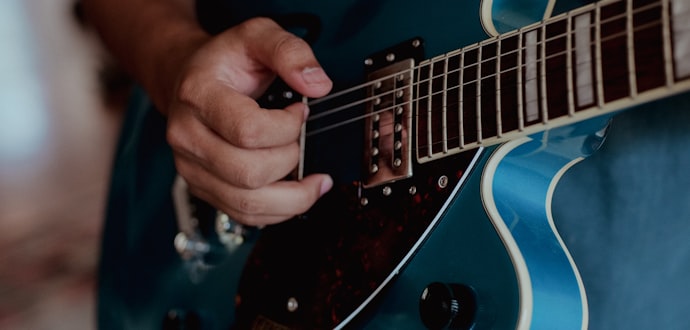
Angus Young has played Gibson SG guitars, and only Gibson SG guitars, throughout his entire career with AC/DC, a commitment to a single model over five decades that is without parallel in rock music. The SG's double-cutaway body gives full access to the upper frets; its relatively light weight compared to a Les Paul makes the physical performance style, the duck walk, the headbanging, the crawling across the stage, physically sustainable over a two-hour show. The twin humbucker configuration provides the output level his playing requires without the neck-heavy balance problems that make other guitars impractical for the degree of movement his performances involve.
His primary SG through most of AC/DC's career has been a 1968 model, acquired early in the band's formation and maintained by his guitar technician to an exacting standard. Gibson has produced multiple Angus Young signature models over the years, including the Custom Shop versions that reproduce the specifications of his primary instrument, but the original remains his preference for performances where reliability is paramount.
Marshall 1959 Super Lead 100W (Modified)
Known for: Defining AC/DC's live guitar sound across five decades
Young's amplification is as consistent as his guitar choice: modified Marshall Super Lead 100-watt heads through 4×12 cabinets, run at volumes that push the power amp into natural saturation. The modification to the standard Marshall circuit, performed by his long-running guitar technician, adjusts the gain staging to produce the specific midrange crunch that defines the AC/DC guitar sound: not the dark, heavy distortion of many metal amplifiers but a forward, cutting overdrive that projects clearly at large-scale outdoor volumes.
His live signal chain between the guitar and the amplifier is essentially empty, no effects pedals, no rack processing, no modulation. The guitar goes directly into the Marshall. This is not minimalism as aesthetic but minimalism as conviction: Young's view is that the guitar and the amplifier are the instrument, and that anything between them is interference with the music.
Signature Technique
High-Voltage Pentatonic & Rhythmic Chug
Angus Young stripped the electric guitar down to its most irreducible elements: minor pentatonic scale, raw tube-driven tone, maximum physical commitment. His solos operate almost exclusively within the minor pentatonic box, but the rhythmic placement, the pick attack, and the intensity of the vibrato are so consistent and so extreme that the limitation becomes an identity. Where technically trained players seek complexity, Angus seeks impact, every note lands like it matters, and the cumulative energy of a solo builds not through harmonic motion but through sheer persistence and forward momentum. He is the antithesis of the virtuoso tradition, and he is just as irreplaceable.
His rhythm work is equally foundational. The AC/DC "chug", a tightly palm-muted, syncopated strum on power chords that defines hard rock rhythm guitar, is his invention as much as anyone's. The riff to "Highway to Hell," the intro to "Back in Black," "Thunderstruck": these are among the most recognised guitar phrases in popular music, and none of them are harmonically complex. What they are is rhythmically precise, tonally enormous, and executed with a conviction that communicates urgency regardless of what language the listener speaks. Chuck Berry taught him the vocabulary; Angus turned the volume up until it shook the room.