


Steve Lukather
Current Ranking
Steve Lukather is ranked #83 of 162 guitarists on the Greatest Guitar Player leaderboard, based on our editorial score until fans weigh in. On the hard rock leaderboard, Steve Lukather ranks #9 of 12. No fan votes yet, so be the first to rate Steve Lukather on 8 attributes at greatestguitarplayer.com/vote.
Biography
Steve Lukather, born in California in 1957, is one of the most recorded and respected guitarists in the history of popular music, a virtuoso whose playing has appeared on an almost unbelievable number of hit records, even as he became a star in his own right with the band Toto. Known affectionately as Luke, he combines blistering technique, impeccable taste, and a warm, singing tone, making him both a guitar hero and the ultimate professional session musician.
As a founding member of Toto, Lukather co-wrote and played on massive hits like Rosanna, Africa, and Hold the Line, his fluid, melodic guitar work and rich harmonies central to the band's polished, sophisticated sound. But Toto was only part of his story. During the late 1970s and 1980s, Lukather was one of the busiest and most in-demand session guitarists in Los Angeles, lending his playing to a staggering range of artists and records across pop, rock, and beyond.
Here is the gem that shows just how ubiquitous he was. Lukather played guitar on Michael Jackson's Thriller, the best-selling album of all time, contributing to its tracks, and that is just one entry on a session resume that includes hundreds upon hundreds of records by an astonishing roster of stars. For a stretch of years, it was nearly impossible to listen to mainstream radio without hearing his guitar on something, whether or not his name was on the cover. That kind of invisible ubiquity, being the trusted hands behind countless famous recordings, is a mark of the very highest level of professional musicianship.
Lukather's playing balances flashy, virtuosic capability with genuine restraint and song-serving taste, which is exactly why so many producers and artists called him for sessions. He could rip a dazzling solo when needed or lay down the perfect understated part, always with flawless tone and feel. He has toured the world, including stints with Ringo Starr's All-Starr Band, and continued leading Toto across decades. A guitarist's guitarist admired by his peers for both his chops and his professionalism, Steve Lukather represents the pinnacle of versatile, reliable, world-class musicianship. He is living proof that some of the most important guitar playing in pop history was done by a master who could shine in the spotlight with Toto and then vanish into the background to make countless other artists sound their best.
Legendary Performance
"Rosanna", Toto Live in Amsterdam
November 25, 2003 · Heineken Music Hall, Amsterdam, Netherlands
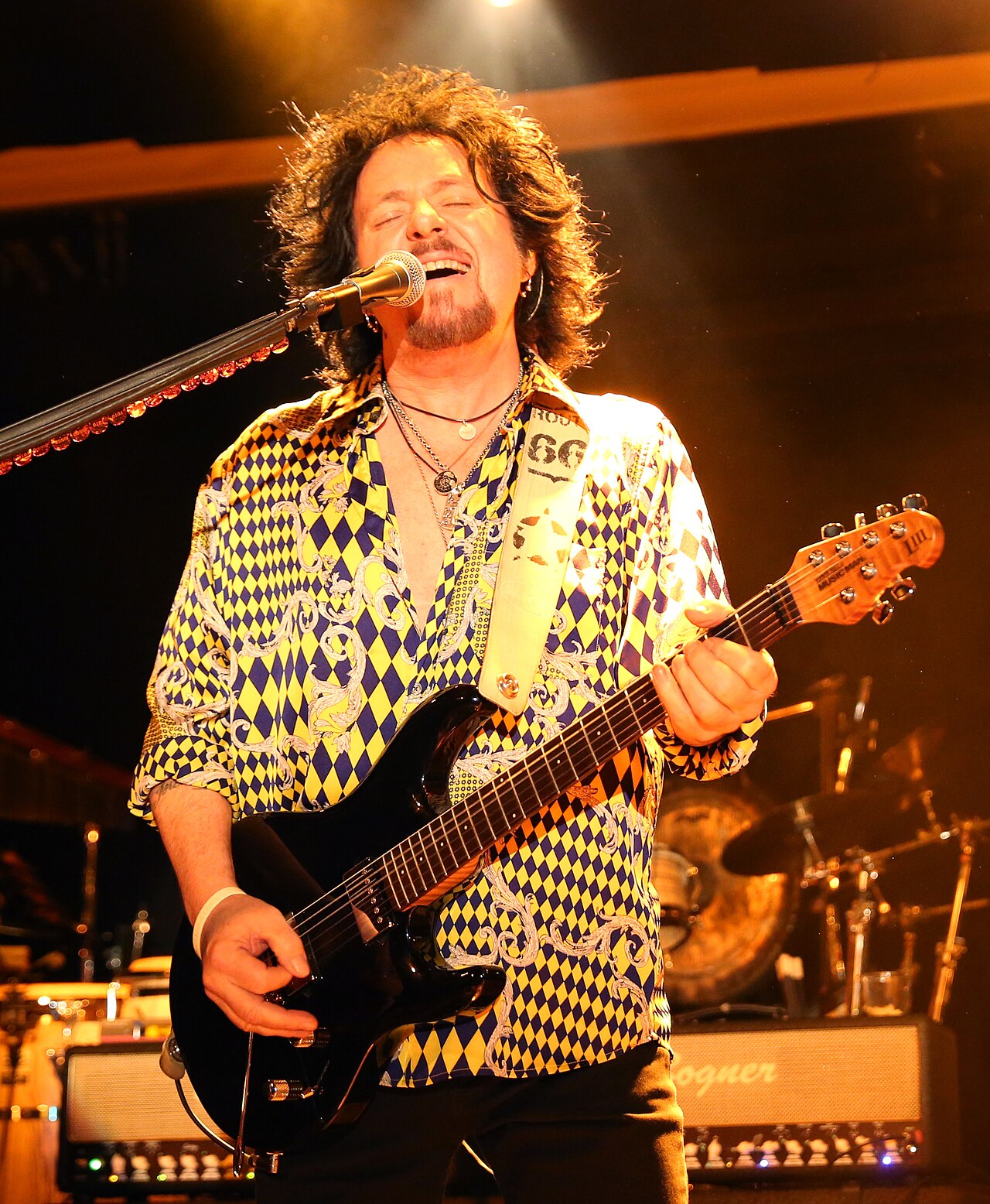
By the time Toto took the stage at the Heineken Music Hall in Amsterdam on November 25, 2003 for their 25th-anniversary concert, the band had spent a quarter-century refining the material from their catalog into some of the most polished and ferocious live performances in rock. The show was recorded in full and released as the Live in Amsterdam DVD and CD, and the version of Rosanna performed that night is widely cited by guitarists as one of Steve Lukather's finest documented solo performances. The original studio solo had already become a teaching standard, but the Amsterdam version stretched it out, building from the original melodic statements into extended passages that displayed his full vocabulary: hybrid-picked sixteenth-note runs, harmonics punctuating the long sustained bends, and the kind of vocal-imitating phrasing that few players of his speed bother to learn.
What made the performance historically significant was its demonstration of what a session-bred rock guitarist could accomplish on a stage in front of thousands without losing the discipline of studio-tight performance. Lukather's tone that night came from his signature Music Man Luke model running into a Bogner amplifier, and the lead lines locked seamlessly into the half-time shuffle groove that drummer Simon Phillips inherited from Jeff Porcaro (who had died in 1992). The Amsterdam recording introduced a generation of younger players to Lukather's mature style and stands as a definitive document of how a band that had spent twenty-five years playing the same songs together could still find new harmonic and dynamic territory inside material the audience knew note for note. It is the kind of performance that rewards repeated listening because the depth of musical conversation between the players reveals itself only after multiple passes.
▶ Watch on YouTubeGear
Music Man Luke Signature Series (First introduced 1993, current Luke III in production)
Known for: Lukather's primary touring and recording guitar since the early 1990s
Steve Lukather's relationship with Ernie Ball Music Man produced one of the most successful signature guitar partnerships in modern electric guitar. The original Luke model debuted in 1993, developed in close collaboration with Lukather and Music Man's design team to combine the playing feel of a vintage Stratocaster with the modern features (high-output pickups, locking tremolo options, slightly wider frets) that a session player and arena-rock soloist needed. Earlier in his career Lukather had used a variety of modified Fender Stratocasters and Valley Arts custom instruments, but the Luke series became his consistent voice once it arrived, and successive revisions (Luke II in 2006, Luke III in 2018) have refined the design without changing its essential character.
The Luke models use DiMarzio Transition pickups designed specifically with Lukather, voiced for the long sustained singing tone he favors for lead work while retaining enough clarity and responsiveness for rhythm and clean playing. The instrument's roasted-maple neck and compound-radius fretboard support the speed and string-bending demands of his style, and the Music Man tremolo unit returns reliably to pitch even after the deep vibrato dives that are part of his sonic signature. The Luke model has been adopted by many players outside Lukather's immediate orbit, a testament to how well the design solved the problem of marrying classic Stratocaster ergonomics to the demands of a working professional guitarist in any genre.
Bogner Ecstasy and Bogner Shiva
Known for: Lukather's primary touring amplification since the late 1990s
Lukather's amp choices over the years have included Mesa Boogie and Marshall in his earlier career, but for the past two decades his primary touring rig has centered on Bogner amplifiers, particularly the Ecstasy and the smaller Shiva. Both designs offer the high-headroom, articulate, harmonically rich overdrive that suits his hybrid-picked lead style, and the Ecstasy in particular gives him the cathedral-like sustain that makes his held notes seem to hang in the air for ages. Reinhold Bogner's amplifier designs are known among session-level players for their consistency and touch sensitivity, both qualities Lukather requires from a rig that has to track every dynamic move he makes.
On record and in the studio Lukather frequently runs multiple amps in parallel, blending different voicings to create the dimensional lead tones heard on his solo records and Toto's later catalog. The clean channel of the Bogner is often used for arpeggiated passages and harmony-rich rhythm parts, while the overdriven channels handle his lead voice. He is also known for using analog and digital reverb generously, often through a wet-dry-wet setup that places the reverberant signal in stereo behind a dry-centered direct guitar signal, producing the spacious lead tone that has been one of his sonic trademarks since the 1980s.
TC Electronic G-System, Custom Effects Rack
Lukather was an early and influential adopter of rack-based effects processing in the 1980s, running systems built around Eventide harmonizers, Lexicon reverbs, and TC Electronic chorus and delay units. The trademark chorused, shimmery clean tone heard on Toto's slower ballads and intros of that era was built from these rack effects, and his approach to using them as voicing tools (rather than special-effects novelties) influenced an entire generation of arena and studio guitarists.
In the modern era he has streamlined to a more compact rig built around the TC Electronic G-System, a programmable floor unit that combines delay, modulation, reverb, and switching in a single integrated package. The unit lets him recall the complex multi-effect presets needed for Toto's catalog with a single footswitch press while keeping the front end of his signal chain (guitar straight into the Bogner's input) clean and uncolored. He typically uses delay and modulation for textural enhancement on lead lines rather than as obvious effects, and his approach demonstrates how a player can use rack-class processing without sacrificing the immediacy and feel that come from a guitar plugged straight into a great amplifier.
Signature Technique
Hybrid Picking, Melodic Sustain, and the Studio Mind
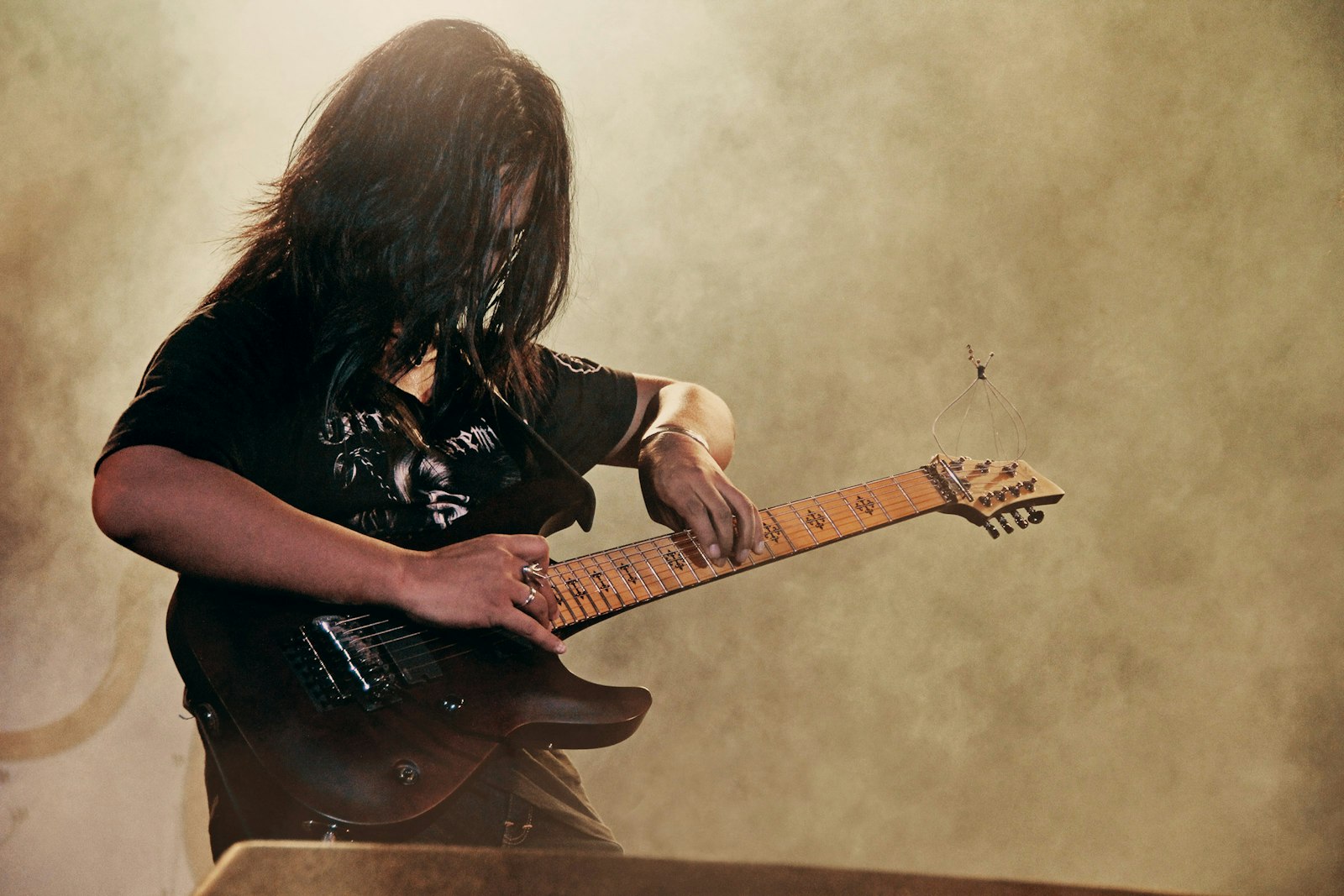
Steve Lukather's technique is built on a foundation of hybrid picking, the technique of using a flatpick in combination with the middle and ring fingers of the picking hand to play patterns that would be impossible with the pick alone. This approach, common among country and jazz players but less so among rock guitarists of his generation, allows him to play wide interval leaps, complex chord-melody passages, and rapid arpeggios with a fluency that has become one of his most recognizable traits. Listening closely to the Rosanna solo or to almost any of his studio-era lead lines reveals the technique at work: notes that cannot have come from a single pick stroke arrive cleanly articulated, and the right hand maintains pick-stroke tightness on the down beats while the fingers handle the upper-string leaps.
His melodic phrasing is informed by his decades of session work, where he was required to construct solos that supported the song rather than competing with it. The result is a soloing voice that treats each phrase as a complete musical statement with a beginning, middle, and end, rather than as a string of pyrotechnic licks. He uses controlled vibrato (slower and wider than many of his peers), and his bends almost always land precisely in tune. The long sustained notes for which he is famous are not just a function of his amp rig; they are a phrasing choice, the result of letting a note breathe before resolving rather than rushing to the next idea.
His use of harmonics is equally distinctive. Pinch harmonics punctuate his rock lead lines, but he also makes frequent use of natural harmonics played at the fifth, seventh, and twelfth frets, often combined with hammer-ons and pull-offs to produce cascading bell-like figures. The technique appears prominently in his solo records and in the more atmospheric Toto material, and it is a hallmark of his harmonic approach: even the flashy moments come from a fundamentally compositional mind.
Perhaps his most underappreciated quality is the studio discipline he brings to live performance. Lukather treats every solo as if it were going onto a master tape, meaning he thinks about how the lead line will sit in the mix, how it interacts with the vocal melody, and how it serves the song's emotional arc. This discipline (honed over thousands of session dates where engineers and producers expected first-take perfection) is what allows his playing to sound effortless and song-serving even at his most virtuosic. It is also why he remains one of the most sought-after teachers and clinicians in contemporary guitar pedagogy: the technique is teachable, but the musical taste behind it is what students actually come to absorb.