









Annie Clark (St. Vincent)
Current Ranking
Annie Clark (St. Vincent) is ranked #91 of 162 guitarists on the Greatest Guitar Player leaderboard, based on our editorial score until fans weigh in. On the punk, grunge and alternative leaderboard, Annie Clark (St. Vincent) ranks #7 of 17. No fan votes yet, so be the first to rate Annie Clark (St. Vincent) on 8 attributes at greatestguitarplayer.com/vote.
Biography
Annie Clark, born in Tulsa, Oklahoma in 1982 and raised in Dallas, is the art-rock auteur known as St. Vincent, and one of the most genuinely inventive guitarists to emerge in the twenty-first century. She briefly attended Berklee, dropped out, and paid her early dues on the road as a member of the sprawling collective the Polyphonic Spree and in Sufjan Stevens' touring band before stepping out on her own and rewriting what a guitar could do inside a pop song.
Clark does not play guitar like a traditional rock soloist. She treats the instrument like a sound-design tool, coaxing out jagged, glitchy, almost violent tones, then dropping them into lush orchestral arrangements so the contrast does the talking. Her solos can sound like a malfunctioning machine in the best possible way, sharp and angular and unpredictable. Across albums like Strange Mercy, the self-titled St. Vincent, Masseduction, and Daddy's Home she has won Grammy recognition, including Best Alternative Music Album, while never repeating herself or settling into a comfortable lane.
Here is the gem for gear lovers: frustrated that so many classic guitars were heavy, awkwardly balanced, and clearly designed for a different body, Clark designed her own. Her Ernie Ball Music Man St. Vincent signature model is one of the rare production guitars conceived by a woman, light and ergonomically contoured, with cutaways she has joked were shaped to leave room for a breast. It was a quietly radical statement, the idea that the instrument should fit the player rather than the other way around, and it became a genuinely popular guitar far beyond her own fan base.
There is a second gem hiding in her family tree. St. Vincent is the niece of the virtuoso jazz guitarist Tuck Andress, of the duo Tuck and Patti, and as a teenager she worked for them on tour, soaking up serious guitar craft from the inside long before she made it weird and wonderful on her own terms. That mix of deep traditional grounding and fearless experimentation is the whole St. Vincent story, a player who knows exactly what the rules are and breaks them on purpose.
Legendary Performance
Live at Pitchfork Music Festival
By 2012 Annie Clark had established herself as one of the most genuinely original guitarists in contemporary music, and her Pitchfork Music Festival performance that summer demonstrated why. Armed with a custom Ernie Ball Music Man signature guitar and an effects rig of considerable complexity, she delivered a set that moved between the theatrical precision of her studio recordings and an improvisational ferocity that those recordings only implied. Her guitar work throughout was simultaneously architectural and visceral, constructing dense layers of processed sound that surrounded her vocals before dissolving into passages of controlled noise that recalled Sonic Youth's most extreme experiments while remaining melodically coherent.
What made the performance definitive was the physicality Clark brought to playing that is often described in purely cerebral terms. Her stage presence, the controlled aggression with which she attacked her guitar, the precision of the transitions between pristine clean tones and abrasive distortion, made clear that the intellectual framework of her music was inhabited by genuine emotional urgency. The festival circuit that summer introduced her guitar playing to audiences who knew her voice, and established St. Vincent as a live force whose guitar work was not an accessory to the songs but their structural foundation.
▶ Watch on YouTubeGear
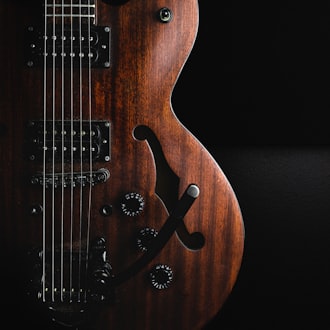
Ernie Ball Music Man St. Vincent Signature
Annie Clark's signature Ernie Ball Music Man guitar, developed collaboratively with the company over several years, is one of the most distinctive instrument designs in contemporary guitar. Its compact, slightly offset body, designed to accommodate her smaller frame without sacrificing tonal depth, is paired with a 24-fret neck, a hardtail bridge for maximum sustain and tuning stability, and a pickup configuration that moves between pristine clean tones and the harmonically saturated lead sound she uses for her more abrasive passages. The guitar's visual design, which has gone through several striking finish variations, reflects the same aesthetic intelligence she brings to every aspect of her artistic presentation.
Mesa/Boogie & Fender Twin Reverb
Clark uses a combination of amplification depending on the sonic requirement of a given passage: a Mesa/Boogie provides the gain and compression needed for her heavier, more distorted material, while a Fender Twin Reverb delivers the crystalline clean foundation over which her effects processing creates textural complexity. The combination allows her to move between the two tonal poles that define her music, the pristine and the abrasive, within a single performance, without compromising either extreme.
Extensive Modular Effects System
St. Vincent's effects rig is among the most sophisticated in contemporary rock, incorporating a modular processing system that allows real-time manipulation of guitar tone beyond what conventional pedal chains permit. Pitch shifting, heavy reverb, octave effects, and carefully calibrated distortion units combine to create the sonic environments that characterise her recordings. The complexity of the rig reflects her fundamental approach to the guitar as a sound-design instrument rather than simply a melodic or harmonic voice.
Signature Technique
Signature Technique
Annie Clark's guitar technique is one of the most genuinely original in contemporary music, built on a foundation of precise technical control deployed in service of tonal extremes that most guitarists treat as mutually exclusive. She moves between crystalline clean chord voicings and abrasive, feedback-saturated noise within a single song with a control that suggests the two registers are not opposites but points on a continuous spectrum that her playing navigates with the same fluency a jazz player brings to moving between major and minor tonality. Her technique is simultaneously the most disciplined and the most violent in contemporary indie rock, a combination that defines the St. Vincent sound as clearly as any production choice.
Clark's harmonic language extends well beyond the power chords and minor pentatonic scales that dominate guitar-based rock. She uses jazz-influenced chord voicings, dominant sevenths, major sevenths, altered chords, in rock contexts, creating harmonic richness that distinguishes her arrangements from those of her contemporaries. Her chord choices frequently create unresolved tension within verse sections that the chorus resolves, a compositional technique borrowed from classical and jazz practice and applied within pop song structures. The precision of her voicings reflects significant formal musical knowledge applied to an instrument and genre that rarely require it.
St. Vincent's use of guitar noise, feedback, harmonics, controlled distortion, is as carefully crafted as her melodic playing, treating sonic disruption not as accident but as compositional material. Her ability to sustain feedback at specific pitches, to sculpt its harmonic content through pick position and amplifier distance, and to integrate noise passages into songs that also contain pristine melodic content demonstrates technical control over the least controllable aspect of electric guitar playing. This technique, developed through extensive experimentation with effects and amplifier settings, gives her live performances their characteristic quality of danger coexisting with precision.