
.jpg)
_(cropped).jpg)
Matt Bellamy
Current Ranking
Matt Bellamy is ranked #62 of 162 guitarists on the Greatest Guitar Player leaderboard, based on our editorial score until fans weigh in. On the punk, grunge and alternative leaderboard, Matt Bellamy ranks #3 of 17. No fan votes yet, so be the first to rate Matt Bellamy on 8 attributes at greatestguitarplayer.com/vote.
Biography
Matt Bellamy is the singer, guitarist, pianist and chief architect of Muse, the Devon trio that took the drama of classical music, the weight of heavy riffs and the paranoia of a sci-fi paperback and built one of the biggest live rock bands of the century out of them. He was born June 9, 1978, in Cambridge and grew up in the seaside town of Teignmouth, and music was already in the family. His father, George Bellamy, played rhythm guitar in The Tornados, whose 1962 instrumental "Telstar" became the first American number one by a British group. Matt started piano at six, picked up the guitar at eleven, and played his first public show at Teignmouth Community School in 1991.
At school he found drummer Dominic Howard and bassist Chris Wolstenholme, and the three cycled through names like Gothic Plague and Rocket Baby Dolls before winning a local battle of the bands in 1994 and settling on Muse. Showbiz arrived in 1999 and drew lazy Radiohead comparisons, but Origin of Symmetry (2001) blew those apart with "Plug In Baby," "New Born" and "Bliss," a storm of fuzz, arpeggios and falsetto that sounded like nobody else. Absolution (2003) gave the band its first UK number one, and the records only got bigger and stranger from there: Black Holes and Revelations, The Resistance, The 2nd Law, Drones and Simulation Theory, with Grammys for Best Rock Album going to The Resistance and Drones. In January 2010 Total Guitar named him its Guitarist of the Decade.
His guitars are as much a signature as his voice. Since the early 2000s he has worked with Hugh Manson's workshop in Devon on custom instruments packed with things no factory would fit, including built-in Fuzz Factory circuits, Sustainiac pickups and touch-sensitive pads wired to a Korg Kaoss Pad, so he can sweep filters and glitches with a fingertip in the middle of a solo. He liked the partnership so much that in 2019 he bought a majority stake in Manson Guitar Works. He has also been famously hard on the merchandise: on the 2004 Absolution tour he smashed 140 guitars, which Guinness World Records listed as the most guitars smashed on a single tour.
Here is the gem: Jeff Buckley's Grace was the record that convinced a teenage Bellamy a rock singer could live up in falsetto, and in 2020 he bought the Fender Telecaster Buckley used to make that album, then put it to work on sessions for The Jaded Hearts Club, the covers supergroup where he happily plays bass. He has named Jimi Hendrix and Kurt Cobain for their sense of chaos, Spanish and Latin guitar for its fire, and Rachmaninoff for the sweep of it all. He also pays it forward, and in 2021 he sent shredder Sophie Lloyd one of his Manson guitars, which she used for a "Plug In Baby" cover on the song's 20th anniversary. Two decades in, with Will of the People (2022) filling arenas and stadiums, he is still the rare frontman whose guitar parts are as big a draw as the songs.
Legendary Performance
HAARP, Wembley Stadium
June 16 and 17, 2007 · Wembley Stadium, London
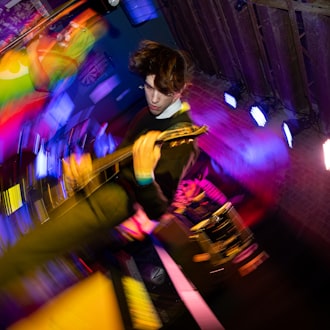
By the summer of 2007 Muse had grown from a cult band that kept getting compared to Radiohead into a full stadium act, and the proof came on June 16 and 17, 2007, when they headlined two nights at the newly rebuilt Wembley Stadium in London. Both shows sold out, roughly 90,000 people a night, and the band dressed the stage as a replica of the HAARP research station in Alaska, all antenna arrays, satellite dishes and cabling, a fitting set for a band whose lyrics leaned on conspiracy and the end of the world. Men in yellow hazmat suits walked out during the intro, the band hit the stage to Prokofiev's "Dance of the Knights," and support came from The Streets, Dirty Pretty Things and Rodrigo y Gabriela.
What made it legendary was how Bellamy's guitar held a show that size together. "Knights of Cydonia" came early, its galloping Morricone-style riff and trumpet-like lead turning the stadium into one big western, and the set ran through "Hysteria," "Supermassive Black Hole," "Map of the Problematique," "Citizen Erased" and "New Born," every one built on a riff instead of a light show. Fans still talk about "Man of Mystery," the old Shadows instrumental, played by the son of a 1960s instrumental-band guitarist. During "Blackout," trapeze artists hung from giant balloons floating over the crowd, and during "Plug In Baby" more balloons bounced across the floor while 90,000 people sang that arpeggio riff back at him.
The two nights were filmed and recorded for HAARP, the CD and DVD released in March 2008, which captured the moment Muse stopped being a big band and became an event. It also cemented the idea that a three-piece could fill the biggest stage in Britain without a second guitarist, with Bellamy switching between riffs, piano and Kaoss-pad noise while singing in a falsetto that never cracked.
▶ Watch on YouTubeGear
Manson custom guitars with built-in Kaoss Pad and Fuzz Factory (2001)
Known for: Origin of Symmetry onward, the touchpad glitches of the Absolution and Black Holes tours
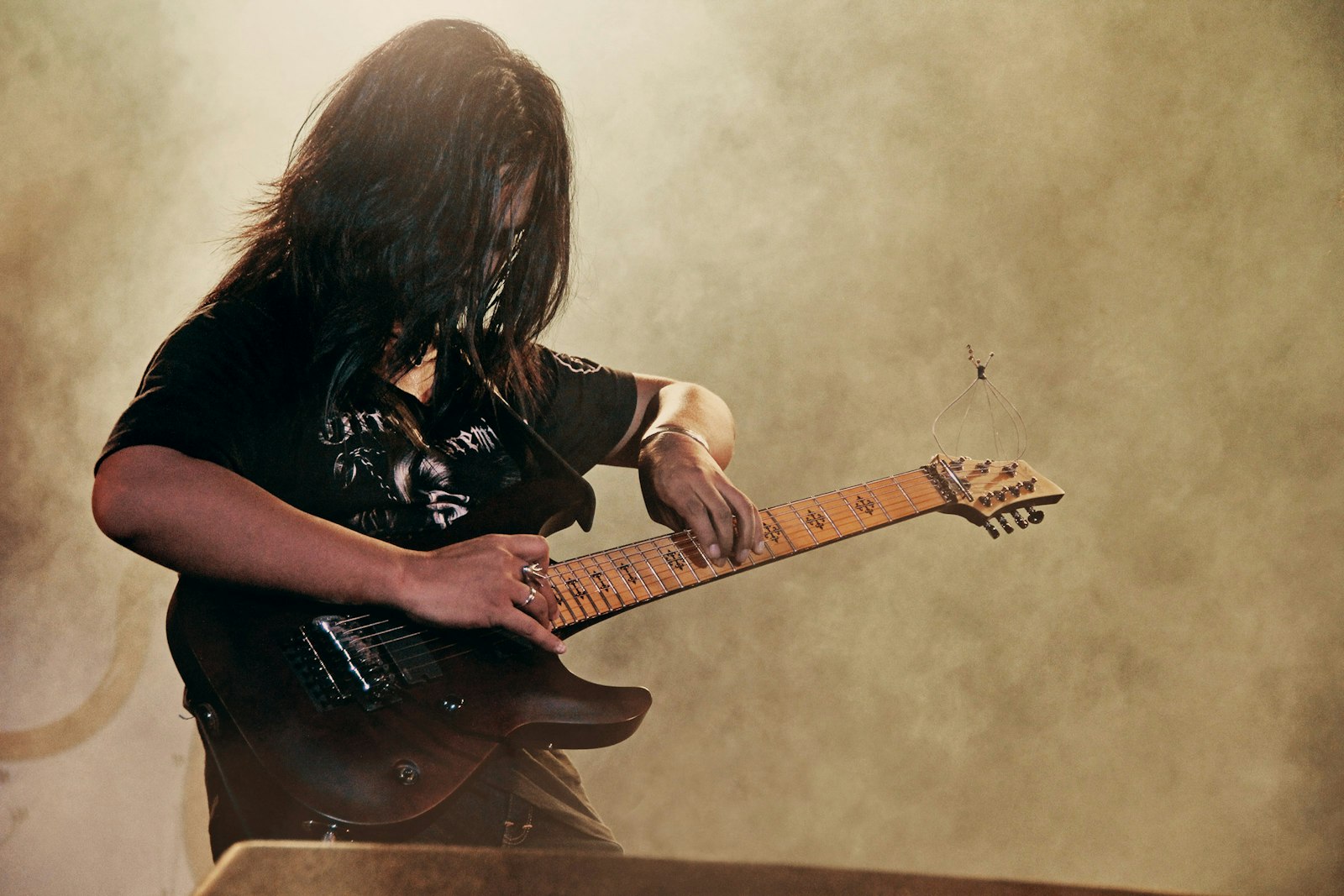
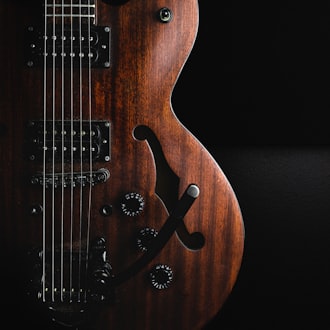
Bellamy's main guitars come from Manson Guitar Works, the small Devon workshop founded by Hugh Manson, who had already built instruments for Led Zeppelin's John Paul Jones. Starting around the Origin of Symmetry era, the two developed a run of one-off guitars that work more like instruments from the future than tweaked Stratocasters: sleek, often mirror-finished bodies with a Fuzz Factory circuit built right into the guitar, a Sustainiac pickup for endless notes, and, most famously, an X/Y touchpad on the body that controls a Korg Kaoss Pad, so he can pull filter sweeps, glitches and stutters out of the guitar with one finger while his picking hand keeps going.
The point was never decoration. Bellamy has described wanting a guitar that would push him toward 21st-century music, and the onboard electronics let a trio make the kind of noise that would otherwise need a second guitarist or a laptop. Those ideas later went into the production MB-1 signature model, and in 2019 he bought a majority stake in the company, steering Manson toward new instruments and pedals, including a guitar with a Whammy built in.
Diezel VH4
Known for: tight, articulate high gain for a power-trio stadium rig
For much of Muse's career the backbone of Bellamy's live rig has been Diezel heads, the German VH4 in particular, a four-channel amp that goes from glassy clean to a tight, saturated roar. The amp suits his playing because the heavy lifting on fuzz and texture happens in the guitar, so the head's job is to stay focused and articulate under all that gain, keeping arpeggios like "Plug In Baby" defined in a stadium instead of turning to mush.
Running a trio means the guitar has to cover a lot of sonic ground, and the Diezel's headroom and low-end punch let one rig carry riffs, solos and the walls of noise that fill the space a second guitarist would normally take.
Z.Vex Fuzz Factory, DigiTech Whammy, Korg Kaoss Pad
Fuzz is the heart of the Bellamy sound, and the Z.Vex Fuzz Factory is the one he leans on most, either as a pedal or wired directly into his Manson guitars. Its gating and squeal controls give him the sputtering, velcro-like distortion and runaway oscillation that turn up all over Origin of Symmetry and Absolution. Add a DigiTech Whammy for octave jumps and dive-bombing pitch effects, and the Kaoss Pad touch controller for filter sweeps and glitch textures, and you have a signal chain built less for subtle tone than for making a guitar sound like it is short-circuiting on purpose.
Signature Technique
Classical Arpeggios, Fuzz Chaos and Spaghetti Western Drama
Matt Bellamy plays guitar like a classically trained pianist who discovered fuzz pedals, which is close to the truth. His riffs are often broken-chord arpeggios in minor keys, the left hand walking through harmonic-minor shapes while the right hand picks fast, even notes. "Plug In Baby" is the textbook case, a winding arpeggio riff often compared to Bach's Toccata and Fugue in D minor, and "New Born" opens with a delicate piano figure before slamming into a fuzz riff. Rachmaninoff runs through his piano parts too, most famously the romantic piano break in "Butterflies and Hurricanes."
His picking hand is a big part of the drama. He uses fast tremolo picking and alternate picking to keep riffs like "Stockholm Syndrome" and "Hysteria" relentless, then switches to Spanish-flavored lines and flamenco-style strumming on songs like "Hoodoo," and to a galloping, Ennio Morricone-inspired spaghetti western feel on "Knights of Cydonia." Live, Muse often sets that song up with a jam on Morricone's "Man with a Harmonica."
The third ingredient is noise used as music. Bellamy treats the Fuzz Factory, the Whammy and the Kaoss Pad touchpad as part of his technique, riding the fuzz's gate and oscillation, jumping octaves with the Whammy, and sweeping the touchpad with his fretting hand for glitchy stutters that a sampler would usually provide. Solos often build like classical cadenzas, with fast scalar runs, wide vibrato and big bends resolving into a final screaming held note.
His influence shows up all over modern rock. He proved a power trio could sound orchestral without a second guitarist, made built-in electronics on guitars feel like a serious creative tool rather than a gimmick, and gave a generation of players a riff, "Plug In Baby," that turns up on almost every list of modern riffs learners want to master. Total Guitar's readers naming him Guitarist of the Decade in 2010 put a stamp on what everyone at a Muse show already knew.