


Buddy Holly
Current Ranking
Buddy Holly is ranked #121 of 162 guitarists on the Greatest Guitar Player fan leaderboard, based on 1 fan vote so far. On the rock and roll leaderboard, Buddy Holly ranks #5 of 8. Agree? Rate Buddy Holly on 8 attributes at greatestguitarplayer.com/vote.
Biography
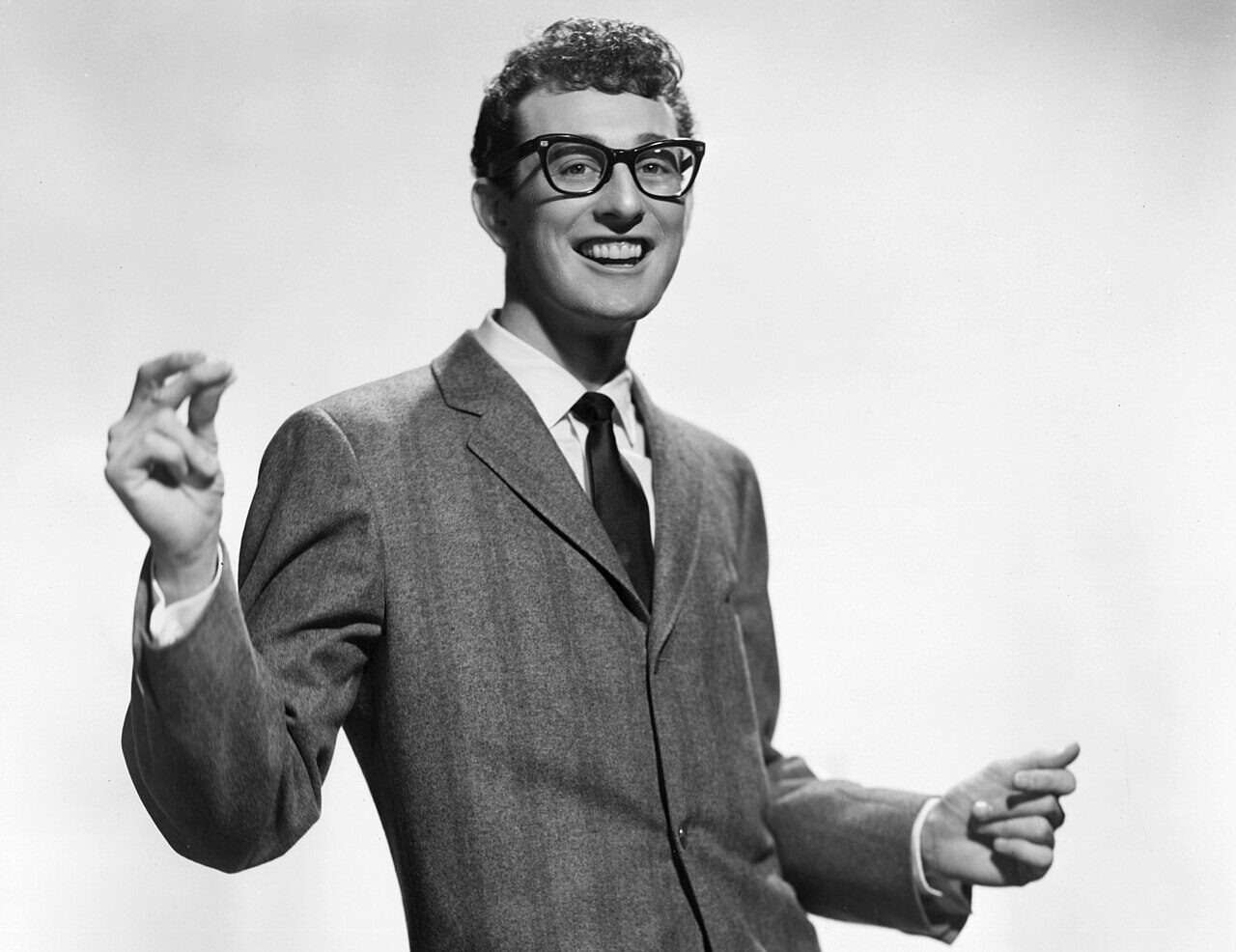
Buddy Holly, born Charles Hardin Holley in Lubbock, Texas in 1936, packed more influence into a recording career of barely eighteen months than most artists manage in a lifetime. With his horn-rimmed glasses and his Fender Stratocaster, he looked like an ordinary kid and sounded like the future, helping to invent the template for the modern rock band and writing a handful of songs so perfect they have never stopped being covered.
Holly's great innovation was the self-contained band that wrote and played its own material. His group, the Crickets, settled on the lineup of two guitars, bass, and drums that became the standard configuration for rock and roll bands ever after, and Holly handled the songwriting, the singing, and the lead guitar himself. His playing was clean, rhythmic, and endlessly melodic, full of bright chord work and catchy hooks on songs like That'll Be the Day, Peggy Sue, and Not Fade Away, the last of which rode a Bo Diddley beat straight into the rock canon. He was also among the first stars to make the Stratocaster look like the coolest object on Earth.
Here is the gem that shows how deep his influence runs: when four young men in Liverpool were choosing a name for their band, they took inspiration from Holly's Crickets and landed on the Beatles, an insect pun in tribute to their hero. John Lennon and Paul McCartney studied his records obsessively, learning how a band could write its own songs, and the Rolling Stones scored one of their early hits with a cover of Not Fade Away. Bob Dylan saw Holly play live just days before his death and never forgot it, mentioning it decades later when he accepted a Grammy.
That death is the tragedy that froze him in time. In February 1959 Holly was killed in a small-plane crash in Iowa, alongside Ritchie Valens and the Big Bopper, a loss later immortalized as the day the music died. He was only twenty-two. The cruel brevity of his life makes the size of his legacy almost hard to believe, but it is real and it is everywhere. Nearly every guitar-driven band that writes its own songs is, knowingly or not, working from the blueprint that Buddy Holly drew up in a year and a half.
Legendary Performance
Winter Dance Party, Surf Ballroom
February 2, 1959 · Surf Ballroom, Clear Lake, Iowa
The Winter Dance Party tour of early 1959 was organized in part because Buddy Holly needed money. A break with his former manager had left him in debt, and the twenty-four-date Midwestern run, crossing Wisconsin, Ohio, Minnesota, Iowa, and Illinois in the dead of winter, mostly by an unheated bus, was meant to restore his finances. The conditions were miserable: multiple musicians suffered frostbite, instruments went out of tune in the cold, and the itinerary required travel that the bus could barely manage. But on February 2, 1959, when the bus pulled into the Surf Ballroom in Clear Lake, Iowa, the capacity crowd of roughly a thousand teenagers who had waited in the cold to get in had no idea they were about to witness the last performance Buddy Holly would ever give.
Holly played the full set with everything he had. The Surf Ballroom's crowd, young, loud, dressed in their best, packed onto the dance floor, responded to each number with the kind of physical delirium that only early rock and roll produced in its audience. He played "That'll Be the Day," "Peggy Sue," "Oh, Boy!", songs that had defined a sound so new and so complete that they had changed popular music in the eighteen months since their release. His Fender Stratocaster, played with that hiccuping vocal style and those driving rhythm figures that made every song feel simultaneously inevitable and entirely surprising, was at the center of all of it. Those who were in the room that night have said, for the sixty-five years since, that they have never forgotten it.
At approximately 1 a.m. on the morning of February 3rd, the small charter plane carrying Holly, Ritchie Valens, and J.P. "The Big Bopper" Richardson hit a snowstorm and crashed in a cornfield outside Clear Lake, killing all three. The date passed into American cultural mythology as "the day the music died," a phrase Don McLean wrote into "American Pie" twelve years later. But what died that night was not music, it was a specific and irreplaceable musician at twenty-two years old, at the height of his powers, who had already done more to define the vocabulary of the electric guitar in popular music than almost anyone who came before him. The Surf Ballroom performance is what he gave the world last.
▶ Watch on YouTubeGear
1955 Fender Stratocaster
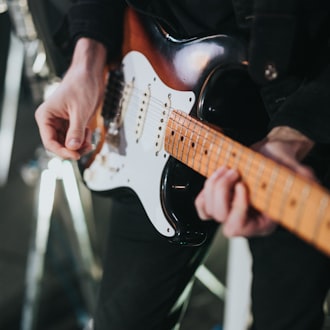
Buddy Holly was among the very first prominent rock and roll performers to adopt the Fender Stratocaster, purchasing one of the new double-cutaway instruments in 1955, just a year after Fender introduced the model. His association with the Stratocaster helped establish it as the rock and roll guitar, and photographs of Holly playing the sunburst Strat defined the instrument's visual identity for a generation of aspiring musicians. Holly used the Stratocaster's tremolo arm sparingly but effectively, and his rhythm playing, combining upstroke and downstroke patterns with syncopated timing, pioneered the rock rhythm guitar vocabulary that subsequent guitarists would develop. His guitar was not modified; he played the instrument essentially as Fender built it.
Fender Deluxe Amplifier / Small Combos
Holly's amplification was the straightforward Fender combo setup appropriate to his era: small, reliable, and capable of the clean, slightly reverberant tone that suited the Crickets' uptempo rock and slow ballads alike. The Fender Deluxe provided his primary guitar tone on stage and in the studio, its natural warmth and moderate output suiting both the Stratocaster's single-coil pickups and the primitive recording technology of Norman Petty's Clovis studio. His amplifier setup was entirely conventional by late-1950s standards, which makes his musical innovations all the more remarkable.
Tremolo Arm / Clean Tone / Vocal Doubling
Buddy Holly's 'effects' were primarily compositional and arranging decisions rather than electronic processing. His guitar playing was notable for its rhythmic sophistication, the syncopated patterns that underpinned 'Peggy Sue,' the gentle strumming of 'Everyday,' the driving rhythm of 'Not Fade Away', rather than any tonal manipulation. In the studio, Norman Petty's production technique of doubling and layering Holly's vocals gave the records their characteristic warmth. Holly himself focused on playing the song as cleanly and rhythmically as possible, establishing a standard of guitar-based rock songwriting that influenced the Beatles and virtually every British Invasion act that followed.
Signature Technique
Signature Technique
Buddy Holly's guitar technique stands at the origin point of rock and roll guitar, not as a virtuosic display but as the establishment of the vocabulary that all subsequent rock rhythm guitarists would draw from. His innovations were rhythmic and structural rather than tonal: he defined how a guitar should function in a small rock combo, what kind of strumming patterns create rhythmic interest over a simple chord progression, and how simple melodic fills could serve a song in the space between vocal phrases.
Holly's defining rhythmic contribution was his use of syncopation, placing rhythmic accents on unexpected beats, within his guitar strumming. On 'Peggy Sue,' his strumming pattern is not simply on the beat but distributed across the bar in a way that creates rhythmic tension against the drum pattern. This syncopation, derived partly from country and R&B traditions, gave Holly's rhythm playing a forward momentum that simpler on-the-beat strumming cannot achieve. It remains the foundational rhythmic approach for virtually all rock and pop guitar playing.
Holly's lead playing, short melodic fills between vocal phrases, brief solos that serve the song rather than displaying technique, established the model for lead guitar in a pop context. His fills are melodically memorable and rhythmically placed with precision, entering and exiting the mix without disrupting the song's flow. They are not technically demanding by later standards, but they are perfectly musical, a distinction that separates songwriting guitar from technically impressive but musically incoherent playing.
Holly's work with the Crickets effectively invented the guitar-bass-drums power trio format that would become rock music's foundational ensemble. His guitar had to provide harmonic, rhythmic, and melodic functions simultaneously in a way that a guitarist in a larger band with keyboards and other rhythm instruments does not. This triple responsibility shaped his playing: chord voicings had to be harmonically clear without a piano filling in the harmony, rhythm had to be self-sufficient without other rhythm guitar, and lead fills had to be economical because no rhythm instrument would continue beneath them.