



Hank Marvin
Current Ranking
Hank Marvin is ranked #158 of 162 guitarists on the Greatest Guitar Player leaderboard, based on our editorial score until fans weigh in. On the rock and roll leaderboard, Hank Marvin ranks #8 of 8. No fan votes yet, so be the first to rate Hank Marvin on 8 attributes at greatestguitarplayer.com/vote.
Biography
Hank Marvin, born in Newcastle, England in 1941, may be the single most important guitarist that casual American listeners have never heard of, because for an entire generation of British musicians he was the spark that started it all. As the lead guitarist of the Shadows, both on their own instrumentals and as the backing band for the pop star Cliff Richard, Marvin became the first British guitar hero, the man who showed the kids of the United Kingdom what an electric guitar could be.
Marvin's style was clean, melodic, and instantly recognizable, built on crisp, twangy single-note melodies drenched in echo and tremolo. The Shadows' instrumental hits, above all the global smash Apache, were essentially showcases for his tuneful, atmospheric lead playing, and they topped the charts and filled the airwaves across Britain and Europe. He played the melody like a singer, with impeccable timing and a warm, shimmering tone, and he made the guitar itself the star of the song at a time when that was a genuinely new idea.
Here is the gem that makes him a foundational figure. Marvin is widely credited as the owner of the first Fender Stratocaster in the United Kingdom, a flamingo-pink instrument that Cliff Richard helped import from America when such guitars were almost impossible to obtain there. That guitar, and the sound Marvin coaxed out of it, became an object of fascination and desire for every aspiring British guitarist, and the list of players who have named him as their first and most important inspiration is staggering. Eric Clapton, Jeff Beck, Jimmy Page, Brian May, Pete Townshend, Mark Knopfler, and David Gilmour have all pointed back to Hank Marvin as the guitarist who first made them want to play.
In other words, the towering British guitar explosion of the 1960s and beyond grew, in large part, out of a generation of kids watching one bespectacled man play melodic instrumentals on a pink Stratocaster. Marvin kept performing for decades and remains a beloved figure, but his greatest legacy is that influence, the way he planted the seed for nearly everyone who followed. He is the quiet origin point of British rock guitar, the first hero in a lineage that changed the world.
Legendary Performance
The Shadows at the London Palladium, 1960
Hank Marvin and the Shadows had a lock on British pop culture at the turn of the 1960s that is difficult to overstate. Their residency at the London Palladium, backing Cliff Richard and performing their own instrumental sets, brought the electric guitar to a mainstream British audience that had previously heard it mainly as a background instrument.
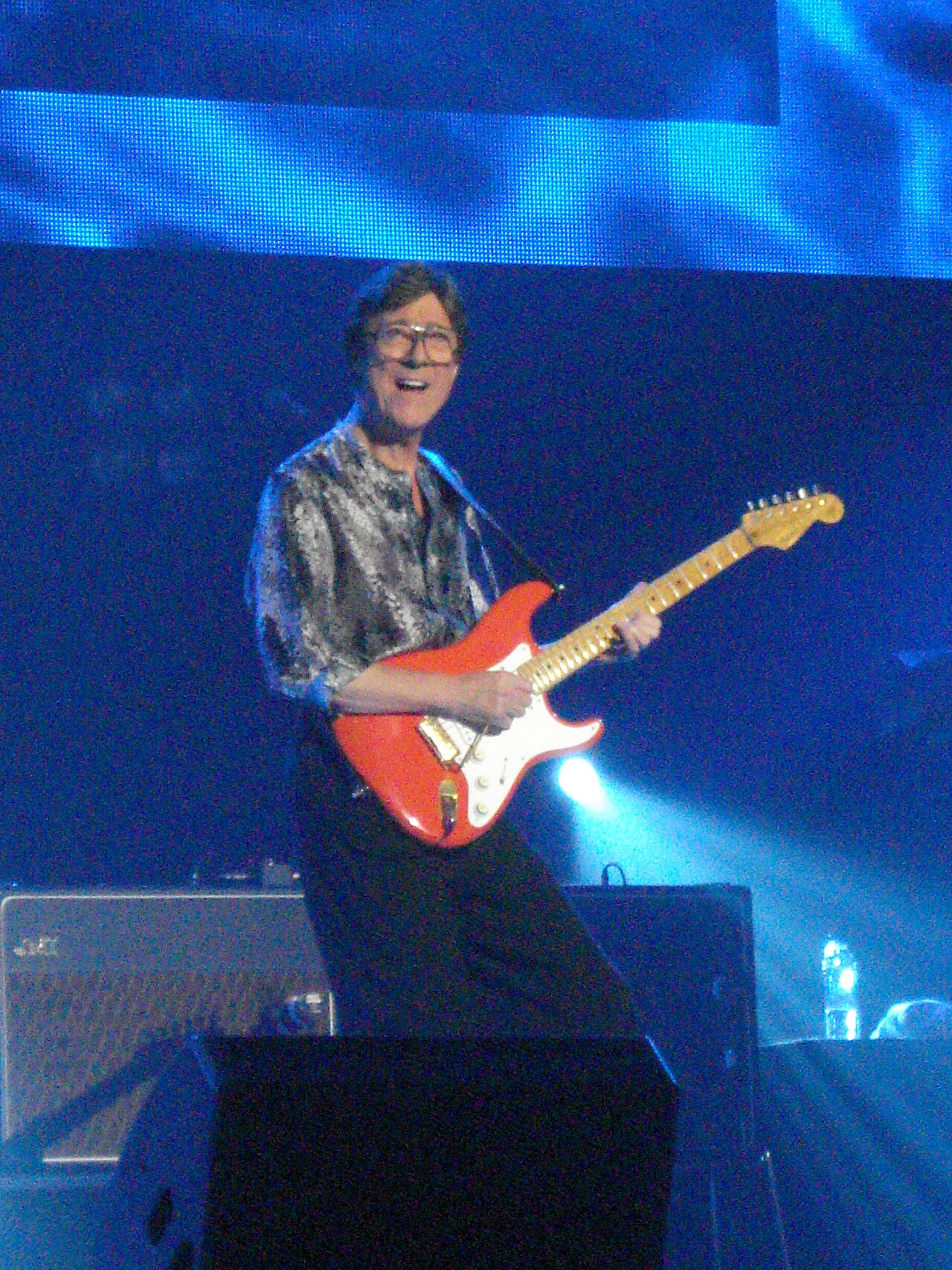
Marvin played a Fiesta Red Fender Stratocaster, at the time almost impossible to obtain in Britain, and processed it through a Watkins Copicat tape echo unit. The combination produced that distinctive shimmer: melodic lines that seemed to float in a halo of their own reflections, clean and precise but somehow otherworldly.
Virtually every British guitarist of the following decade grew up watching Marvin on television and trying to replicate what he was doing. His influence on Pete Townshend, Eric Clapton, and Brian May has been widely acknowledged, and it begins with those early Palladium performances.
▶ Watch on YouTubeGear
Fender Stratocaster • Fiesta Red • Watkins Copicat • Tape Echo • Pioneer of British Rock
Hank Marvin's gear is inseparable from his sound, and his sound is inseparable from the Fender Stratocaster. In 1959, Cliff Richard ordered one of the first Stratocasters to arrive in the UK from the United States, Fiesta Red with a maple neck, and gave it to Marvin. The guitar was so exotic in Britain at the time that it became an object of fascination in its own right.
Marvin ran the Stratocaster through a Watkins Copicat tape echo unit, a British-made device that created the shimmering, repeating trails that defined the Shadows' sound. The Copicat's organic, slightly imprecise echo had a warmth that modern digital delays have never quite replicated, and Marvin exploited its characteristics with total mastery.
He later used Burns guitars during a period when the Shadows promoted British-made instruments, and he has played various Stratocaster models throughout his career, but the image of Marvin with a Fiesta Red Strat and a Copicat echo unit is the one that shaped a generation of British guitarists.
Signature Technique
Melody Playing & Vibrato Bar Mastery
Hank Marvin's technique centers on the art of playing melody, something so obvious it is easy to undervalue. He takes a tune, identifies its essential notes, and plays them with a purity of tone and precision of intonation that makes the melody sound inevitable. No excessive ornamentation, no gratuitous speed, just the melody made as clear and beautiful as the instrument allows.
His vibrato bar technique was groundbreaking for the early 1960s. The Stratocaster's synchronized tremolo allowed him to apply controlled pitch variation to sustained notes, producing an effect that suggested a human voice or a steel guitar. He used the bar for gentle scoops into notes and controlled wobbles on sustained tones, always in service of the melody.
Marvin also developed a distinctive picking technique that maximized the Stratocaster's sustain. His pick attacks were precise but not aggressive, allowing the guitar's natural resonance to carry notes through their full decay. The result was a tone that seemed to breathe rather than simply sound.