


Chuck Schuldiner
Current Ranking
Chuck Schuldiner is ranked #108 of 162 guitarists on the Greatest Guitar Player leaderboard, based on our editorial score until fans weigh in. On the heavy metal leaderboard, Chuck Schuldiner ranks #11 of 14. No fan votes yet, so be the first to rate Chuck Schuldiner on 8 attributes at greatestguitarplayer.com/vote.
Biography
Chuck Schuldiner, born in Florida in 1967, is widely and rightly called the father of death metal, the guitarist and visionary who took heavy music to a new extreme and then, restlessly, kept pushing it somewhere more sophisticated. As the leader of the aptly named band Death, he helped invent an entire genre as a teenager and spent the rest of his too-short life refusing to let it stand still.
In the mid-1980s, Death's early recordings codified the sound of a brutal new style, faster, heavier, and darker than the thrash metal around it, with growled vocals and savage, downtuned riffing. But Schuldiner was never content to simply be heavy. Across albums like Human, Individual Thought Patterns, and Symbolic, he steadily transformed his band's music into something far more intricate and ambitious, weaving in complex time signatures, jazz-influenced harmony, melodic lead playing, and genuinely thoughtful lyrics about the mind, mortality, and the human condition. He effectively founded technical and progressive death metal, dragging a genre known for shock value toward real musical depth.
What made him special as a guitarist was that combination of aggression and intelligence. His riffs were precise and architecturally complex, his solos melodic and expressive, and his playing carried an emotional weight that elevated the whole genre's reputation among serious musicians. He cared deeply about craft in a corner of music that outsiders often dismissed as noise, and he proved them wrong with every record.
Here is the gem, and it is a heartbreaking one. Schuldiner accomplished all of this and reshaped an entire genre while still a young man, only to be diagnosed with a brain tumor at the height of his creative powers. He fought the illness while continuing to make music, including a new progressive metal project called Control Denied, before dying in 2001 at just thirty-four. The metal community's grief was immense, and in the years since, his stature has only grown. Today he is revered far beyond death metal as one of the genre's great innovators and one of its most genuinely creative minds, a guitarist who built a whole world of music and then kept making it more beautiful until the very end.
Legendary Performance
Death, Live in Eindhoven
May 30, 1998 · Dynamo Open Air Festival, Eindhoven, Netherlands
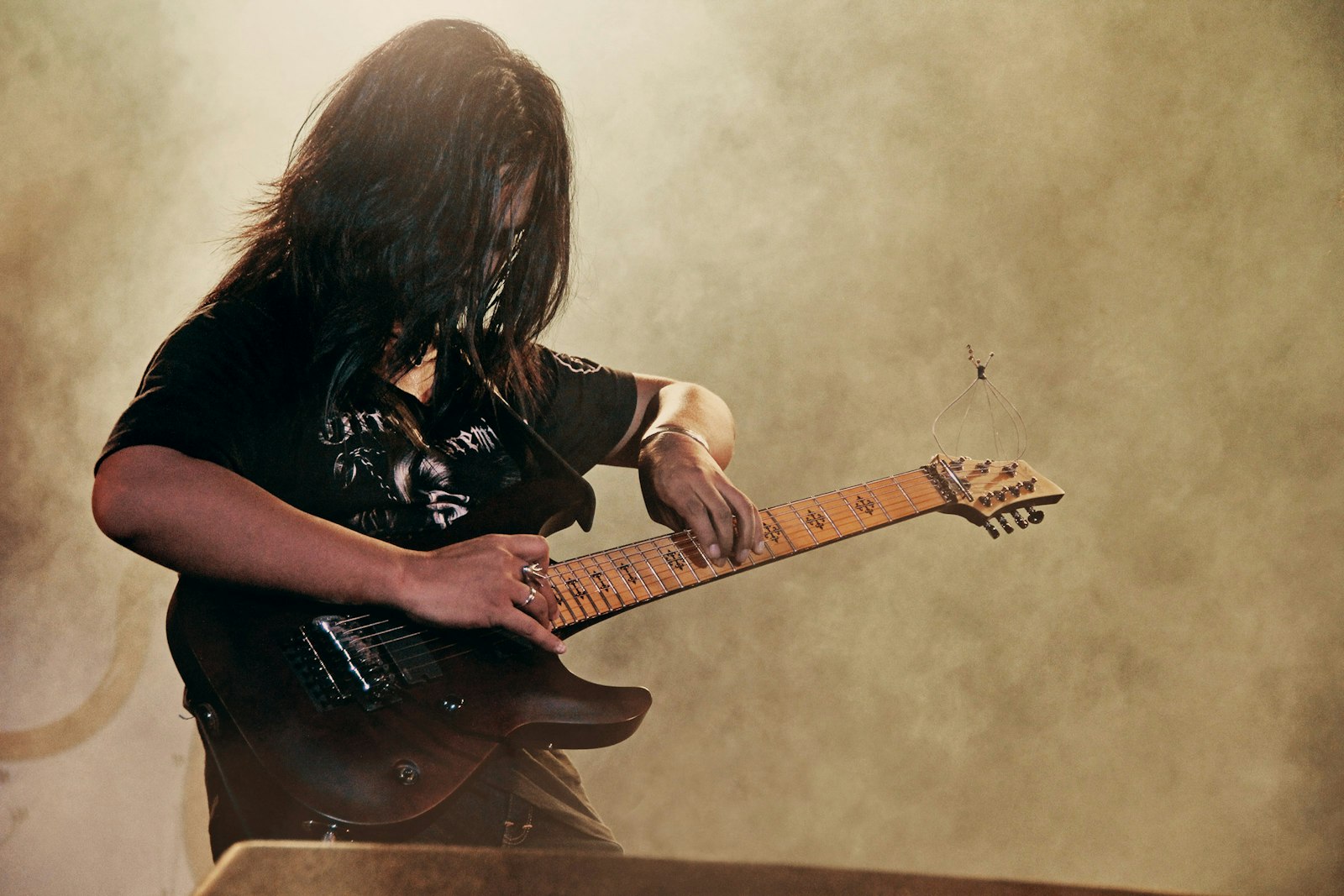
Death's appearance at the Dynamo Open Air Festival in Eindhoven on May 30, 1998 captured Chuck Schuldiner at the absolute summit of his powers as a composer, bandleader, and guitarist. The set was filmed and released as Live in Eindhoven, and the recording stands as the most widely studied concert document of his career. By this point Death's lineup had stabilized around Schuldiner, guitarist Shannon Hamm, bassist Scott Clendenin, and drummer Richard Christy, all of whom matched the technical demands of the Sound of Perseverance material that the band was touring behind. The set drew from across the Death catalog, juxtaposing early Scream Bloody Gore tracks against the more progressive material from Symbolic and Sound of Perseverance, and the contrast illustrated just how far Schuldiner had taken his own band's sound across a single decade.
His soloing throughout the Eindhoven set demonstrated everything that distinguished him from the brutality-first death metal contemporaries of his era. Where most extreme-metal lead playing of the period relied on quasi-random sweep arpeggios and chromatic chaos, Schuldiner's solos were structured melodic statements, often using modal vocabularies (Phrygian dominant, harmonic minor, diminished) to build phrases that resolved with the logic of jazz heads rather than the abandon of conventional metal soloing. The performance of Crystal Mountain (with its memorable melodic motif), the long instrumental passages of Spirit Crusher, and the technically demanding Symbolic title track demonstrated his discipline as a player who could execute complex parts at full intensity for ninety minutes while singing simultaneously. The Live in Eindhoven recording became the entry point for an entire generation of extreme-metal guitarists who discovered through Schuldiner that death metal could function as composed art music rather than as pure aural assault.
▶ Watch on YouTubeGear
B.C. Rich Stealth and ST-III (Late 1980s through 2001)
Known for: Schuldiner's primary instruments across his Death career
Chuck Schuldiner's relationship with B.C. Rich guitars defined his visual and tonal identity across his career. He gravitated to the brand's angular, aggressive body shapes (the Stealth, Mockingbird, and the later ST-III models) for both their visual statement and their tonal characteristics: dense mahogany bodies, set or neck-through construction, and high-output humbucking pickups that delivered the saturated low-end and harmonic clarity his picking style required. The black B.C. Rich Stealth he used through much of the late 1990s became one of the most iconic guitars in death metal, its distinctive lightning-bolt silhouette inseparable from his stage presence.
Schuldiner typically used DiMarzio X2N or similar high-output humbuckers in the bridge position, voiced for the tight palm-muted attack that defines death metal rhythm playing. He kept his action moderately high and used relatively heavy strings, both choices that supported the controlled, articulate picking attack on which his riffs depended. The specific Stealth he played on the Sound of Perseverance tour and that appears prominently in the Live in Eindhoven footage has become a sought-after collector's item, a status it shares with very few death metal guitars from that era. His commitment to a single instrument family across a decade and a half is part of why his recorded tone remained instantly recognizable across albums that otherwise evolved substantially in compositional complexity.
Marshall JCM800 and Valvestate Combos
Known for: Schuldiner's primary amplification across the Death catalog
Schuldiner's amp choices throughout the Death years centered on Marshall heads, most consistently the JCM800 2203 100-watt model that was the standard British rock and metal amplifier of the 1980s. The JCM800's natural saturation at moderate gain provided the tight, articulate distortion that death metal rhythm playing demands, and unlike many extreme-metal players of his era he never relied on a separate distortion pedal to push the amp into harder saturation. The amp's own circuit, combined with his high-output B.C. Rich pickups and aggressive picking attack, produced everything he needed without additional dirt processing in the signal chain.
On the road during the Sound of Perseverance tour and other late-1990s outings, Schuldiner also used Marshall Valvestate combos for backup and rehearsal situations, valuing their reliability and tonal proximity to the JCM800 character. Studio recordings from across the Death discography sometimes incorporated additional amp options (notably Mesa Boogie heads on some Symbolic-era tracks), but the live Marshall tone remained his signature voice. His amp discipline mirrored his broader philosophy: identify the tools that serve the music and stick with them long enough to develop genuine command, rather than constantly changing gear in search of novelty.
Boss NS-2 Noise Suppressor and Minimal Chain
Schuldiner's effects rig was famously minimal even by metal standards, focused on a single essential tool: the Boss NS-2 Noise Suppressor, configured as an aggressive noise gate that killed the signal cleanly between palm-muted attacks. For death metal rhythm playing, where every chord must end with precise silence rather than ringing decay, a tight noise gate is not optional but foundational, and Schuldiner relied on the NS-2 to produce the staccato gap-and-attack pattern that defines the genre's rhythm-guitar feel.
Beyond the noise gate, his signal chain stayed remarkably uncluttered. A tuner pedal for stage maintenance, occasional use of a chorus pedal for the cleaner ambient passages of Symbolic-era material, and very little else. There were no overdrive pedals (the Marshall provided all the gain he needed), no delay processors (the dry signal kept his complex riffs articulate), and no rack effects of the kind that many of his contemporaries built elaborate touring rigs around. The minimalism was a tonal philosophy as much as a practical choice: he believed that the sound should come from the hands, the guitar, and the amplifier, and that adding processors between those elements diluted the immediacy his music depended on. The approach has aged remarkably well, and Death recordings still sound tonally direct and harmonically clear in a way that many heavily processed metal albums of the same era do not.
Signature Technique
Modal Soloing, Progressive Riffing, and the Composed Death Metal Solo
Chuck Schuldiner's foundational technical contribution to extreme metal was the demonstration that lead guitar in the genre could be composed rather than improvised, modal rather than chromatic, and melodically structured rather than randomly aggressive. His early albums established the basic death metal rhythm vocabulary (tremolo-picked single-note lines, palm-muted chord-tone riffing, complex syncopated articulation), but from Human onward his approach to solos evolved dramatically, drawing on Phrygian dominant, harmonic minor, the diminished scale, and modal jazz vocabularies that almost no other death metal player of his generation engaged with seriously.
His solos are built like jazz heads: a memorable opening motif states the melodic idea, subsequent phrases develop or vary the motif, and the solo resolves with the logic of an instrumental composition rather than a string of improvised licks. The Crystal Mountain solo from Symbolic is one of the most-studied examples, its melodic arc as memorable as any vocal hook and its underlying scale choices clearly thought through rather than improvised in the moment. Spirit Crusher, Symbolic, and Lack of Comprehension all illustrate the same approach: solos that exist as composed instrumental passages within the larger song architecture, executed with precision rather than improvised abandon.
His right-hand technique combined alternate picking with extensive use of legato (hammer-ons and pull-offs) for sustained melodic passages, and his command of string-skipping arpeggios across the modal scales gave his lead lines a sense of harmonic motion that conventional pentatonic-based metal soloing rarely achieves. The fretting hand was equally disciplined, with the kind of clean fretting and consistent vibrato that lets fast passages remain pitch-distinct rather than blurring into general velocity. Schuldiner did not play as fast as some of his shred-metal contemporaries, but everything he played was articulate, intentional, and serving a larger musical purpose.
His rhythm playing evolved across the Death catalog from the relatively conventional early albums to the rhythmically complex, jazz-influenced material of Individual Thought Patterns and Symbolic, where odd time signatures, syncopated accent patterns, and harmonized rhythm-guitar passages took on the structural role of the music itself. The riffs were no longer just heaviness machines but compositional elements with their own melodic and harmonic content. This treatment of the riff as a composed entity rather than a riff-vocabulary cliche became the template that progressive death metal (Opeth, Cynic, Atheist, Gojira, and countless followers) built upon.
Beyond technique, Schuldiner's most enduring lesson for extreme-metal guitarists is the demonstration that intensity and intelligence are not opposed. He proved that death metal could carry the same compositional ambition as progressive rock or jazz fusion without sacrificing any of its visceral impact, and the entire post-2000 evolution of technical and progressive death metal (Necrophagist, Gorod, Beyond Creation, Obscura) traces directly back to the path he opened with the Human album in 1991. His death at 34 cut short what would almost certainly have been further evolution of his vocabulary, but the body of work he left behind remains the standard against which serious extreme-metal guitar composition is measured.