

.jpg)
Eric Clapton
Current Ranking
Eric Clapton is ranked #5 of 162 guitarists on the Greatest Guitar Player leaderboard, based on our editorial score until fans weigh in. On the blues leaderboard, Eric Clapton ranks #1 of 32. No fan votes yet, so be the first to rate Eric Clapton on 8 attributes at greatestguitarplayer.com/vote.
Biography
Eric Clapton, born in Surrey, England in 1945, is one of the most celebrated and enduring guitarists in rock history, a bluesman at heart whose career has spanned six decades and nearly every important British rock movement. Nicknamed Slowhand, he built his reputation on taste, tone, and a deep devotion to the American blues, becoming the rare guitar hero famous enough to be a household name while still revered by other musicians as the real thing.
Clapton's path reads like a tour of rock's golden age. He passed through the Yardbirds, then joined John Mayall's Bluesbreakers, where his fierce, sustaining Les Paul-through-a-Marshall tone rewired what British blues guitar could sound like. He co-founded Cream, the original power trio, pushing blues into heavy, improvisational new territory on Sunshine of Your Love and a thunderous live take on Robert Johnson's Crossroads. He briefly chased a quieter sound with Blind Faith, formed Derek and the Dominos, and then built a long, hugely successful solo career, picking up his trusty Stratocaster, Blackie, and recording enduring songs like Wonderful Tonight, Cocaine, and the heartbreaking Tears in Heaven.
Here is the gem that shows how big he loomed even as a young man. In mid-1960s London, an anonymous admirer spray-painted the words Clapton is God on a wall, a piece of graffiti that was photographed and became legendary. He was barely into his twenties, and people were already treating him as a deity of the instrument. He has always seemed faintly embarrassed by the title, insisting he was just a disciple of the blues masters he loved.
A second gem captures his roots. That career-defining Bluesbreakers record is universally known as the Beano album, because in the cover photo Clapton sits reading a Beano comic rather than looking at the camera, a small act of teenage indifference on a record whose guitar tone became the holy grail that British blues-rockers chased for decades. There is real human drama in his greatest work too. The desperate, beautiful song Layla was inspired by his unrequited love for Pattie Boyd, the wife of his close friend George Harrison, and its famous slide parts came courtesy of Duane Allman. Decades later his stripped-down MTV Unplugged set, with its gentle acoustic reworking of Layla, became one of the best-selling live albums ever.
The only three-time Rock and Roll Hall of Fame inductee, honored with the Yardbirds, Cream, and as a solo artist, Clapton has weathered triumph and tragedy, addiction and recovery, and emerged as an elder statesman of the guitar who founded the Crossroads festival to celebrate the instrument and support his addiction-recovery center. Through it all, his core has never changed. He is a blues believer who spent a lifetime carrying that music to the world, and convinced a few generations of guitarists to fall in love with it too.
Legendary Performance
Cream Reunion at the Royal Albert Hall
May 2-6, 2005 · Royal Albert Hall, London
The Cream reunion concerts at the Royal Albert Hall in May 2005, four sold-out nights, 37 years after the band's original dissolution, were among the most anticipated comeback performances in rock history. The three surviving members, Clapton, Jack Bruce, and Ginger Baker, had not performed together since the Farewell Concert at the Royal Albert Hall in 1968, and the intervening decades had added a weight of retrospective significance to the material that the original performances could not have carried. Clapton's guitar playing in 2005 was a different instrument from the "Beano"-era Bluesbreakers playing that had made his reputation, technically more refined, emotionally more controlled, and the reunion gave him the opportunity to revisit arrangements he had not played in public since his twenties.
The performance of "Crossroads", the Robert Johnson adaptation that had become Cream's signature piece and the template for a generation of blues-rock guitar playing, was the reunion's most discussed guitar moment. Clapton's lead work demonstrated the quality that had always distinguished his playing from technically comparable guitarists: the phrase endings, the specific note choices within the blues scale, the relationship between the guitar and the rhythm section that was built on forty years of musical maturity rather than the urgency of a young player establishing himself. The concerts were filmed and released, and the document they provide is among the most thorough studies of Clapton's guitar language available.
▶ Watch on YouTubeGear
"Blackie", Custom Composite Stratocaster (1956-1985)
Known for: "Lay Down Sally", "Cocaine", live work 1973-1985
"Blackie" is a composite guitar assembled by Clapton in 1970 from the bodies and necks of three 1950s Fender Stratocasters purchased at Nashville's Sho-Bud guitar shop. He selected the best neck from one, the best body from another, and the best hardware from a third, combining them into a single instrument that he played as his primary guitar for the following fifteen years. The guitar was retired from regular use in 1985 when the neck had worn beyond reliable playability; it sold at Christie's in 2004 for $959,500, at the time the highest price ever achieved at auction for a guitar. Before Blackie, Clapton's primary instrument was a 1960 Gibson Les Paul Standard, the "Beano" guitar, named for the comic book visible on the cover of the "Bluesbreakers" album, whose tone was the foundation of the British blues sound that defined his early reputation.
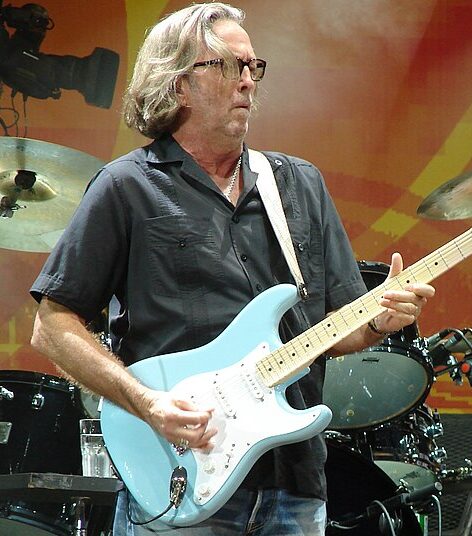
Clapton has used Gibson ES-335s, Fender Stratocasters, and various vintage guitars throughout his career, returning repeatedly to the Stratocaster as his primary instrument from the late 1960s onward. His Eric Clapton signature Stratocaster, developed with Fender in the late 1980s, incorporates an active mid-boost circuit and a blocked tremolo system that replicates the fixed-bridge feel he prefers.
Marshall 1962 "Bluesbreaker" Combo / Fender Vibro-Champ
Known for: "Beano" tone on Blues Breakers with John Mayall, 1966
The Marshall 1962 combo amplifier that Clapton used for the "Bluesbreakers" recording sessions in 1966 became so associated with the tone he produced on that album, a Les Paul through a pushed Marshall combo, producing the first fully formed British blues overdriven guitar sound, that Marshall subsequently named the model the "Bluesbreaker." The specific combination of the 1960 Les Paul Standard's output and the Marshall combo's natural power-amp saturation at recording volumes produced a distorted guitar sound that had not previously been captured on a major blues recording, and its influence on every British rock guitarist who followed is direct and documented.
For cleaner, more transparent work, particularly the slide playing and lighter fingerpicking of his later career, Clapton has used Fender amplifiers, including the small Vibro-Champ that he has described as his favourite studio amplifier for its natural-sounding breakup at low volumes. His amplification choices have consistently prioritised the guitar's character over the amplifier's, seeking equipment that transmits rather than transforms.
Signature Technique
Blues String Bending
String bending, pushing or pulling a fretted string sideways to raise its pitch, is the guitar's closest equivalent to the human voice. Eric Clapton learned it from the Chicago blues masters and refined it into something deeply personal. By curving a string a half step, a whole step, or even a minor third upward, he could mimic the portamento and cry of a blues singer, making the instrument speak with genuine emotional weight. The pitch of his bends is consistently accurate, his timing impeccable, and his target note always chosen for maximum expressiveness.
Listen to the Cream-era recordings, "White Room," "Crossroads," "Sunshine of Your Love", and the bends are the voice of the songs. Clapton rarely plays a lead line without a bend shaping at least one key phrase. The technique looks simple on paper but demands exact pressure, exact speed, and exact pitch memory. His gift was making all of that sound natural, as if the guitar were simply telling the truth.