


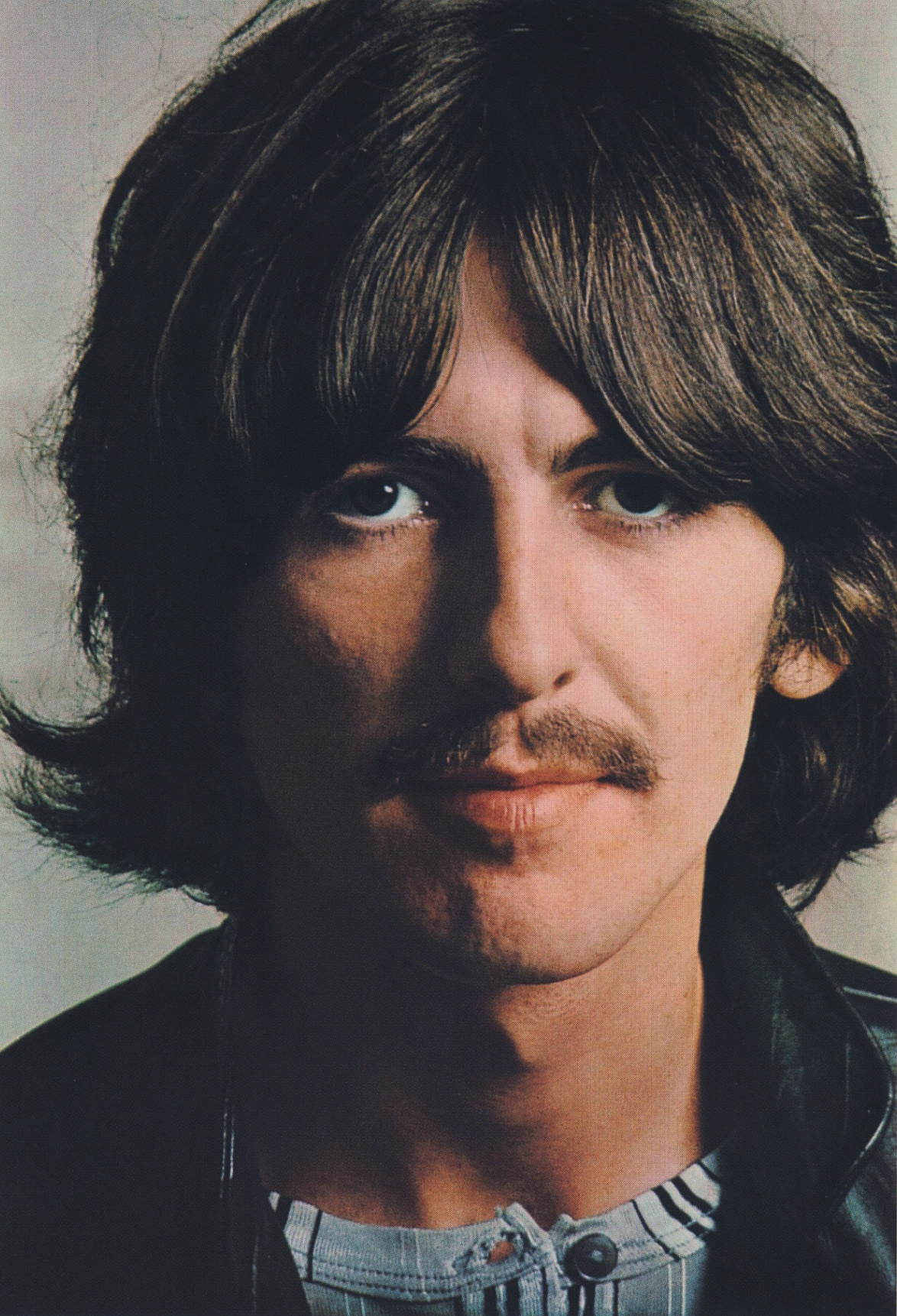

George Harrison
Current Ranking
George Harrison is ranked #29 of 162 guitarists on the Greatest Guitar Player leaderboard, based on our editorial score until fans weigh in. On the classic rock leaderboard, George Harrison ranks #8 of 18. No fan votes yet, so be the first to rate George Harrison on 8 attributes at greatestguitarplayer.com/vote.
Biography
George Harrison, born in Liverpool in 1943, was the lead guitarist of the Beatles and, despite being overshadowed in the press by his songwriting bandmates, one of the most quietly influential guitarists in the history of rock. Known as the quiet Beatle, he favored taste over flash, crafting melodic, perfectly judged guitar parts that served the song, and in doing so he helped invent several of the sounds that would shape the next decade of music.
Harrison's genius was for the right part rather than the most notes. His clean, economical solos and inventive riffs are woven through the Beatles catalog, and his later embrace of slide guitar gave songs like My Sweet Lord and Something their gorgeous, vocal lead lines. He was endlessly curious about new sounds, and that curiosity changed popular music more than once.
Here is the gem that opened a new era with a single strum. The Beatles song A Hard Day's Night famously begins with one enormous, ringing, unmistakable chord, played in large part on Harrison's twelve-string Rickenbacker. That jangling, chiming twelve-string tone became one of the defining sounds of the 1960s, directly inspiring the Byrds and, through them, the entire genre of folk-rock, with its echoes running on to Tom Petty, R.E.M., and beyond. A great deal of the bright, shimmering guitar jangle of the decade traces straight back to Harrison and that Rickenbacker.
A second gem reveals his role as a true cultural pioneer. Harrison was the musician most responsible for bringing Indian classical music into rock, studying the sitar under the master Ravi Shankar and featuring it on songs like Norwegian Wood, which opened Western ears to a whole new palette of sound and helped spark a lasting fascination with Indian music and spirituality across popular culture. His curiosity reshaped not just guitar but the very boundaries of what pop music could absorb.
His influence did not stop with the Beatles. Harrison launched a major solo career with the sprawling All Things Must Pass, organized the Concert for Bangladesh, the first great all-star benefit concert, and later co-founded the supergroup the Traveling Wilburys alongside Bob Dylan, Tom Petty, Roy Orbison, and Jeff Lynne. A two-time Rock and Roll Hall of Fame inductee, as a Beatle and as a solo artist, Harrison spent his life proving that restraint and good taste are their own kind of virtuosity. He died in 2001, but his fingerprints are all over modern guitar, in every jangling twelve-string, every tasteful slide line, and every player who learned that the best guitar part is the one the song actually needs.
Legendary Performance
The Concert for Bangladesh
August 1, 1971 · Madison Square Garden, New York City, NY
When Ravi Shankar came to George Harrison in early 1971 with news of the catastrophe unfolding in Bangladesh, a genocide, a liberation war, and the aftermath of a cyclone that had killed half a million people, Harrison's response was immediate and total. Within months, he had assembled the most extraordinary gathering of rock and roll talent since Woodstock and booked two shows at Madison Square Garden for August 1st. The Concert for Bangladesh, the first major celebrity benefit concert in history, the template that Live Aid and every subsequent charitable mega-event would follow, brought together Harrison, Ringo Starr, Eric Clapton, Leon Russell, Billy Preston, and Bob Dylan, the latter making his first major live appearance in years. Ravi Shankar played ragas. Forty thousand people spread across two shows sat in reverent silence for the Indian classical passages and erupted for the rock and roll. It was the day the genre proved it could be about something other than itself.
Harrison's guitar playing throughout the concert was marked by the same quality that distinguished his best work in the Beatles: a preference for melody over speed, for the note that serves the song over the note that displays the player. He played a cherry-red Les Paul through a Marshall stack, his slide work on "Here Comes the Sun" carrying a gentleness that the Madison Square Garden crowd, 20,000 people who had paid for their tickets and then been told the money would go to refugees they'd never meet, received in a stillness that bordered on the devotional. His solo on "While My Guitar Gently Weeps," performed with Clapton playing alongside him, was unhurried and emotionally spacious, two guitarists in total command of what they were doing and entirely focused on serving the song rather than each other.
The concerts raised $250,000 from ticket sales; the subsequent three-LP live album and documentary film brought the total to nearly twelve million dollars for UNICEF's Bangladesh relief fund. Rolling Stone called the concert album one of the greatest live records ever made. More than that, the Concert for Bangladesh established the principle, since adopted by dozens of subsequent benefit events, that the scale and appeal of popular music could be directed toward humanitarian ends. George Harrison had walked out of the Beatles exhausted by the machinery of global fame and rebuilt himself as something rarer: a musician who understood that the platform his gift had given him carried obligations, and who honored those obligations completely.
▶ Watch on YouTubeGear
Rickenbacker 360/12 / Gibson J-160E
George Harrison's early adoption of the Rickenbacker 360/12, a twelve-string electric guitar that Rickenbacker brought to New York specifically for The Beatles to try in February 1964, produced one of the most instantly recognizable sounds in pop history. The cascading, jangly intro to 'A Hard Day's Night' was played on that instrument, and the 12-string Rickenbacker defined the sonic character of The Beatles' mid-period recordings. Harrison also played the Gibson J-160E acoustic for the band's ballad recordings, and his later career saw him embrace slide guitar played on a Fender Stratocaster and various Dobros, particularly after his time with Delaney & Bonnie introduced him to American roots music.
Vox AC30 / Fender Twin Reverb
Harrison's amplification evolved with The Beatles' career arc. The Vox AC30, Britain's most celebrated valve combo, was central to the group's early and mid-period sound, providing the chiming clarity that suited Harrison's melodic lead style. As the band moved into the studio-as-instrument era of Revolver and Sgt. Pepper , amplification choices became increasingly experimental, with direct injection, Leslie cabinet routing, and tape manipulation all employed to serve the album's concept. His post-Beatles solo work saw him favor Fender amplifiers for their clean headroom.
Slide Technique / Minimal Effects
Harrison's most distinctive tonal contribution was his mastery of Hawaiian-influenced slide guitar, a technique absorbed partly from Carl Perkins and deepened through his association with Indian classical music. His slide playing on tracks like 'My Guitar Gently Weeps,' 'While My Guitar Gently Weeps,' and throughout All Things Must Pass brought a lyrical, singing quality to electric guitar that complemented his melodic compositional sensibility perfectly. He ran his slide guitar essentially clean, letting the note bend and vibrato of the technique itself carry the expression.
Signature Technique
Sitar Influence, Melodic Restraint & Slide
George Harrison brought Indian classical music into Western rock through two distinct avenues. First, his actual sitar playing, most audibly on "Norwegian Wood" and "Within You Without You", introduced drone-based melody and microtonal ornaments (the meend, or note-bending technique of Hindustani classical music) to an audience that had no prior frame for them. Second, and more pervasively, the Indian aesthetic of melodic restraint and note economy reshaped his guitar phrasing entirely. Where Western rock rewarded speed and density, Indian classical music rewarded the space around a note and the way a melody resolved. Harrison absorbed that ethic and brought it back to the guitar.
His slide work, developed seriously after the Beatles' breakup, is technically distinctive because he played in standard tuning rather than open tuning, which demands more precise pitch placement from the slide and produces a different set of natural resonances than the open-chord approach of Allman or Muddy Waters. "My Sweet Lord," "Give Me Love," and "All Things Must Pass" demonstrate his slide vocabulary at its most developed: slow, sustained notes, melodic rather than ornamental, and always placed for maximum emotional effect within the song rather than technical display outside it.