



Jerry Garcia
Current Ranking
Jerry Garcia is ranked #43 of 162 guitarists on the Greatest Guitar Player leaderboard, based on our editorial score until fans weigh in. On the classic rock leaderboard, Jerry Garcia ranks #9 of 18. No fan votes yet, so be the first to rate Jerry Garcia on 8 attributes at greatestguitarplayer.com/vote.
Biography
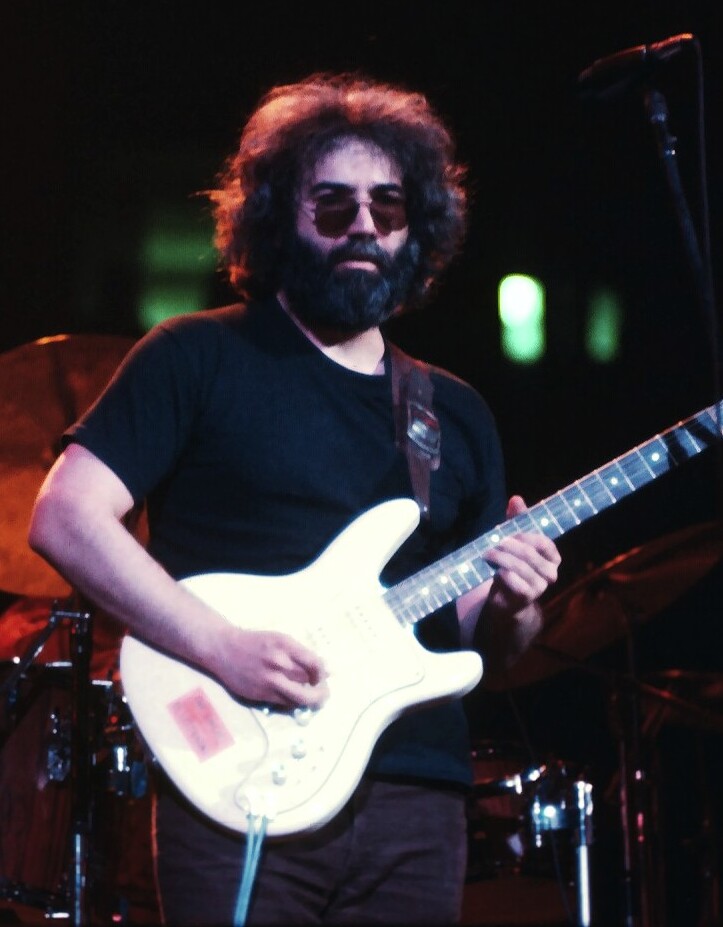
Jerry Garcia, born in San Francisco in 1942, was the guiding spirit and lead guitarist of the Grateful Dead, and one of the most distinctive improvisers in the history of American music. More than a guitarist, he was the heart of an entire cultural movement, but at the center of it all was his playing, fluid, melodic, conversational, and endlessly exploratory, the sound of a man treating every solo as an open-ended journey rather than a fixed destination.
Garcia's style drew on an enormous range of American music, bluegrass, country, blues, jazz, folk, and rock, all flowing together into long, winding improvisations. With the Grateful Dead he helped pioneer the whole idea of the jam band, building concerts around extended, spontaneous musical conversations that were different every night, which is exactly why fans followed the band for years and traded thousands of live recordings. His tone was warm and singing, his note choices unmistakably his own, and he played with a relaxed, searching quality that invited listeners to come along on the ride.
Here is the gem that makes his fluidity all the more astonishing. Garcia was missing most of the middle finger on his right hand, having lost it in a childhood wood-chopping accident when his brother brought down an axe at the wrong moment. Despite that, he became one of the most graceful and articulate improvisers the guitar has ever known, a reminder, much like Django Reinhardt before him, that a physical limitation is no barrier to genius when the musical imagination is strong enough. He simply adapted and played beautifully anyway.
Garcia was also a gear devotee who commissioned a series of gorgeous, elaborate custom guitars, including the famous instruments known as Wolf and Tiger, and he later experimented with MIDI technology to push his sound into strange new territory. His easy charisma and benevolent presence made him an unlikely icon, so beloved that an ice cream flavor was named in his honor. When he died in 1995, the loss was felt far beyond music, but his playing endures in a mountain of live recordings. For improvising guitarists, Jerry Garcia remains a patron saint, the proof that the guitar can be a vehicle for genuine exploration, community, and joy.
Legendary Performance
Grateful Dead, Woodstock
The Grateful Dead's Woodstock performance in the early hours of August 16, 1969 was not, by most contemporary accounts, their finest hour, equipment failures plagued the set, the stage power was unreliable, and Garcia himself was famously critical of the band's playing. Yet the performance remains one of the defining documents of his approach to guitar precisely because of those difficulties. Where another player might have compensated for technical problems by playing more safely, Garcia pushed deeper into improvisation, his guitar conversations with keyboardist Tom Constanten exploring melodic territory that had no relationship to the setlist and every relationship to the moment. The Woodstock footage captures the Dead's philosophy of music as a living event made present only by performance.
Garcia's guitar playing throughout the Dead's career was built on the idea that extended improvisation, what the band called "space", was not a technical exercise but a form of collective listening. At Woodstock, with half a million people in the audience and everything going wrong, his guitar maintained the meditative, searching quality that made him one of the most distinctive improvisers in American music. His lines during the extended jams drew on modal jazz, bluegrass, and psychedelia simultaneously, a synthesis that no other guitarist of his era had assembled, and the sincerity of his playing in adverse conditions stands as the most revealing document of his musical character.
▶ Watch on YouTubeGear
Custom Doug Irwin Guitars (Wolf & Tiger)
Jerry Garcia's most celebrated instruments were the custom guitars built for him by luthier Doug Irwin in the 1970s and 1980s: Wolf, delivered in 1973, and Tiger, completed in 1979. Both were built to Garcia's specific requirements, multiple pickups with individual volume controls, onboard switching for complex signal routing, and construction tailored to his large hands and specific tonal requirements. Tiger, Garcia's primary instrument from 1979 to 1989, featured a cocobolo and maple body, a highly figured maple neck, and a switching system that allowed him to blend pickups in combinations unavailable on any production instrument. The guitars' visual complexity reflected their functional sophistication, and their sound, warm, sustain-rich, with exceptional clarity in the upper registers, was central to the Dead's sonic identity.
McIntosh Amplification & Custom Envelope Filter
Garcia's amplification system was as unconventional as his guitars: he used McIntosh hi-fi amplifiers in place of conventional guitar amplifiers, powering JBL speaker cabinets through a system that prioritised headroom and low distortion over the saturated tone of standard guitar rigs. The McIntosh system produced a clean, detailed amplification of his guitar signal that preserved every nuance of his picking and allowed his effects processing to be heard at full resolution. The result was a tone simultaneously clean and warm, lacking the harmonic saturation of Marshall or Fender tube amplification but possessing a transparency that suited his improvisational approach.
Mutron III Envelope Filter
Garcia's most characteristic effect was the Mutron III envelope filter, a device that creates a wah-like filtering effect triggered by the dynamics of the player's picking rather than a foot pedal. His use of the Mutron III, heard throughout the Dead's 1970s material, added a vocal, almost conversational quality to his guitar lines that reinforced the melodic, singing approach that defined his style. The filter's sensitivity to picking dynamics meant that its effect varied with every note, giving his lines an organic, expressive quality that a conventional wah pedal could not replicate.
Signature Technique
Signature Technique
Jerry Garcia's guitar technique is best understood not as a set of technical skills but as a musical philosophy made physical: the belief that improvisation is a form of conversation, that each musical idea should respond to what preceded it, and that the emotional content of a performance is inseparable from its spontaneous creation. He was technically proficient, his work in bluegrass and his facility across the guitar's full range make this clear, but technique was never his subject. His subject was the melodic idea, the phrase that could carry a listener forward through a twenty-minute improvisation while maintaining the quality of felt experience rather than structural analysis.
Garcia's improvisational language drew heavily on modal jazz, the approach pioneered by Miles Davis and John Coltrane of treating each section of a composition as an opportunity to explore a single scale or mode rather than following the rapid harmonic changes of bebop. Applied to rock and psychedelic contexts, this approach allowed him to develop ideas at length without the pressure of harmonic movement, creating the extended, searching improvisations that defined the Grateful Dead's concert experience. His scale choices moved freely between major, minor, and modal tonalities, often within a single solo, following emotional logic rather than theoretical prescription.
Garcia's earliest serious musical study was the banjo, he played in bluegrass bands before forming the Dead, and the melodic phrasing of that tradition shaped his guitar playing permanently. Banjo technique emphasises clear, separated notes rather than the legato runs of blues guitar or the sustain-based playing of rock, and Garcia's picking retained this note-by-note clarity even at extended tempos. His solos have a quality of singing a melody rather than running scales, each note landing with intention and ringing clear before the next arrives, a characteristic that makes his lines immediately identifiable and accessible to listeners who have never analysed a guitar scale.