




Joan Jett
Current Ranking
Joan Jett is ranked #150 of 162 guitarists on the Greatest Guitar Player leaderboard, based on our editorial score until fans weigh in. On the punk, grunge and alternative leaderboard, Joan Jett ranks #13 of 17. No fan votes yet, so be the first to rate Joan Jett on 8 attributes at greatestguitarplayer.com/vote.
Biography
Joan Jett, born in Philadelphia in 1958, is the godmother of punk rock guitar, a fierce, no-nonsense rhythm player and frontwoman who kicked down doors for women in rock and never looked back. She is not a flashy soloist, and she has never wanted to be. Her power lies in attitude, drive, and the perfect three-chord crunch, and she wields it with a swagger and conviction that have made her an enduring icon of rock and roll rebellion.
Jett got her start as a teenager in the Runaways, the pioneering all-female hard-rock band that proved young women could play loud, tough rock as well as anyone, even as the industry condescended to them. When that band ended, she launched a solo career and quickly scored one of the defining anthems of the era. Her version of I Love Rock n Roll, all stomping rhythm guitar and snarling vocals, became a massive number-one hit and a permanent jukebox staple, built on exactly the kind of muscular, no-frills rhythm playing that is her trademark.
Here is the gem that captures her trailblazing independence. When Jett went looking for a label to release her debut solo album, she was reportedly turned down by more than twenty record companies, none of whom knew what to do with a tough woman playing raw rock and roll. So she and her manager simply started their own label, Blackheart Records, making her one of the first women in rock to found her own independent label and put out her own music on her own terms. That refusal to wait for permission is the essence of who she is, and the album she released that way went on to be a huge success.
Playing her signature white Gibson guitar, Jett built a career on grit and authenticity, influencing countless punk and rock bands and especially inspiring generations of women to pick up an electric guitar and start a band. She was eventually inducted into the Rock and Roll Hall of Fame, a fitting recognition for an artist whose impact reaches far beyond her hits. Joan Jett is living proof that rock and roll is about attitude and conviction more than technical fireworks, and that the most rebellious thing a guitarist can do is refuse to be told no.
Legendary Performance
I Love Rock 'N' Roll Tour, 1982
Joan Jett and the Blackhearts took their breakout anthem global in 1982, playing arenas across North America on the back of the smash hit I Love Rock 'N' Roll . Jett's performances were a masterclass in stripped-back, high-voltage rock: a Melody Maker guitar, a wall of Marshall amplifiers, and an attitude that left no room for hesitation or apology.
Jett's stage presence was confrontational in the best possible way. She stared audiences down while delivering power chords with a precision that belied their apparent simplicity. The show was proof that rock and roll didn't need flourish, it needed conviction, and Jett had that in abundance.
She made being a female rock guitarist look not just possible but inevitable, inspiring a generation of players who had previously seen no reflection of themselves in the genre's front lines.
▶ Watch on YouTubeGear
Epiphone Melody Maker • Marshall JCM800 • Single Pickup • Power Chord Tone • No-Frills Rig
Joan Jett's rig is one of the most honest in rock: she plays what works and ignores everything else. Her primary guitar for decades has been an Epiphone copy of the Gibson Melody Maker, a simple single-cutaway with a single pickup and no frills. Jett had it refinished in black and never looked back. The guitar's no-nonsense design mirrors her approach to playing.
Through the amplifier chain, Jett has relied on Marshall stacks throughout her career, typically a JMP or JCM800 head driving a 4×12 cabinet. The combination of the Melody Maker's single humbucker and the Marshall's natural breakup produces a tone that is thick without being muddy and aggressive without being shrill, perfect for the power chord vocabulary she has made her trademark.
She also played a Gibson SG in the early years, but the Melody Maker became her signature, a guitar that costs a fraction of a vintage Les Paul and sounds like a statement of principle in her hands.
Signature Technique
The Power Chord as a Statement
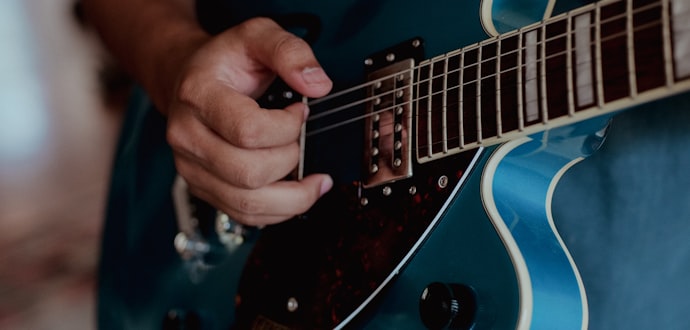
Joan Jett's technique is often underestimated because it is deliberately economical. She built her sound around the power chord, two or three notes played with a flat pick and a downstroke, and she played those chords with a conviction and rhythmic precision that transformed simple patterns into something commanding.
Her right-hand attack is heavy and consistent. She strikes the strings with authority, and the rhythmic placement of her downstrokes drives the music forward with an almost physical force. This is not a technique associated with flash or complexity, but it is a technique that requires genuine discipline to execute consistently at tempo across a full set.
Jett also understands the value of space. Her solos, when she plays them, are brief and targeted, usually pentatonic phrases chosen for maximum impact rather than maximum note count. She learned from early rock and roll and punk rock that the listener doesn't need to hear everything the guitarist can do, only the part that serves the song.