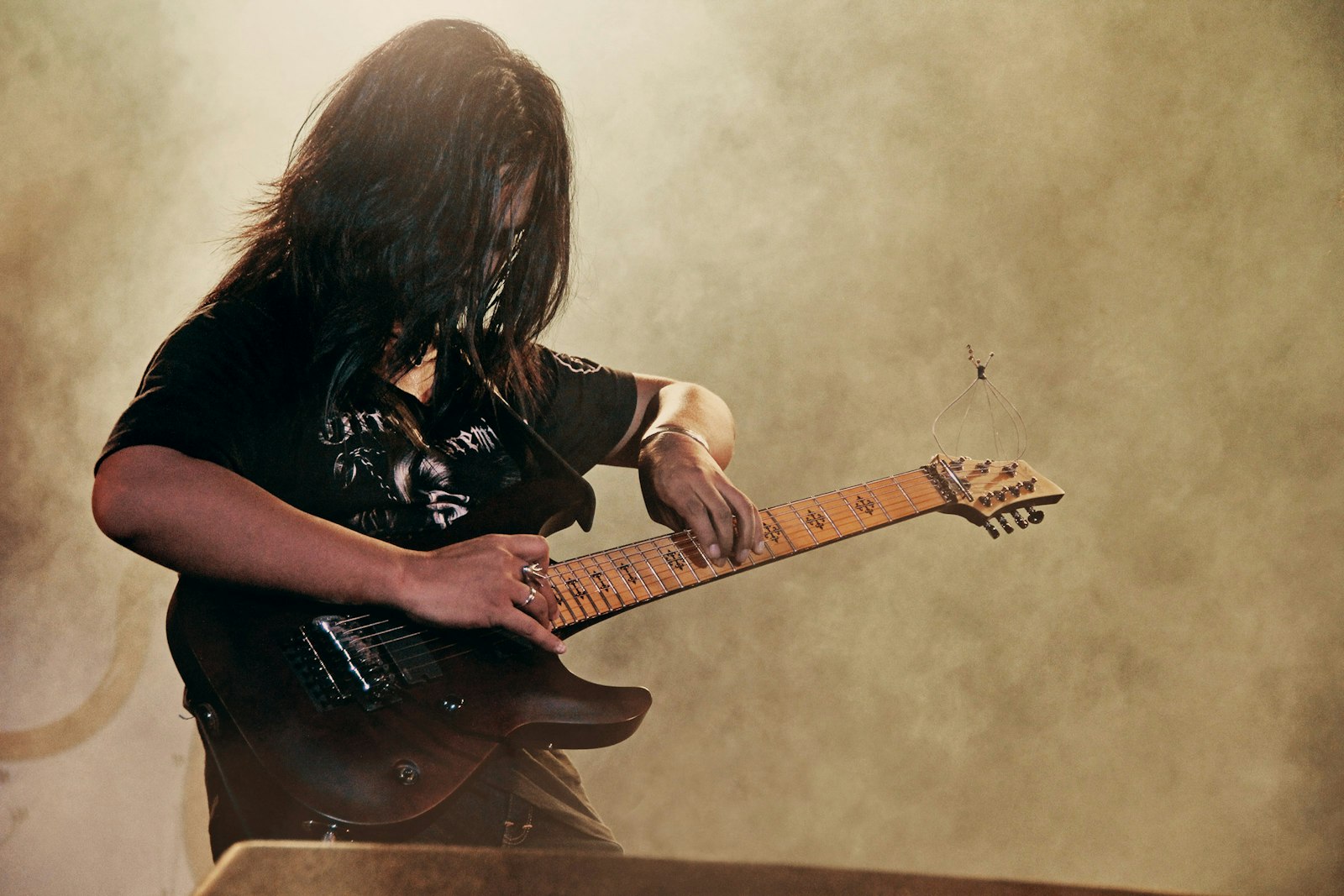









Kim Thayil
Current Ranking
Kim Thayil is ranked #162 of 162 guitarists on the Greatest Guitar Player leaderboard, based on our editorial score until fans weigh in. On the punk, grunge and alternative leaderboard, Kim Thayil ranks #17 of 17. No fan votes yet, so be the first to rate Kim Thayil on 8 attributes at greatestguitarplayer.com/vote.
Biography
Kim Thayil, born in Seattle in 1960, is the guitarist of Soundgarden and one of the most distinctive and underrated architects of the heavy guitar sound that came out of the Pacific Northwest in the late 1980s and early 1990s. While Soundgarden is often filed under grunge, Thayil's playing draws on heavy metal, psychedelia, and a love of dissonance and unusual sounds, creating dark, dense, hypnotic music that stood apart from everything around it.
Thayil's signature is his embrace of strangeness. He is famous for using unconventional and dropped tunings and for writing riffs full of dissonance, odd time signatures, and droning, almost Eastern-sounding textures, giving Soundgarden's music a heavy, disorienting, psychedelic quality. Songs like Rusty Cage, Black Hole Sun, and Spoonman are built on his thick, sludgy, oddly tuned riffs and his eerie, atmospheric soloing, which favored mood, feedback, and texture over conventional flash. He tended to avoid the usual rack of effects, relying instead on raw tone, a Guild guitar, and his own idiosyncratic ideas.
Here is the gem that defines his approach. Thayil and Soundgarden delighted in writing in strange tunings and unusual time signatures, often making music in meters like seven or nine beats that would trip up most listeners, yet somehow turning those odd structures into massive, anthemic songs. Black Hole Sun, with its woozy, shifting harmony and dreamlike feel, became a huge hit despite, or because of, its weirdness, proving that Thayil's adventurous, dissonant instincts could connect with a mass audience. He brought an art-rock sense of experimentation into heavy guitar music and made it sound both crushing and otherworldly.
As a key figure in the Seattle scene, Thayil helped define an entire era of rock, and his influence on heavy alternative guitar is significant even if his name is less famous than some of his peers. He played with an intelligence and a willingness to be strange that set Soundgarden apart, and after the tragic death of singer Chris Cornell, his contributions to that band's legacy have only become more appreciated. For guitarists interested in heaviness with brains, in riffs that are as weird as they are powerful, Kim Thayil is a master worth studying, the man whose dissonant, oddly tuned vision gave Soundgarden its dark and singular soul.
Legendary Performance
Soundgarden at Lollapalooza, 1992
Soundgarden's appearances at Lollapalooza 1992 introduced Kim Thayil's guitar work to a mass audience that had previously encountered it mainly through alternative radio. The outdoor festival format suited the band perfectly: the massive low-end weight of Thayil's detuned riffs translated across open fields with a physical presence that indoor venues couldn't quite replicate.
Thayil played a Gibson SG and various other guitars through Marshall amplifiers tuned to drop D or lower, giving his rhythm work the heaviness of metal while retaining the harmonic ambiguity and rhythmic complexity that distinguished Soundgarden from their heavier contemporaries.
His slide guitar work on songs like Like Suicide and his use of dissonance and feedback as compositional tools rather than noise were particularly striking in the festival context. Thayil was not playing to the back of the field the way many rock guitarists approached outdoor shows. He was playing precisely, at volume.
▶ Watch on YouTubeGear
Gibson SG • Gibson Melody Maker • Drop Tuning • Marshall Stack • Big Muff Pi
Kim Thayil's gear philosophy centers on heavy guitars played in low tunings through high-gain amplification. His primary guitars during Soundgarden's peak years were various Gibson SG models and Gibson Melody Makers, the latter valued for their simplicity and the way their single pickups responded to detuning with a particular low-end density.
He typically tuned to Drop D or lower, sometimes dropping as far as C or B depending on the song. The low tunings gave Soundgarden's music its distinctive weight, and Thayil exploited the unusual chord voicings and open-string effects that result from non-standard tunings.
For amplification, Thayil used Marshall stacks and later Hiwatt amplifiers, running them at settings that produced natural tube saturation at stage volume. He also used various effects pedals including an Electro-Harmonix Big Muff and a DigiTech Whammy, the latter for the pitch-shifted effects that appear throughout Soundgarden's catalog.
Signature Technique
Dissonance, Drone & Unconventional Structure
Kim Thayil's guitar technique is defined by a willingness to use dissonance, noise, and unconventional song structures as primary compositional tools rather than as incidental effects. He approaches the guitar as a sound-generating object rather than simply as a melodic instrument, exploring what happens when strings are detuned, feedback is controlled, and standard harmonic expectations are deliberately frustrated.
His rhythm playing relies on low open strings as drones against which he plays riffs in higher positions, creating an interval clash between the drone and the riff that generates harmonic tension without resolving it conventionally. Soundgarden's most distinctive compositions exploit this quality: the listener feels the pull toward resolution but the music refuses to provide it cleanly.
Thayil also uses feedback as a textural element, controlling it through pick angle, distance from the amplifier, and string selection. His slide work employs a glass bottleneck and favors unusual interval combinations that reinforce the dissonant harmonic world Soundgarden occupied throughout their career.