




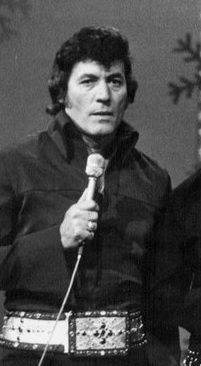

Carl Perkins
Current Ranking
Carl Perkins is ranked #146 of 162 guitarists on the Greatest Guitar Player leaderboard, based on our editorial score until fans weigh in. On the rock and roll leaderboard, Carl Perkins ranks #6 of 8. No fan votes yet, so be the first to rate Carl Perkins on 8 attributes at greatestguitarplayer.com/vote.
Biography
Carl Perkins, born in 1932 to a sharecropping family in rural Tennessee, was one of the true founding fathers of rockabilly and a guitarist whose influence on rock and roll far outstrips his fame. He grew up dirt poor, picking cotton alongside Black field workers who taught him the blues, and he fused that with country and gospel to help invent the rowdy, twangy hybrid that would explode out of Sun Records in Memphis in the mid-1950s.
At Sun, Perkins was labelmates with Elvis Presley, Johnny Cash, and Jerry Lee Lewis, the legendary roster captured in the famous Million Dollar Quartet photograph. In 1956 he wrote and recorded Blue Suede Shoes, a song so huge it became one of the first records to top the country, pop, and R&B charts all at once, and it looked like Perkins might become as big a star as Presley. His guitar style was the blueprint for rockabilly lead playing, all snapping, chicken-pickin' double stops, bluesy bends, and rhythmic drive, the sound of country music plugged in and let loose.
Then fate intervened. On his way to a national television appearance to promote Blue Suede Shoes, Perkins was badly injured in a car crash that killed his brother and sidelined him at the exact moment his career was peaking, and Elvis's version of the song sailed past his own. He never again reached those commercial heights, but his songs and his playing seeped permanently into rock and roll.
Here is the gem that captures his stature among musicians: George Harrison idolized Carl Perkins so completely that in the Beatles' earliest days he sometimes performed under the stage name Carl Harrison. The Beatles recorded several Perkins songs, including Everybody's Trying to Be My Baby, Honey Don't, and Matchbox, more covers than they gave almost any other artist, and Harrison's bright, rockabilly-tinged lead style owes a direct debt to him. Perkins kept writing and playing for decades, was inducted into the Rock and Roll Hall of Fame, and lived to see the giants he influenced repeatedly tell the world how much they owed him. He is the quiet architect whose fingerprints are all over the music that followed, even when his name is not the first one people remember.
Legendary Performance
The Ed Sullivan Show, 1956
Carl Perkins was poised to appear on The Ed Sullivan Show in March 1956 to perform Blue Suede Shoes , a song he had written that was outpacing Elvis Presley's cover on the charts. A car accident on the way to New York put Perkins in the hospital and Elvis on the show instead, one of the great what-ifs of rock and roll history.
Despite that cruel twist, Perkins appeared on other television programs later that year, and the live performances that survive reveal a guitarist of exceptional authority. His Butterscotch Blonde Fender Telecaster, played through a small combo amp, produced a cutting, articulate tone that drove his rockabilly rhythms forward with physical force.
His guitar work defined rockabilly: the snapping string bends, the chicken-pickin' hybrid technique, the interplay between rhythm chords and single-note lead runs executed on a single instrument simultaneously. He was the architect of a guitar vocabulary that country, rock, and blues players still draw from today.
▶ Watch on YouTubeGear
Fender Telecaster • Butterscotch Blonde • Single-Coil Tone • Combo Amp • Rockabilly Rig
Carl Perkins is identified above all with the Fender Telecaster, specifically the Butterscotch Blonde model he played in the mid-1950s when rockabilly was being invented in real time. The Telecaster's bright, cutting tone was perfectly suited to the genre: it could cut through a drum kit and upright bass without needing massive amplification, and its single-coil pickups responded to the aggressive pick attack Perkins favored with clarity and presence.
Perkins amplified through small combo amplifiers, typically a Fender or similar unit run at the edge of breakup, where the amp contributed a mild overdrive that gave his tone grit without obscuring the note definition his hybrid picking technique required.
He later played Gibson ES-335 and similar semi-hollow guitars as his career continued, but the Telecaster remains his signature instrument. Many players who attempted to replicate his style discovered that the Tele's architecture was essential to the sound, not just incidental to it.
Signature Technique
Hybrid Picking & Rockabilly Architecture
Carl Perkins developed the hybrid picking technique that became the foundation of rockabilly guitar: a flat pick held between thumb and index finger while the remaining fingers pluck strings independently, allowing a single player to alternate between bass notes, rhythmic chord stabs, and treble lead lines without changing hand position.
This chicken-pickin' approach, as it is often called, gave Perkins the ability to play what sounded like two or three guitar parts simultaneously. He could drive a bass line with downstrokes on the low strings, accent beats with chord stabs in the midrange, and pick out lead melodies on the high strings in quick succession, often within a single measure.
His string bending technique was equally distinctive: he favored sharp, quarter-step bends that gave notes a vocal inflection associated with country music but deployed at the tempo and intensity of rock and roll. These micro-bends became central to the rockabilly vocabulary and were adopted wholesale by virtually every guitar player who worked in the genre after him.