




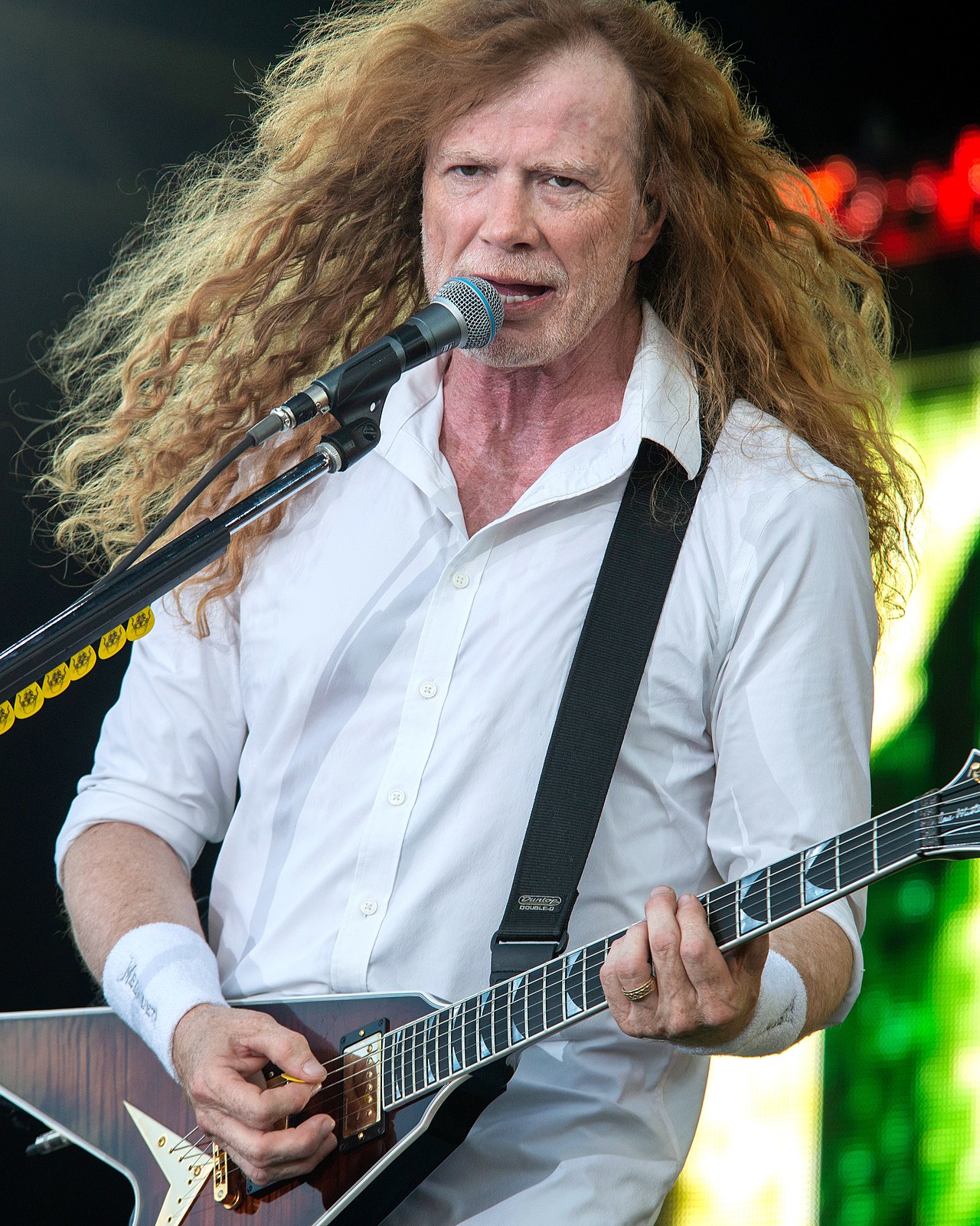

Dave Mustaine
Current Ranking
Dave Mustaine is ranked #53 of 162 guitarists on the Greatest Guitar Player fan leaderboard, based on 1 fan vote so far. On the heavy metal leaderboard, Dave Mustaine ranks #7 of 14. Agree? Rate Dave Mustaine on 8 attributes at greatestguitarplayer.com/vote.
Biography
Dave Mustaine, born in California in 1961, is the founder, frontman, and lead guitarist of Megadeth, and one of the most technically formidable rhythm guitarists thrash metal ever produced. He plays with a ferocious precision, stacking intricate, fast-picked riffs into songs of unusual complexity, and he sings with a snarling sneer that became one of the defining voices of the genre. He is also, by his own admission, a man fueled for much of his career by one enormous chip on his shoulder.
That brings us straight to the gem, because it is the central fact of his story. In the early 1980s Mustaine was the original lead guitarist of Metallica, and he was talented and volatile in equal measure. Just as the band was about to record the debut album that would launch them toward becoming the biggest metal act in the world, his bandmates abruptly fired him over his drinking and his temper, putting him on a cross-country bus home with nothing. Humiliated and furious, Mustaine channeled that rejection into a vow to build a band faster and heavier than the one that had cast him out, and Megadeth was born out of pure competitive fire.
He made good on the threat. Megadeth became one of the so-called Big Four of thrash metal alongside Metallica, Slayer, and Anthrax, and Mustaine's musical vision was the most intricate and technically demanding of the bunch. Albums like Peace Sells But Who's Buying, Rust in Peace, and Countdown to Extinction are packed with complex, interlocking riffs and dual-guitar gymnastics, and Rust in Peace in particular, featuring the epic Holy Wars, is regarded as one of the greatest and most technically dazzling metal albums ever made.
Mustaine's career has been as turbulent as his playing is precise, marked by lineup chaos, addiction and recovery, outspoken opinions, and a long, complicated rivalry with his former band. Yet through it all he has kept Megadeth at the top of the metal world for four decades and survived a throat cancer diagnosis to keep performing. For all the drama, his guitar legacy is secure. He is one of thrash's true architects, a player whose riffs raised the technical bar for an entire genre, and living proof that getting kicked out of one legendary band can be exactly the fuel needed to build another.
Legendary Performance
The Big Four: Live from Sofia, Bulgaria
June 22, 2010 · Sonisphere Festival, Kamenitza Arena, Sofia, Bulgaria
The Big Four, Metallica, Slayer, Megadeth, Anthrax, had never performed on the same stage in their combined histories. The thrash metal movement they had collectively built in the early 1980s had made each of them wealthy and influential, but the internecine tensions of that world, and the particular history between Dave Mustaine and his former Metallica bandmates, had kept a joint performance perpetually in the category of the theoretically possible rather than the actually planned. The Sonisphere Festival in Sofia in June 2010 changed that: the four bands shared a stage for the first time, performing to 80,000 people and a worldwide satellite broadcast. For Mustaine, whose ejection from Metallica in 1983 had defined the subsequent narrative of his career, the performance was both a musical event and a personal resolution.
Megadeth played a set that included "Peace Sells," "Symphony of Destruction," and "Holy Wars… The Punishment Due", a catalogue built on the premise that Mustaine's technical and compositional ambitions were not only comparable to Metallica's but in some respects exceeded them. His downpicking at thrash tempos, his riff construction using diminished intervals and chromatic movement, and the sheer structural complexity of the material demonstrated why Megadeth had endured for 25 years. The Sofia concert was broadcast to cinemas in 40 countries and became the definitive document of thrash metal's original generation performing together for an audience that had waited three decades for exactly that occasion.
▶ Watch on YouTubeGear
Jackson King V & VMNT Dave Mustaine Signature (1983-present)
Known for: "Peace Sells", Peace Sells… but Who's Buying?, 1986
Dave Mustaine's association with Jackson guitars began in the early 1980s when the company was building instruments specifically for the new thrash metal players who required high-output pickups, fast-action necks, and body shapes that facilitated the downpicking at extreme tempo that the genre demanded. His Jackson King V, the flying-V-derived body shape with Jackson's through-neck construction, became his primary instrument for most of Megadeth's classic period. The neck-through design provides enhanced sustain compared to bolt-on construction, which matters for the longer palm-muted riff sections where note definition at the end of each phrase needs to be maintained.
After a period with Dean guitars in the mid-2000s, during which the Dean VMNT signature was developed, Mustaine returned to Jackson, and the Jackson Dave Mustaine VMNT became his definitive signature model. The guitar retains the King V body shape he had played for decades, with active EMG pickups designed to provide the consistent high output that thrash rhythm playing requires across a full-length set.
Randall RG100ES & Marshall
Known for: "Holy Wars… The Punishment Due", Rust in Peace, 1990
Mustaine's long-running association with Randall amplifiers produced the "Mustaine" tone: a high-gain solid-state drive character that differs from the tube-amplifier warmth of most rock guitarists. Solid-state distortion has a harder, more aggressive quality than tube saturation, it clips more abruptly, producing a compressed attack that suits the mechanical precision of thrash downpicking. The Randall RG100ES was his primary live amp for the majority of Megadeth's active years.
He has also used Marshall amplifiers extensively, particularly in the early Megadeth period and for studio recording where the tube warmth of a Marshall JCM 800 complemented the aggressive playing style. The combination of Marshall tube warmth and Randall solid-state aggression has appeared in different configurations across the Megadeth catalogue, reflecting the range of tonal requirements across albums as stylistically varied as "Killing Is My Business" and "Countdown to Extinction."
ISP Decimator Noise Gate, Cry Baby Wah, Boss DD-7 Delay
Dave Mustaine's effects vocabulary is famously utilitarian rather than expressive, reflecting his preference for letting picking attack and amp gain do the heavy lifting. The single most important pedal in his rig is the ISP Decimator noise gate, an unusual centerpiece for an effects discussion but a non-negotiable tool for the kind of aggressive downpicked thrash rhythm playing he is known for. Without an extremely tight noise gate, the high-gain pickup-and-amp combination he uses would produce uncontrollable feedback and string ringing between palm-muted chord hits, and the percussive precision that defines his rhythm style would be impossible to achieve. The Decimator runs in his loop with the threshold set aggressively, killing the signal cleanly between every muted note and producing the staccato gap-and-attack pattern that is central to Megadeth's sonic identity.
Beyond the noise gate, his pedalboard is restrained by metal-guitar standards. A Dunlop Cry Baby wah appears occasionally for solo expression, most often during sustained lead passages where he wants vocal-like vowel shifts on held notes rather than continuous sweeping. A Boss DD-7 (or earlier DD-3) digital delay sits in the chain for slapback thickening on leads and for the occasional longer repeat on atmospheric intros. He typically uses a TC Electronic PolyTune for stage tuning and a clean boost (often a simple overdrive pedal set for unity gain with a slight push) for solo lift. The chain is deliberately small, fits on a compact pedalboard, and reflects the broader philosophy that drives his whole rig: tone is in the hands and the amp, and pedals exist to control the signal rather than to color it.
Signature Technique
Thrash Rhythm Mechanics & Downpicking Endurance
Dave Mustaine's foundational technical contribution to heavy metal is the codification of thrash rhythm guitar: downpicking at tempos that most players can only sustain for short bursts, combined with riff construction that uses chromatic passing tones, tritone intervals, and the half-step tension of the minor second as melodic materials rather than avoiding them. The tritone, historically called the "devil's interval" for its dissonant quality, is structurally central to Megadeth's riff vocabulary: "Peace Sells," "Holy Wars," and "Symphony of Destruction" are built on interval relationships that create maximum harmonic tension without resolving it in the ways classical or blues-based music would suggest.
His downpicking endurance, the ability to sustain all-downstroke picking at thrash tempos for the duration of a full set, is the physical technique that underpins the rhythmic character of his playing. Alternating picks produce a subtly different accent pattern; all downstrokes produce uniformity of attack that gives thrash rhythm guitar its mechanical, driving quality. The compositional complexity of Megadeth's arrangements, time signature changes, unison lines between guitar and bass, extended instrumental sections, means that Mustaine's rhythm playing must maintain technical precision across structures that are genuinely demanding to track, let alone execute at the speeds required.