

.jpg)

Eddie Van Halen
Current Ranking
Eddie Van Halen is ranked #3 of 162 guitarists on the Greatest Guitar Player fan leaderboard, based on 4 fan votes so far. On the hard rock leaderboard, Eddie Van Halen ranks #1 of 12. Agree? Rate Eddie Van Halen on 8 attributes at greatestguitarplayer.com/vote.
Biography
Eddie Van Halen, born in the Netherlands in 1955 and raised in Pasadena, California, is the guitarist who reset the clock on rock guitar, dividing it into the era before him and the era after. With his band Van Halen he brought a joyful, explosive virtuosity to the instrument that made everything that came before sound a little tame, and he did it with a grin, a sense of fun, and a homemade guitar he built with his own hands. Trained as a classical pianist as a boy, he poured that musicality into a wholly new vision of what the electric guitar could be.
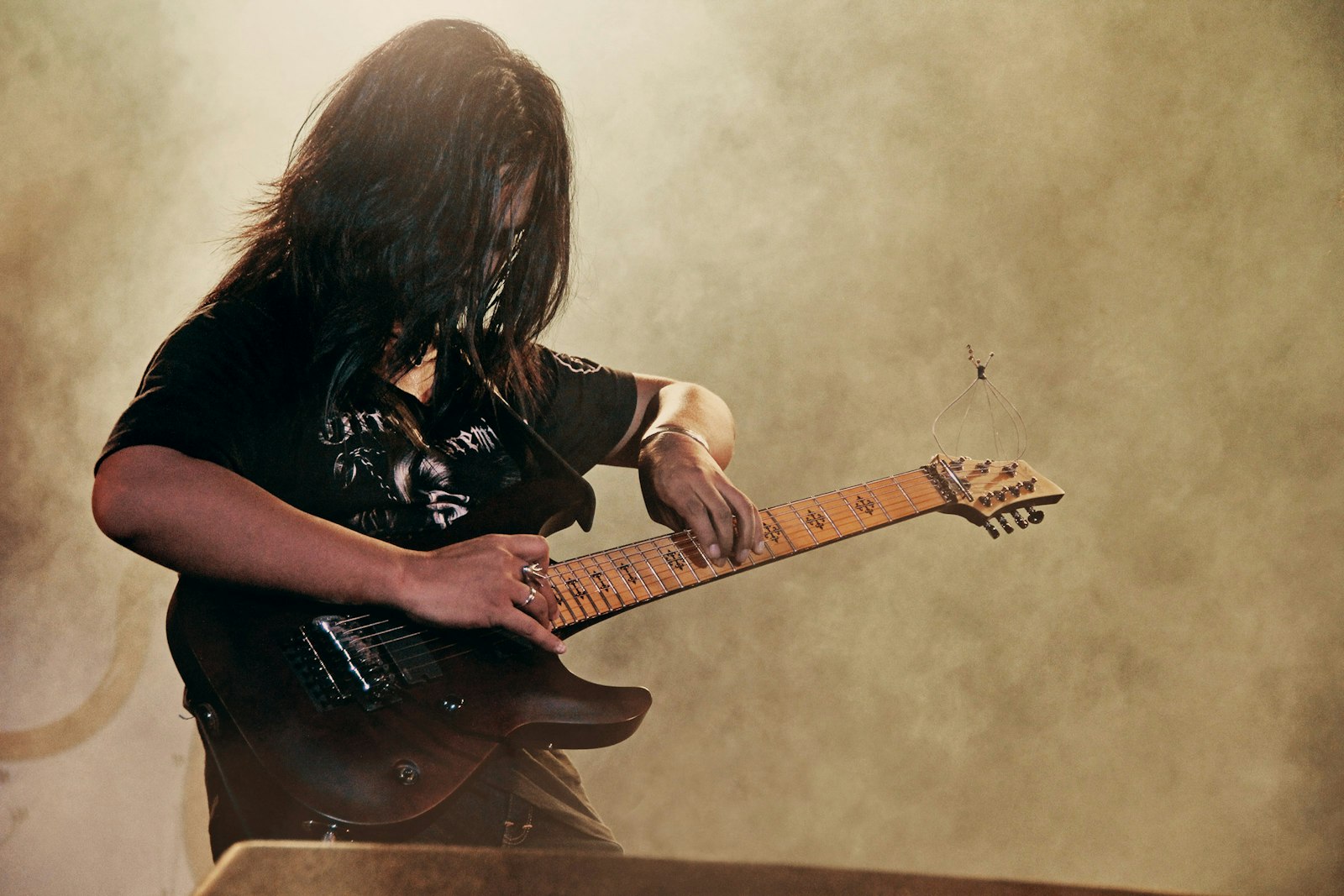
The shot heard round the guitar world was Eruption, a roughly ninety-second instrumental on Van Halen's 1978 debut that left players everywhere stunned. On it, Eddie showcased two-handed tapping, using the fingers of his right hand on the fretboard alongside his left to play cascading, piano-like runs at impossible speed. He did not invent tapping outright, but he popularized and perfected it so completely that he made it his own, and within months guitarists around the world were trying to reverse-engineer what he had done. His warm, singing brown sound, his whammy-bar dive bombs, and his harmonics expanded the vocabulary of the instrument permanently, across hits like Runnin with the Devil, Panama, Hot for Teacher, and the synth-driven smash Jump.
Here is the gem that captures how protective he was of his breakthrough. In Van Halen's early club days, Eddie was so worried about other guitarists stealing his tapping technique that he would reportedly turn his back to the audience during his solos, hiding his hands so no one could see exactly how he was doing it. He was guarding a secret that would soon belong to everyone.
A second gem shows his inventor's mind. Unsatisfied with any factory instrument, he built his own, the red, white, and black striped Frankenstrat, by combining a cheap body, a humbucker, and salvaged parts to get exactly the sound and feel he wanted, and he kept tinkering with guitars, amps, and gear his whole life, eventually patenting designs of his own. And that unmistakable guitar solo on Michael Jackson's Beat It, one of the most famous solos in pop history, is Eddie, who played it as a favor, reportedly for no fee, and even helped rearrange part of the track in the studio.
Across decades at the top, he remained rock's happiest virtuoso, playing fiendishly difficult music as though it were the most fun imaginable, his joy as infectious as his technique was intimidating. A Rock and Roll Hall of Fame inductee with Van Halen, he influenced essentially every rock and metal guitarist who followed him. When he died in 2020, the outpouring confirmed what every guitarist already knew: Eddie Van Halen changed the instrument forever, and made it look like a blast.
Legendary Performance
Van Halen at the US Festival
May 28, 1983 · Glen Helen Regional Park, San Bernardino, California
The 1983 US Festival's Heavy Metal Day brought Van Halen to a single-day audience of 375,000 people, at that point the largest paying crowd in North American concert history, for a fee of $1.5 million that established a new ceiling for live performance economics. By 1983, "Eruption" had been available on record for five years and had become the reference point for electric guitar possibility; hearing Eddie Van Halen perform the piece live, in front of an audience the size of a small city, gave the technical argument a human scale. His set that day included both the studio version of "Eruption" and an extended live solo that went further than the recorded version, demonstrating that the record had captured a technique rather than exhausted it.
The US Festival performance is the moment that Van Halen's arena-era dominance is most fully documented. The band at this point, with David Lee Roth's showmanship and Eddie's guitar language operating in full coordination, was the most commercially successful and musically distinctive rock act in America, and the festival crowd's response confirmed both facts simultaneously. For guitar players watching the broadcast, the performance demonstrated that two-handed tapping, the technique Eddie had developed in his garage in Pasadena and debuted on record in 1978, was not a studio device but a live performance approach that could hold the attention of 375,000 people across an outdoor venue.
▶ Watch on YouTubeGear
The "Frankenstrat", Homemade Striped Guitar (1974-1979)
Known for: "Eruption", Van Halen, 1978
The Frankenstrat was not purchased, it was built. Eddie Van Halen constructed the guitar himself in the mid-1970s from a $50 Boogie Bodies ash body, an $80 Charvel maple neck, and a single PAF-style humbucker, assembled in his garage in Pasadena. He finished it in black with white stripes of bicycle tape, then partially repainted sections in red. The result looked like a visual argument.
On "Eruption," Eddie demonstrated a two-handed tapping technique that redefined what was possible on the electric guitar. The Frankenstrat's low-mass tremolo and single hot-output humbucker were central to that technique, a guitar built by a player who knew exactly what he needed to do. The original now resides in the Smithsonian National Museum of American History.
Marshall 1959 Super Lead 100W, Modified "Plexi"
Known for: "Ain't Talkin' 'Bout Love", Van Halen, 1978
Eddie ran his Frankenstrat into late-1960s Marshall Super Lead amplifiers that he modified extensively, most famously installing a variable resistor ("Variac") on the rear panel that allowed him to reduce the voltage reaching the output tubes. This produced the amp's most compressed, harmonically rich distortion at volumes lower than the full 100 watts normally required.
The result was a tone of unusual density and touch-sensitivity: a distortion that responded to pick attack, string bending, and fret-hand pressure in ways that studio-driven distortion seldom does. When Eddie picked harder, the amp got louder and brighter. When he lightened his touch, it compressed back into warmth.
MXR Phase 90
The MXR Phase 90 is a four-stage phaser with a single control, speed, and no other adjustments. Its simplicity is its strength: a warm, organic phase sweep that adds movement and three-dimensionality to a guitar signal without altering its fundamental character.
Eddie placed the Phase 90 early in his signal chain, before the amp rather than in an effects loop, so that its sweep became part of the overdriven tone. The result is audible across "Eruption": sustained tapped notes pulse with a slow, even modulation that adds an almost vocal quality to the most abstract passages. MXR eventually released an EVH Phase 90 signature model, one of the best-selling phaser pedals ever made.
Signature Technique
Two-Hand Tapping
Eddie Van Halen didn't invent two-hand tapping, but he introduced it to the mainstream with such force that the technique was forever altered. Tapping works by using a finger of the picking hand to hammer onto a fret, essentially treating both hands as fretting hands simultaneously. The result is an ability to span intervals and execute runs at speeds mechanically impossible when restricted to one hand. When "Eruption" appeared on Van Halen's debut in 1978, the 102-second solo functioned like a starting pistol for an entire era of technical rock guitar.
What separated Eddie from the hundreds of players who immediately copied the technique was musicality. His tapping was never a mere display, it served the song. He varied the rhythm, the dynamics, and the register of his tapped lines in ways that kept even technically demanding passages sounding melodic rather than mechanical. That instinct for phrasing, more than the physical act of tapping, is what defined his genius.