
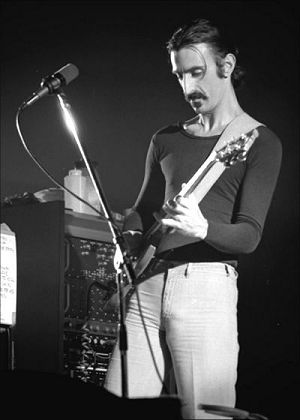

Frank Zappa
Current Ranking
Frank Zappa is ranked #13 of 162 guitarists on the Greatest Guitar Player leaderboard, based on our editorial score until fans weigh in. On the classic rock leaderboard, Frank Zappa ranks #5 of 18. No fan votes yet, so be the first to rate Frank Zappa on 8 attributes at greatestguitarplayer.com/vote.
Biography
Frank Zappa, born in Baltimore in 1940 and raised in California, was one of the most singular figures in all of music, a wildly prolific composer, bandleader, satirist, and guitarist who refused to respect any boundary between high art and low comedy. Across dozens of albums he fused rock, jazz, doo-wop, and modern classical music into something entirely his own, and somewhere inside that sprawling output was a fiercely original electric guitarist whose long, exploratory solos are studied and beloved by players who care about improvisation.
Zappa approached the guitar the way a jazz or avant-garde composer might, treating each solo as a spontaneous composition rather than a set of memorized licks. His tone was distinctive and his phrasing unpredictable, full of unusual rhythms, sudden melodic leaps, and a vocal, conversational quality. He thought so highly of his own improvised guitar work that he released entire albums consisting of nothing but solos lifted from live performances, most famously the collection Shut Up n Play Yer Guitar, a bold statement that the solo itself could be the art.
But his guitar playing was only one facet of a staggering musical mind. Zappa was a serious, self-taught composer who idolized the modernist Edgard Varese, wrote complex orchestral works, and conducted ensembles performing his music, all while leading rock bands of fearsome technical ability through satirical songs about American life. He demanded virtuoso musicianship from everyone around him and was famous for the impossibly difficult parts he wrote, running his bands like a tireless musical boot camp.
Here is the gem that shows the principled streak under all the absurdist humor. In 1985, when a group of politically connected spouses known as the PMRC pushed to put warning labels and censorship on music they deemed offensive, Zappa testified before the United States Senate, delivering a sharp, articulate, and unflinching defense of free expression and artists' rights. The same man who wrote deliberately silly, provocative songs turned out to be one of the music world's most eloquent and serious defenders of the First Amendment, dressing in a suit to school senators on the Constitution.
A second gem captures how unclassifiable he was. Zappa's curiosity was so boundless that he discovered and championed unknown talents, embraced cutting-edge recording technology like the Synclavier in his later years, and earned admiration from worlds as far apart as punk rockers and avant-garde classical composers, even being honored by orchestras and conductors who took his serious compositions as seriously as he did. He worked at a furious pace until cancer took his life in 1993, leaving behind a catalog so vast that posthumous releases continued for decades. For guitarists, he remains an inspiration to think bigger, take risks, and treat the instrument as a tool for genuine, unfettered creativity.
Legendary Performance
Roxy & Elsewhere, The Roxy Recordings
December 8-10, 1973 · The Roxy Theatre, Los Angeles, California
The three nights Frank Zappa and the Mothers of Invention spent at the Roxy Theatre in December 1973 produced the recording that many consider his definitive live document. The band at this point, including George Duke, Ruth Underwood, and Jean-Luc Ponty, was the most musically sophisticated he had assembled, capable of navigating the composition-improvisation hybrid that Zappa's music required. His guitar solos during the Roxy performances were improvised over pre-composed frameworks, a method he called "xenochrony", the combination of rhythmically unrelated elements to produce a result that sounds composed. The solos on the resulting "Roxy & Elsewhere" album demonstrate the modal fluency that made his guitar work categorically different from rock lead playing of the period.
Zappa approached guitar soloing as a compositional act rather than an expressive one: the solo was a structural element of the piece, not a showcase appended to it. His technique, rooted in Edgard Varèse's concept of organised sound rather than blues phrasing, produced melodic shapes that followed harmonic logic rather than emotional convention, and the Roxy performances captured this approach at a moment when his band could fully realise it. The recordings also document his relationship with the audience, the extended stage banter, the running commentary on the absurdity of the music industry, which was itself a performance practice as deliberate as anything he played.
▶ Watch on YouTubeGear
1963 Gibson SG Special & Various Custom Instruments (1963-1993)
Known for: "Watermelon in Easter Hay", Joe's Garage, 1979
Zappa played a variety of guitars across his career but is most associated with his SG-style instruments and, from the early 1980s, a range of custom guitars built by luthiers including Steve Carr. His 1963 Gibson SG Special, a stripped, double-cutaway guitar with P-90-style pickups, produced the thinner, more cutting tone that suited his melodic soloing approach, where note clarity at high speed was more important than warmth or sustain. He was not sentimental about instruments and replaced or modified them freely according to tonal requirements.
Among his more unusual guitar-adjacent possessions was a collection of instruments signed or previously owned by Jimi Hendrix, acquired partly as collector's items and partly as artefacts of a guitarist he admired. His own playing on these instruments, however, was entirely his own, Zappa's guitar voice was so distinctive that the instrument's provenance was irrelevant to the output.
Marshall & Mesa/Boogie
Known for: Live guitar tone across touring career
Zappa's amplification choices were practical rather than philosophical: Marshall stacks for large stage volume and projection, Mesa/Boogie for the higher-gain, more compressed tone that certain studio applications required. He was not a tone obsessive in the way that some of his contemporaries were, his primary interest was in what the guitar said rather than how it said it, and amplifier choice was a means to an adequate end rather than an artistic statement.
His touring band's production values were consistently high, and the guitar sound in his live performances, as documented on the numerous official and bootleg live recordings, reflects a competent professional setup rather than a specifically designed tonal identity. The musical character of his guitar playing was created by his fingers and his harmonic thinking, not by his equipment chain.
Signature Technique
Modal Improvisation & Compositional Guitar Thinking
Frank Zappa's guitar technique is inseparable from his compositional methodology: he approached soloing as organised sound rather than emotional expression, drawing on Edgard Varèse's concept of music as the organisation of sound in time rather than the communication of feeling through convention. His solos were modal rather than blues-based, built on harmonic frameworks that included diminished scales, whole-tone passages, and the kind of chromatic movement that jazz had developed but rock had largely avoided. He described his best solos as "air sculptures," three-dimensional shapes in acoustic space that were designed to occupy time the way a physical object occupies space. Whether or not that description is poetically accurate, it captures the non-linear quality of his improvisations: they do not develop from a beginning through a middle to a conclusion in the way blues-based solos do.
His picking technique was conventional but his harmonic thinking was not, fast alternate picking navigating intervallic jumps that most rock players would not have considered as melodic materials. The xylophone-like precision of his best melodic runs, achieved at high tempo with consistent dynamics, was the technical vehicle for a compositional approach that treated the guitar as an orchestral voice rather than a lead instrument in the rock sense. His recorded solos, across the enormous Zappa catalogue, are among the most studied by players who are interested in how harmonic complexity and physical technique interact, because they represent a case where the thinking is sufficiently unconventional to be genuinely instructive.