





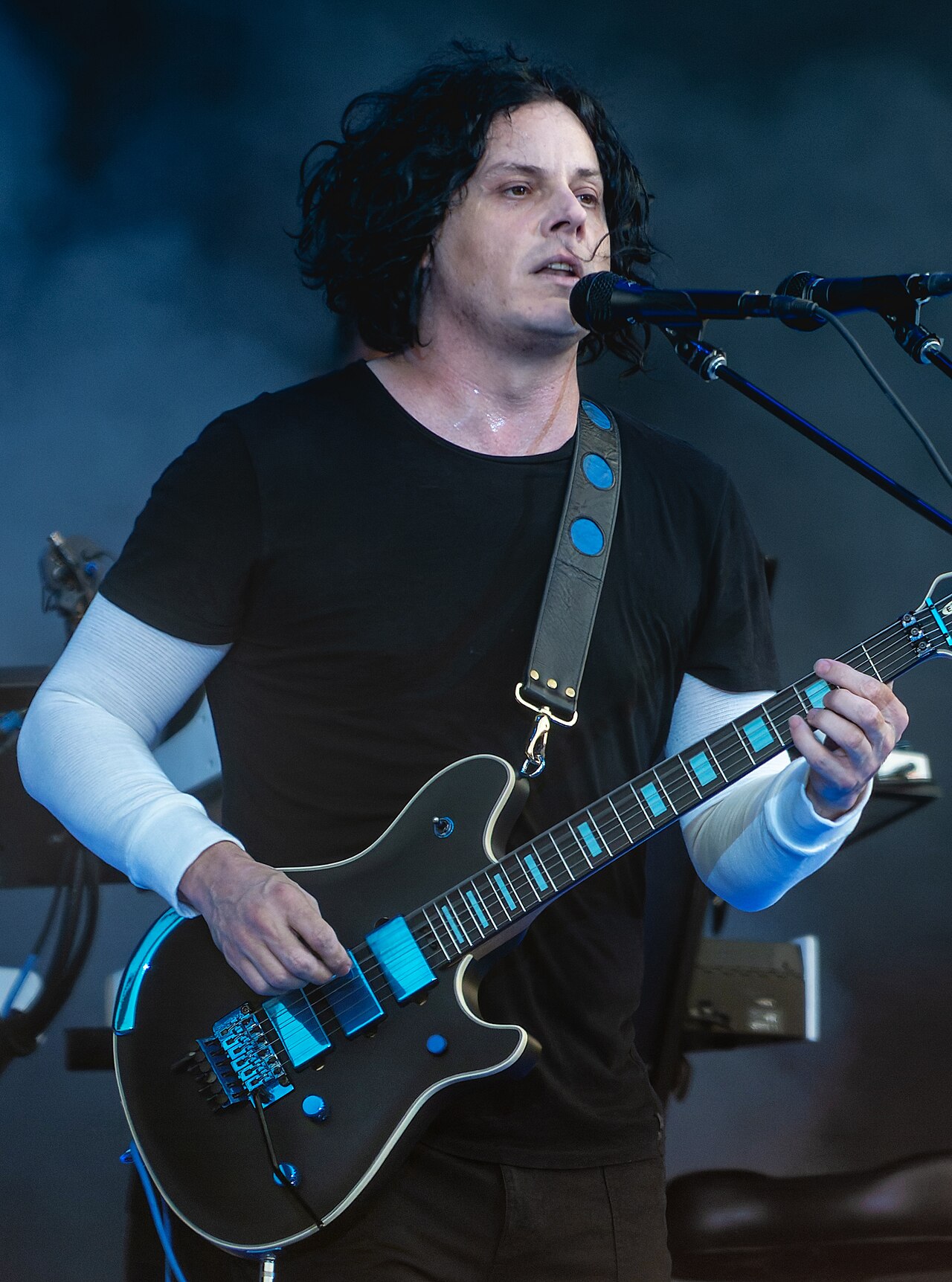

Jack White
Current Ranking
Jack White is ranked #74 of 162 guitarists on the Greatest Guitar Player leaderboard, based on our editorial score until fans weigh in. On the punk, grunge and alternative leaderboard, Jack White ranks #4 of 17. No fan votes yet, so be the first to rate Jack White on 8 attributes at greatestguitarplayer.com/vote.
Biography
Jack White, born John Gillis in Detroit in 1975, is the restless, inventive force who did as much as anyone to drag raw, bluesy guitar rock back into the mainstream in the early 2000s. As the leader of the White Stripes, the deliberately stripped-down duo he formed with Meg White, he built a huge sound out of almost nothing, proving that two people, a guitar, and a drum kit could be more thrilling than any polished arena act.
White's whole philosophy is built on creative limitation. He deliberately restricted the White Stripes to a spare red, white, and black aesthetic and a bare-bones setup, forcing himself to wring maximum impact out of minimal means. His guitar playing is jagged, primal, and bluesy, full of howling slide, distorted riffs, and unpredictable, on-the-edge solos that sound like they might fall apart at any second, which is exactly what makes them exciting. He worships the old Delta bluesmen and garage rockers, and he channels their raw spirit through a thoroughly modern sense of drama.
Here is the gem that captures his embrace of difficulty. For much of the White Stripes' run, White's main guitar was a cheap, semi-hollow plastic-bodied 1960s budget instrument, a Montgomery Ward Airline that most players would have considered a toy. It was hard to keep in tune and tricky to play, and White chose it precisely for that reason, because fighting the instrument forced him to play with urgency and invention rather than comfort. He has often said that struggle and limitation are where creativity comes from, and he made a beat-up plastic guitar into one of rock's most iconic images.
There is a second gem worth knowing. The riff he wrote for Seven Nation Army, played on guitar but pitched down with an octave pedal to sound like a bass, became one of the most recognizable musical phrases on Earth, adopted by sports crowds and stadiums worldwide as a wordless chant that millions of people sing without even knowing where it came from. Beyond the White Stripes, White has stayed prolific and curious, fronting the Raconteurs and the Dead Weather, building a successful solo career, and founding Third Man Records, a label and a passionate champion of vinyl and analog craft. He is one of modern rock's true believers, the man who proved that the rawest, most limited approach can produce the biggest and most enduring sounds.
Legendary Performance
The White Stripes at Glastonbury Festival
June 26, 2005 · Pyramid Stage, Glastonbury Festival, Somerset, England
The White Stripes' headline set at Glastonbury in 2005 resolved a question that critics had been raising since the duo's emergence: whether a two-piece band with no bass player, building its music on Delta blues structures and raw fuzz guitar, could hold a festival crowd of 100,000. Jack White's answer was the Glastonbury performance itself, a set that covered the full White Stripes catalogue through an approach that treated volume and dynamic contrast as its primary expressive tools. The Airline guitar he played through a Fender amp and a minimum of pedals produced a tone that was deliberately unglamorous, and the songs' simplicity, the open-G slide work of "Death Letter," the single riff of "Seven Nation Army", scaled to the Pyramid Stage without loss of intensity.
The performance documented that White's approach to guitar, the deliberate limitation, the refusal of technical refinement for its own sake, the preference for conviction over precision, was not a recording studio strategy but a live performance philosophy. Where most guitarists add equipment and technique as their audiences grow, White had stripped his setup to the minimum that the music required and trusted that the music was sufficient. The Glastonbury crowd's response confirmed it. The set is regularly cited in discussions of the greatest festival performances of the 2000s.
▶ Watch on YouTubeGear
1964 JB Hutto Montgomery Ward Airline "Jack White" Model (1964)
Known for: "Seven Nation Army", Elephant, 2003
The Montgomery Ward Airline guitar that Jack White used throughout the White Stripes era is among the most recognisable instruments in rock. Made in the early 1960s by Valco for the Montgomery Ward mail-order catalogue, a budget instrument sold by a department store, it was chosen by White precisely for its limitations: the pickups are imprecise, the neck is difficult to intonate accurately, and the construction is far below professional standards. White has described the necessity of working around these limitations as a creative catalyst, forcing him to approach the guitar differently than a more capable instrument would have allowed.
The guitar's resonite (a plastic-like composite material) body produces a tone that is nasal and forward in the midrange, fundamentally different from the wood-body warmth of conventional electric guitars. This tonal character, immediately distinctive and impossible to mistake for a conventional guitar sound, became the sonic identity of the White Stripes. Eastwood Guitars subsequently produced reproduction models to meet demand from players who wanted to access the same tonal and physical character.
Fender Blues Junior & Various Vintage Combos
Known for: "Ball and Biscuit", Elephant, 2003
White's amplifier choices have been deliberately modest, Fender Blues Junior combos, Silvertone practice amplifiers, small vintage combos that were not designed for the volumes he uses them at. Running these amplifiers beyond their intended operating level produces a natural distortion that is less controlled than a purpose-built high-gain amplifier but more characterful, the kind of aggressive, slightly out-of-control drive that suits playing built on deliberate imprecision.
His preference for under-powered amplifiers run at excessive volume is the hardware equivalent of his guitar choice philosophy: tools working beyond their designed parameters, stressed into producing sounds their designers did not anticipate. The combination of a budget guitar, an overdriven small amplifier, and minimal pedal processing produces a sound that is paradoxically more distinctive than the carefully optimised rigs of players working with professional-grade equipment.
Signature Technique
Deliberate Limitation & Maximalist Blues Output
Jack White's technique begins with a philosophical commitment that is itself the technique: the deliberate restriction of available tools as a method of generating creative necessity. The White Stripes operated on a two-piece format, guitar and drums, no bass, that required White to occupy the full frequency spectrum a band normally distributes among multiple instruments. His solution was to run the guitar through fuzz and distortion heavy enough to generate low-frequency content that compensated for the missing bass, while using open-G tuning, the tuning associated with Delta blues and Keith Richards, to maximise chord resonance from the fewest possible notes. The Airline guitar he used was cheap, imprecise, and incapable of the technical refinement that professional instruments allow; he chose it specifically for those characteristics.
His slide guitar work, particularly in open G, draws directly from the Delta blues tradition, Son House, Robert Johnson, and applies it with the amplification levels of a stadium rock band, producing a combination of acoustic rawness and electric volume that is entirely his own sonic territory. His right-hand picking is aggressive to the point of imprecision by conventional standards, favouring attack and conviction over evenness and control. That asymmetry, a technically informed player deliberately playing below his technical capability to serve the music's emotional character, is the most sophisticated element of his approach, and the hardest for other guitarists to reproduce because it requires knowing the rules thoroughly enough to break them with intention.