




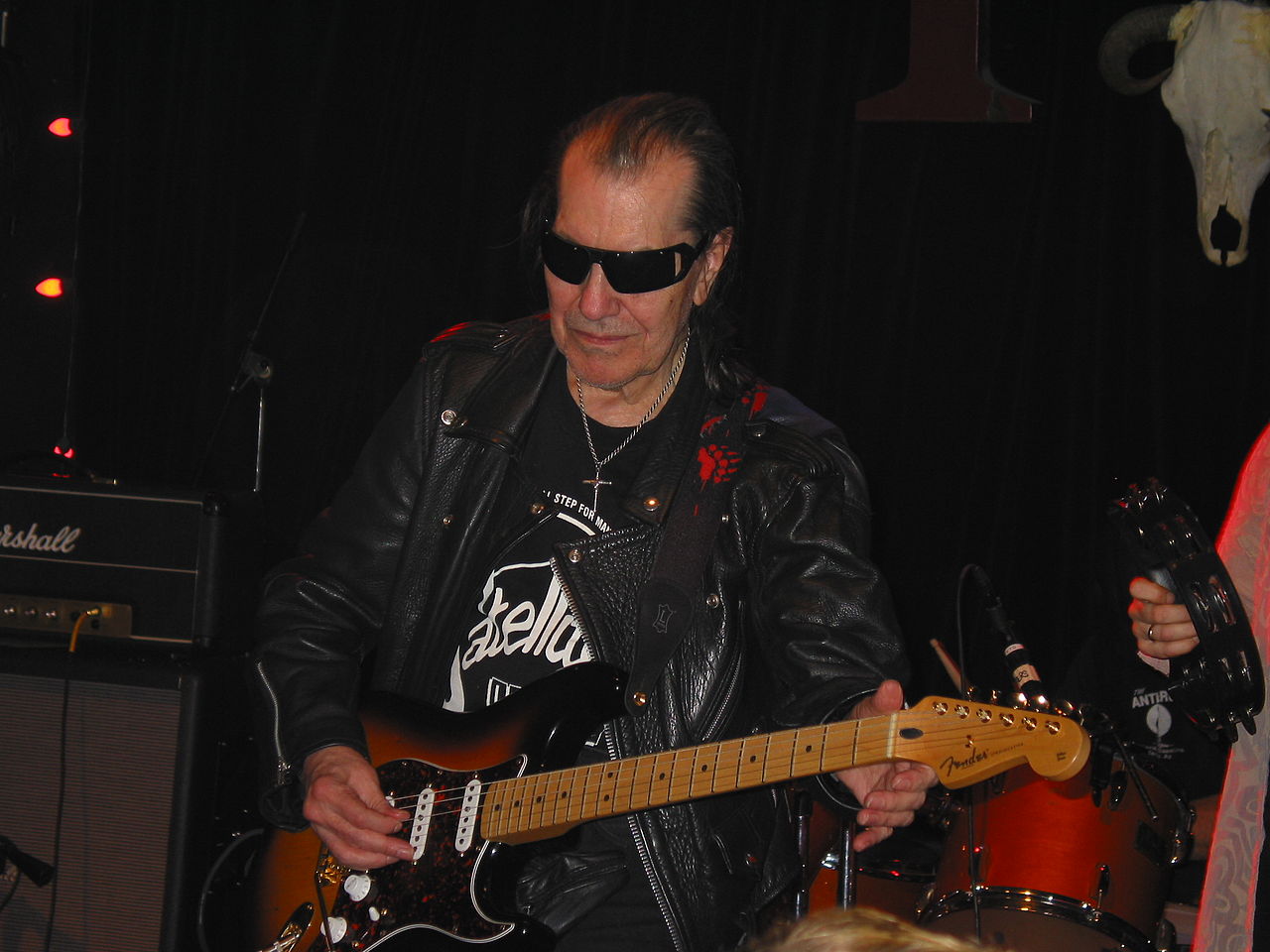

Link Wray
Current Ranking
Link Wray is ranked #151 of 162 guitarists on the Greatest Guitar Player leaderboard, based on our editorial score until fans weigh in. On the rock and roll leaderboard, Link Wray ranks #7 of 8. No fan votes yet, so be the first to rate Link Wray on 8 attributes at greatestguitarplayer.com/vote.
Biography
Link Wray, born in North Carolina in 1929, was a rock and roll pioneer whose influence vastly outstrips his fame, a guitarist who, with a single instrumental in 1958, helped invent the very vocabulary of hard rock guitar. Of Shawnee heritage and largely self-taught, Wray created a sound so raw, menacing, and powerful that it pointed the way toward heavy metal, punk, and everything in between, decades before those genres existed.
The record that did it was Rumble, a slow, swaggering instrumental built on thick, distorted, menacing power chords that dripped with attitude and danger. Wray is widely credited as one of the inventors, and certainly the great early popularizer, of the power chord, the two-or-three-note chord shape that became the fundamental building block of rock and metal guitar. The sound he achieved was dark, fuzzy, and aggressive in a way nothing else on the radio was, and it changed what guitarists thought the instrument could be.
Here is the gem that captures just how dangerous that sound seemed at the time. Rumble has the rare distinction of being an instrumental that was banned from radio stations in several places, despite having no lyrics at all, because authorities feared its menacing, swaggering tone would incite teenage gang violence, the title itself being slang for a street fight. A song with no words was considered too threatening to play, purely on the strength of its sinister guitar sound. It is perhaps the only instrumental in history to be censored for being too cool and too dangerous, a perfect testament to the raw power Wray unleashed.
To get that groundbreaking distorted tone, Wray famously experimented with damaging his equipment, reportedly poking holes in his amplifier's speaker to create the fuzzy, broken-up sound he wanted, an act of sonic vandalism that prefigured the deliberate distortion at the heart of rock guitar. His influence on the players who followed is immense, with everyone from Pete Townshend to Jimmy Page to Iggy Pop and countless punk and metal musicians citing him as a foundational inspiration. Link Wray took the guitar somewhere new, somewhere dark and loud and thrilling, and in doing so he helped lay the groundwork for the entire future of rock. He is the rough-edged originator whose menacing power chords still echo through every heavy riff played today.
Legendary Performance
D.C. Club Circuit, Late 1950s
Link Wray never headlined Woodstock or played Carnegie Hall, but his performances at the clubs and ballrooms around Washington, D.C. in the late 1950s were as consequential as any concert of that decade. It was in these settings that Wray developed the overdriven, aggressive guitar approach that would produce Rumble in 1958, the first rock instrumental to be banned from radio for fear it would incite juvenile delinquency.
Wray played a Danelectro guitar through amplifiers he deliberately damaged, punching holes in the speakers with pencils to achieve a distorted, buzzing tone that no commercial equipment of the era was designed to produce. The resulting sound was threatening in a way that made radio programmers genuinely nervous, which was exactly the point.
These club performances established Wray as the pioneer of power chords and deliberate distortion, the guitarist who showed the following generation, including Pete Townshend, Neil Young, and Jimmy Page, that the electric guitar's potential for aggression had not yet been fully explored.
▶ Watch on YouTubeGear
Danelectro • Modified Speaker Cones • Silvertone Guitar • Pencil Holes in Speakers • Distortion Pioneer
Link Wray's gear was the sonic equivalent of a blunt instrument, and that was entirely intentional. In the late 1950s he played a Danelectro guitar, an inexpensive instrument with lipstick-tube single-coil pickups that produced a thin, slightly metallic tone ideal for cutting through small club mixes.
His most famous modification was to the amplifiers: he punched holes in the speaker cones with pencils or other sharp objects, causing the speakers to rattle and distort at lower volumes than damaged speakers would otherwise require. The resulting sound was rough, buzzing, and aggressively unappealing to conventional ears, which is precisely what made it perfect for Rumble and the material that followed.
Wray also used a Sears Silvertone guitar and various low-cost guitars throughout his career, never particularly interested in high-end instruments. The aggression in his playing came from attack and amplifier modification rather than from expensive gear. He demonstrated that distortion is a choice, not a luxury.
Signature Technique
Power Chords & Intentional Distortion
Link Wray's most significant technical contribution to guitar history is the power chord: a two or three note voicing built on the root and fifth of a scale, without the third that would define the chord as major or minor. The ambiguity of this voicing, combined with heavy distortion, gave Rumble its threatening, deliberately unresolved quality.
Power chords existed before Wray, but he was the first guitarist to make them the primary compositional element of a recording and to deliberately distort the amplification to enhance their impact. The technique he used to distort his amplifiers, physically damaging speaker cones, was crude but effective, and it established the principle that distortion was a valid musical choice rather than a technical defect to be corrected.
His right-hand attack was heavy and percussive, with an emphasis on downstrokes that gave his chord stabs a physical impact. He understood intuitively that rhythm and attack were as important as pitch in making guitar music feel dangerous, and he designed his technique accordingly. Every major punk and metal guitarist who followed owes him a debt.