






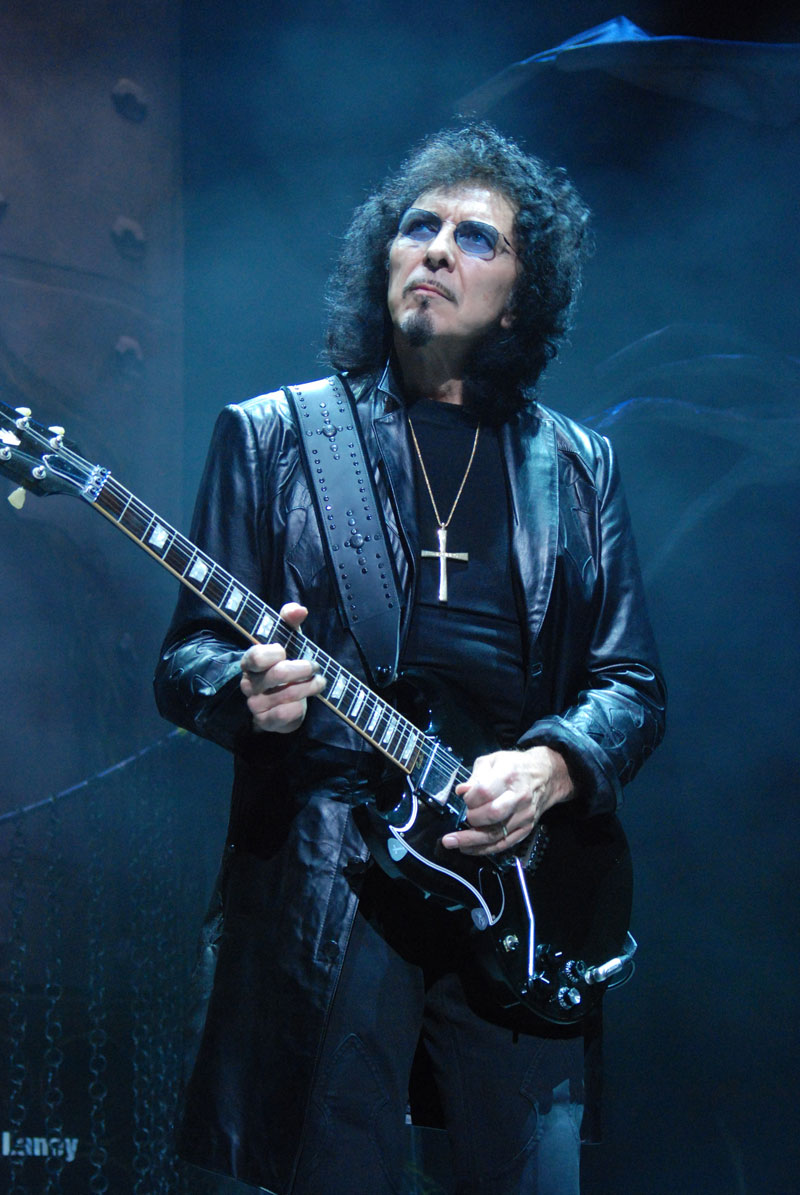

Tony Iommi
Current Ranking
Tony Iommi is ranked #25 of 162 guitarists on the Greatest Guitar Player fan leaderboard, based on 2 fan votes so far. On the heavy metal leaderboard, Tony Iommi ranks #3 of 14. Agree? Rate Tony Iommi on 8 attributes at greatestguitarplayer.com/vote.
Biography
Tony Iommi, born in Birmingham, England in 1948, is quite simply the man who invented heavy metal. As the guitarist and primary creative force of Black Sabbath, Iommi conjured the dark, heavy, doom-laden sound that became the foundation of an entire genre, and he did it while overcoming a devastating injury that, by all logic, should have ended his guitar playing forever. His story is one of the most remarkable triumphs over adversity in all of music.
Here is the gem, the central and astonishing fact of his career. As a young man working in a sheet-metal factory, on what was meant to be his last day before pursuing music, Iommi lost the tips of two fingers on his fretting hand in an industrial accident. For a guitarist, this seemed catastrophic. But Iommi refused to quit. He fashioned homemade thimble-like caps for his damaged fingertips, melting down a plastic bottle and covering the caps in leather to help him grip the strings, and he tuned his guitar strings down to lower, slacker tensions that were easier to fret and bend with his injured hand. Those very adaptations, the detuning and the heavier, darker sound they produced, became the sonic signature of heavy metal itself. The genre's crushing, ominous heaviness was born directly out of one guitarist's ingenious response to a crippling injury.
With that sound, Iommi and Black Sabbath created the blueprint for metal. His monstrous, downtuned riffs on songs like Iron Man, Paranoid, War Pigs, and Black Sabbath were heavier and darker than anything that had come before, full of ominous power and doom-laden atmosphere. Riff after monumental riff poured out of him, and virtually every heavy metal and hard rock band that followed built on the foundation he laid. He is, without exaggeration, the father of the metal riff.
A second gem reveals an unlikely inspiration for his triumph over injury. Iommi has said that a key encouragement came from hearing the music of Django Reinhardt, the gypsy-jazz genius who played dazzling guitar with two paralyzed fingers, and learning that someone had overcome a similar handicap gave the young, despairing Iommi the resolve to keep going rather than abandon the instrument. One disabled guitar genius thus directly inspired another to invent an entire genre.
Iommi has weathered the turbulent history of Black Sabbath, including the wild years with singer Ozzy Osbourne, numerous lineup changes, and even a battle with cancer, while remaining the band's unshakable musical anchor. A Rock and Roll Hall of Fame inductee, he is universally revered as one of the most important and influential guitarists who ever lived. Tony Iommi turned a tragic accident into the birth of an entire genre, and every heavy riff played anywhere in the world today echoes the sound he invented with two damaged fingers and an unbreakable will.
Legendary Performance
California Jam
April 6, 1974 · Ontario Motor Speedway, Ontario, California
Forty-eight hours before Black Sabbath took the stage at the California Jam festival, Tony Iommi believed the band had been removed from the bill. Their booking agent had told them as much. Then the promoters called to say that the band's non-appearance would result in a $250,000 lawsuit, and Iommi found himself on a plane from Birmingham to Los Angeles with two days' notice to prepare for the largest audience Sabbath had ever faced. The California Jam, a twelve-hour festival broadcast live on ABC television to an audience of 250,000 at the Ontario Motor Speedway, was the event that would either confirm or deny whether Black Sabbath, after four years of building the template for heavy metal, were ready for the American mainstream. What happened on April 6, 1974 answered the question with a force that eliminated further debate.
Iommi walked out wearing a cape, carrying his customized "Monkey" SG, the instrument he had rebuilt and refined to accommodate the prosthetic fingertips on his right hand, the result of an industrial accident that had nearly ended his guitar career before it began, and that had instead led him to develop the downtuned, heavy sound that defined the entire genre. When Sabbath launched into "War Pigs," the opening riff hit the crowd of 250,000 like a physical event. For those watching on television across America, the ABC broadcast delivered something that the network's prime-time programming had never managed: the unmediated experience of what heavy metal actually felt like at full volume, played by the people who invented it.
The California Jam recording, officially released decades later but circulated as a legendary bootleg for years, captures Iommi at the precise moment when the full consequence of everything he had built with Sabbath since 1970 became undeniable. The riffs of "Children of the Grave," "Killing Yourself to Live," and "Iron Man" had been refined over four years of touring; at Ontario Motor Speedway, before the largest crowd of their career, they arrived with a weight and finality that made it clear these were not songs but structures, permanent additions to the architecture of popular music that no subsequent generation of heavy guitarists would be able to build without. Geezer Butler recalled afterward: "We knew we'd blow everyone else to death." They were right.
▶ Watch on YouTubeGear
1964 Gibson SG Special, "The Monkey" (1964)
Known for: "War Pigs", Paranoid, 1970
The story of the Monkey SG is the story of how heavy metal was invented by accident. In 1965, Tony Iommi lost the tips of two fingers on his fretting hand in an industrial accident. He fashioned prosthetic fingertips from melted plastic and returned to his instrument, but was forced to downtune his strings to reduce tension and use lighter gauges to make bending possible. The resulting sound was darker and heavier than standard-tuned guitar. It was the sound that would become heavy metal.
The 1964 Gibson SG Special, nicknamed the Monkey after a sticker on its headstock, became the primary vehicle for that sound. Iommi replaced its original pickups with custom-wound versions that responded to lower tuning without losing clarity. When Sabbath played "War Pigs" at the California Jam in 1974, the riff arrived at 250,000 people like something structural.
Laney Supergroup LA100BL
Known for: "Iron Man", Paranoid, 1970
While many of his peers chose Marshall, Iommi built his rig around Laney, a small Birmingham-based manufacturer whose early all-tube heads offered more upper-midrange presence than a similarly driven Marshall, which helped lower-pitched riffs retain definition.
The "Iron Man" riff, played in B standard tuning through a cranked Laney head, arrived on Paranoid in 1970 and effectively created a new genre. Nothing that came before sounded like it. A great deal of what came after has been trying to.
Dallas Rangemaster Treble Booster
The Dallas Rangemaster was a single-transistor germanium booster. In Iommi's case it served a counterintuitive function: it put treble back into a signal that his downtuning had pulled toward the low end. Running the booster into his Laney heads, the upper-harmonic content kept his riffs from becoming opaque.
The opening track of the first Black Sabbath album demonstrates this in its starkest form: a three-note riff that should, by physics, be too heavy to remain musical. The Rangemaster's contribution is precisely what keeps it on the right side of that line.
Signature Technique
The Chromatic Trill
A trill is a rapid, repeated hammer-on between two specific notes, essentially a high-speed oscillation that creates a shimmering, unsettled quality. Tony Iommi built the trill into his musical identity more completely than any other rock guitarist, deploying it not as an ornament but as a primary melodic device. His solos frequently climax with extended trills held at peak tension, and his riffs punctuate heavy passages with short chromatic trills that land like exclamation points. The effect is menacing and deliberate, Iommi's trills always feel like they mean something dark.
The Black Sabbath title track contains the most iconic example. After the main heavy riff cycles, a fast, ominous trill on the tritone interval, historically called "the devil's interval", closes the phrase with chilling authority. That single trill has been analysed, imitated, and cited by metal musicians for over fifty years. Remarkably, Iommi developed his entire technique despite having the tips of two fingers severed in a factory accident, a fact that makes his control and speed all the more extraordinary.