




Bo Diddley
Current Ranking
Bo Diddley is ranked #107 of 162 guitarists on the Greatest Guitar Player leaderboard, based on our editorial score until fans weigh in. On the rock and roll leaderboard, Bo Diddley ranks #3 of 8. No fan votes yet, so be the first to rate Bo Diddley on 8 attributes at greatestguitarplayer.com/vote.
Biography
Born Ellas Otha Bates in McComb, Mississippi in 1928 and raised in Chicago after the Great Migration, Bo Diddley invented a rhythmic and tonal vocabulary that became one of the literal foundations of rock and roll. He took the name Bo Diddley, picked up a guitar in the electric blues clubs of Chicago's South Side, and in 1955 released a self-titled debut single that introduced a beat so infectious it would outlive him by generations.
That beat is his monument. The Bo Diddley beat, a syncopated, hypnotic pattern with deep roots in West African and Afro-Cuban rhythm by way of the New Orleans second line, is often paraphrased as the shave-and-a-haircut figure, though it is rhythmically far richer than that shorthand suggests. Once you know it you hear it everywhere: in Buddy Holly's Not Fade Away, in songs by the Rolling Stones, the Yardbirds, the Who, Bruce Springsteen, U2, and George Michael, and in countless others who borrowed it, usually without paying its inventor a dime.
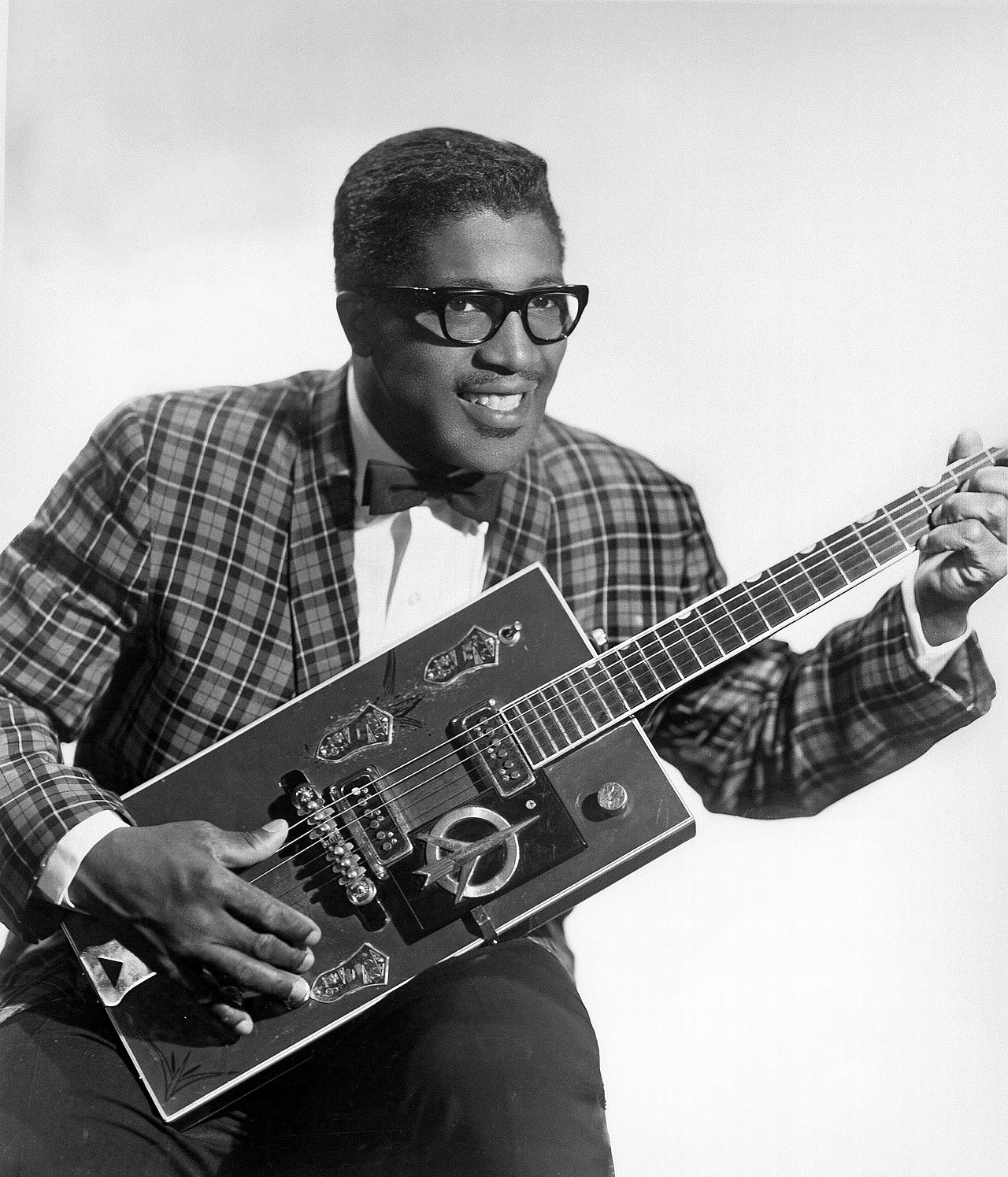
Beyond the beat, Diddley was a genuine guitar innovator. He drenched his instrument in tremolo and played it percussively, making it function as much like a drum as a melodic voice, a primal, hypnotic approach that pointed straight toward rock's future. He also looked the part like no one else, thanks to the gem of his story: dissatisfied with ordinary instruments, Diddley designed and built his own rectangular, cigar-box-shaped guitars, eventually working with Gretsch to produce a signature square model that became one of the most visually distinctive guitars in popular music. He simply decided a guitar should look the way he wanted it to, and made it so.
There is a bittersweet second gem. Despite being inducted into the Rock and Roll Hall of Fame in 1987 as one of the genre's architects, Diddley spent much of his life feeling cheated out of the money and credit his innovations earned, and he said as much, often and bluntly, noting that he opened the door for a lot of people who never paid him back. By the time he died in 2008, his contributions had become so foundational that most listeners no longer recognized the Bo Diddley beat as having come from any one person at all. That is the strange fate of a true originator, to become so woven into the fabric of music that the world forgets there was ever a man who made it up.
Legendary Performance
The Ed Sullivan Show Defiance
November 20, 1955 · CBS Studio 50, New York City
On November 20, 1955, Bo Diddley made his first national television appearance on The Ed Sullivan Show, an opportunity that should have been a straightforward debut for a rising Chess Records artist. The Sullivan staff had asked him to perform Tennessee Ernie Ford's country hit Sixteen Tons, judging it more palatable for the show's prime-time audience than his own material. According to Diddley's own telling, he had agreed during rehearsal and then, when the cameras rolled, walked out on stage with his rectangular guitar and played his self-titled hit Bo Diddley instead, complete with the unmistakable syncopated beat and the heavy tremolo-laden guitar lines that defined the song.
Sullivan was reportedly furious and told Diddley he would never work in television again, a threat that kept Diddley off the Sullivan stage for years. The defiance, captured in front of millions of viewers, was one of the first nationally broadcast acts of artistic insubordination in the early rock and roll era, and the performance itself was a Trojan horse: it smuggled the Bo Diddley beat, the rectangular guitar, and the heavily processed electric tone into living rooms across America. Without that broadcast, the cascade of imitations and homages that followed (from Buddy Holly to the British Invasion) might have arrived years later, or in a much-diluted form. The performance is therefore not legendary for guitar acrobatics but for what it announced: a new rhythmic and tonal language that would dominate popular music for the next sixty years, delivered with the kind of stubborn artistic conviction that defines real originators.
▶ Watch on YouTubeGear
Gretsch G6138 "Bo Diddley" Rectangular Guitar (1958 (first production model))
Known for: The rectangular cigar-box body, custom-built for Diddley and later mass-produced by Gretsch
Bo Diddley's rectangular guitar is one of the most visually recognizable instruments in the history of popular music, and unlike most signature guitars, the design originated entirely with the artist himself. Diddley began building his own cigar-box-style rectangular guitars in the early 1950s, dissatisfied with the way conventional guitar shapes accidentally amplified his hip movements while he played. He reasoned that a flat, rectangular body would sit closer to his body, eliminate the visual distraction of curves, and let the playing speak for itself. The first ones were genuinely homemade, with hardware salvaged from broken guitars.
Gretsch built him his first professional-quality rectangular guitar in 1958, beginning a long partnership that eventually produced the official Gretsch Bo Diddley model. The instrument used standard Gretsch Filter'Tron pickups and electronics, but the unmistakable shape became central to his stage identity. Diddley owned and modified many examples over the decades, often adding extra knobs, switches, and decorative elements (one famous example was covered entirely in white fur). The rectangular shape influenced later guitar designers from B.C. Rich to Steinberger, and the visual statement that an instrument's body shape need not be derived from acoustic-era curves became one of his most enduring contributions to guitar design.
Magnatone Model 280 with Stereo Vibrato
Known for: The pitch-shifting vibrato circuit that gave Diddley's guitar its watery, swimming sound
The shimmering, watery, sometimes seasick texture that pervades Bo Diddley's recordings comes from the Magnatone amplifier and its remarkable vibrato circuit. Unlike the simple tremolo (amplitude modulation) found in most Fender amplifiers of the era, the Magnatone Model 280 used a genuine pitch-shifting vibrato, modulating the frequency of the signal rather than its volume. The result is a distinctive watery wobble that bends the pitch up and down rather than pulsing in and out, producing the swimming, dreamlike quality heard on Mona, Who Do You Love, and dozens of other Diddley tracks.
Diddley used the vibrato aggressively, often at speeds and depths that would be considered extreme today, and the effect became inseparable from his guitar identity in the same way that the tremolo on Duane Eddy records or the spring reverb on surf records did for those styles. The Magnatone amplifier was relatively rare even in its prime, and the unusual circuit design meant that no other amp on the market could replicate the effect convincingly until pedal manufacturers began producing dedicated true-vibrato units decades later. The Magnatone's prominence in Diddley's sound is one of the more striking examples of how a single amplifier choice can shape an entire artist's tonal fingerprint.
Amp-Based True Vibrato and Open Tunings
Beyond the guitar and the Magnatone amplifier, Bo Diddley's effects vocabulary was remarkably minimal by modern standards. There were no stompboxes in front of his amp, no rack effects, no complex signal chains. The transformative element was the Magnatone's built-in pitch vibrato, which functioned as a permanent part of his guitar voice rather than an effect he turned on and off for specific passages. He simply played through it, all the time, and the warm wobble became as much a part of his sound as the rhythm he played.
His other transformational choice was tuning. Diddley frequently played in open E tuning, which let him barre across all six strings and produce dense, drone-like chord beds while keeping his fretting hand free to add percussive flourishes. Combined with his preference for heavy strumming and frequent palm-muting, the open tuning turned the guitar into something close to a one-person rhythm section, a kind of electric body-drum on which the famous Bo Diddley beat could be constructed in real time. This approach (effects-light, tuning-heavy, rhythm-first) was the polar opposite of the gear-saturated paths most rock guitarists would later take, and it remains a master class in how much can be accomplished with how little, when the player has something genuinely original to say.
Signature Technique
The Bo Diddley Beat and Percussive Rhythm Guitar
The Bo Diddley beat is one of the most influential rhythmic patterns in the history of popular music, and its origin is at once obvious and surprisingly nuanced. The basic figure (typically written as two bars, with hits on beats 1, 1.5, 2.5, then 4 of bar one and 2.5 then 4 of bar two) traces back through the Afro-Cuban son clave pattern, which arrived in New Orleans via the same Caribbean traditions that shaped early jazz and the New Orleans second-line drumming Diddley absorbed during his Chicago upbringing. He took that ancestral rhythm, transposed it onto the electric guitar, and used heavy tremolo strumming and muted percussive attacks to make the guitar itself articulate the pattern, rather than relying on drums to carry it.
What made Diddley's approach genuinely new was his treatment of the guitar as a percussion instrument. He muted strings with the heel of his picking hand, struck them with controlled force to produce sharply transient chord attacks, and let the open tuning give him the harmonic density of a full chord with a single barre. The fretting hand was free to add small ornamental moves (slight slides, hammer-ons, pull-offs) that punctuated the otherwise hypnotic groove. The result was a guitar style that functioned simultaneously as rhythm, melody, and drum part, an approach few players before him had attempted and few since have improved upon.
His lead playing, when it occurred, was equally distinctive: short, vocal-like phrases drenched in the Magnatone's vibrato, often built on call-and-response with his own voice or with the backing band, and almost always rooted in blues vocabulary that he made sound brand new through the tonal filter of his rig. He was not a flashy soloist in the manner of his contemporaries Chuck Berry or T-Bone Walker, and his recorded catalog has relatively few solos that stretch beyond eight bars. The choice was deliberate. Diddley understood that the rhythm was the message, and that giving the listener room to feel the groove was more important than demonstrating fretboard fluency.
The lineage of guitarists shaped by this approach is staggering. Buddy Holly's Not Fade Away uses the Bo Diddley beat almost note for note, the Rolling Stones covered the song and never stopped returning to the pattern across their career, the Who built Magic Bus on it, Springsteen used it on She's the One, and U2 referenced it explicitly on Desire. Beyond the beat itself, the broader principle (that the guitar can be a percussion instrument as much as a melodic one) shaped rhythm players from Pete Townshend to Andy Summers to The Edge, and remains one of the most generative ideas in rock guitar over the past seventy years.