


B.B. King
Current Ranking
B.B. King is ranked #28 of 162 guitarists on the Greatest Guitar Player leaderboard, based on our editorial score until fans weigh in. On the blues leaderboard, B.B. King ranks #4 of 32. No fan votes yet, so be the first to rate B.B. King on 8 attributes at greatestguitarplayer.com/vote.
Biography
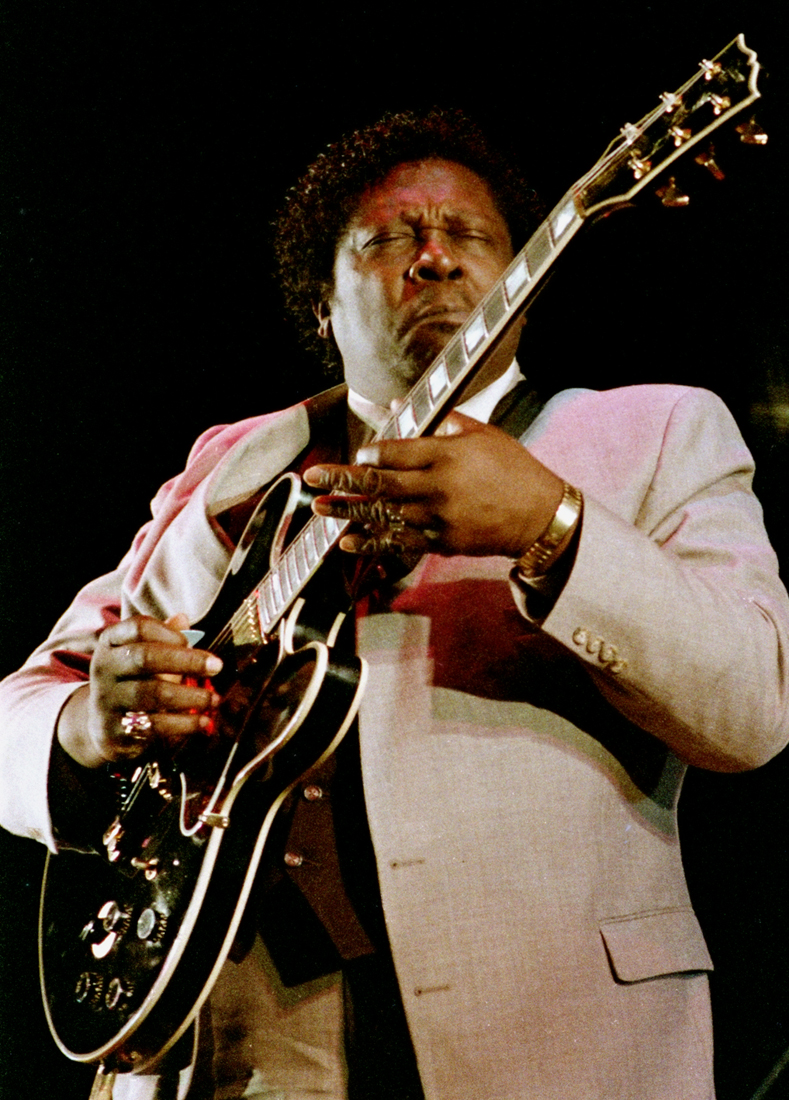
Riley B. King, born on a cotton plantation near Itta Bena, Mississippi in 1925, became the King of the Blues, the most important and most beloved blues musician of the twentieth century and the man who taught rock and roll how to bend a single note. He came up the hard way, working the fields and singing gospel before riding the bus to Memphis, where he found work as a radio DJ, picked up the nickname the Beale Street Blues Boy, shortened it to B.B., and slowly turned himself into a star.
King's genius was economy. While other players crammed in as many notes as possible, B.B. built entire solos out of a few perfectly placed ones, each lit up by his trademark fluttering vibrato, a hummingbird shimmer he created by rocking his hand against the neck. He never played slide, but he chased that vocal, crying quality with his fingers instead, and he famously could not sing and play at the same time, so his guitar and his voice trade lines like two singers in conversation. That call-and-response is the entire architecture of records like The Thrill Is Gone, his 1969 breakthrough into the pop mainstream, and Every Day I Have the Blues.
Here is the gem, one of the great origin stories in music. In the late 1940s King was playing a dance in Twist, Arkansas, heated by a barrel of burning kerosene, when two men got into a fight over a woman, knocked the barrel over, and set the building ablaze. King ran outside to safety, then realized he had left his cheap guitar inside and ran back into the burning hall to save it. When he learned the woman the men had fought over was named Lucille, he named that guitar Lucille and gave the same name to every guitar he owned for the rest of his life, a permanent reminder never to do anything that foolish again.
A second gem is the sheer scale of his devotion to the road. King toured with almost superhuman dedication, playing hundreds of shows a year for decades and racking up well over ten thousand performances in his lifetime, an itinerant ambassador who carried the blues to every corner of the world. His influence is impossible to overstate, running directly through Eric Clapton, who recorded a whole album with him, plus Jimi Hendrix, Stevie Ray Vaughan, and essentially every blues-rock guitarist who followed.
King collected a mountain of Grammys, a place in both the Blues and Rock and Roll Halls of Fame, and a Presidential Medal of Freedom before his death in 2015. More than the awards, though, his legacy lives every time a guitarist bends a string and shakes it to make it sing. That is B.B. King's voice, and it is now the common language of the instrument, the single most imitated sound in all of blues and rock guitar.
Legendary Performance
Live at the Regal
November 21, 1964 · Regal Theatre, Chicago, Illinois
The concert recorded at the Regal Theatre on the South Side of Chicago in November 1964 produced what many blues historians consider the greatest live blues album ever made. B.B. King performed two sets that night to an audience that already knew his recordings intimately, the Regal was a venue where the audience was not discovering the artist but celebrating him, and the resulting interaction between the performer and the crowd gives the recording an energy that studio recordings of the same material do not approach. King played with the particular authority of a musician performing for an audience that holds him to their highest standard, and his response to that standard was the finest sustained performance of his career.
His guitar playing on "Live at the Regal" demonstrates the full vocabulary he had developed through a decade of club and theatre performances: the vibrato produced by shaking his entire fretting hand, which he called "the complete sound of the blues" and had developed as a substitute for the slide technique he found technically limiting; the single-note phrases that operated as statements rather than runs; the call-and-response relationship between his guitar and his voice in which "Lucille" answered or amplified what his vocal could not reach alone. The album has been in continuous print since its release, is taught in university music programmes as a primary blues document, and is the performance against which all subsequent blues guitarists have been measured.
▶ Watch on YouTubeGear
"Lucille", Gibson ES-355 Stereo (1950s-2015)
Known for: "The Thrill Is Gone"; Live at the Regal, 1964
Every guitar B.B. King played from the mid-1950s onward was named "Lucille," a name derived from an incident at a dance hall fire in Twist, Arkansas, in 1949 when he ran back into a burning building to retrieve his guitar, later learning the fire had been started by two men fighting over a woman named Lucille. The name stuck and was applied to every subsequent guitar he played, all of which were Gibson semi-hollow electrics: ES-335s in the early years, ES-345s through the 1960s, and eventually the Gibson B.B. King Lucille signature model, based on the ES-355 with specific modifications including the removal of the f-holes that King believed caused unwanted feedback.
The Lucille signature, introduced in 1980 and remaining in production, incorporates a varitone selector, stereo output, gold hardware, and the sealed f-hole body that King specified. Its twin humbuckers provide the warm, full output that sustains the single-note phrasing and wide vibrato that defined his technique. King's relationship with the instrument was public and ongoing: he spoke about Lucille as a collaborator rather than a tool, and the guitar's visual and cultural identity became inseparable from his own.
Lab Series L5 Transistor Amplifier
Known for: Live touring from the 1970s onward
B.B. King's amplifier of choice from the 1970s onward was the Lab Series L5, a solid-state transistor amplifier whose clean headroom and consistent output across volume levels suited his playing approach. Unlike tube amplifiers, which compress and distort at high volumes in ways that can obscure single-note articulation, the Lab Series maintained clarity at the levels required for large-venue performance, allowing the nuances of his vibrato and string bending to remain audible.
His choice of a transistor amplifier at a time when tube amplifiers were considered the only serious option for electric blues was both practical and musical: the L5's clean character let Lucille's tone speak without amplifier colouration adding to or subtracting from it. King's technique required a transparent window onto the guitar's output, and the Lab Series provided it consistently over decades of touring.
Signature Technique
Signature Technique
B.B. King developed a guitar vocabulary so distinctive and so complete that it constitutes one of the most recognizable individual voices in American music, arguably more immediately identifiable than any other single guitarist. His technique rests on two pillars: an extraordinary vibrato produced by a unique hand movement, and an absolute economy of notes that invests every single pitch with maximum emotional weight. He played no chords, used no effects, and built his entire vocabulary from these two elements.
King's vibrato, described as 'butterfly' because of the fluttering motion of his hand, is produced by a lateral shaking of the entire left hand rather than the conventional side-to-side rolling of the fingertip. This motion oscillates the fretted string sideways, producing a vibrato that is wider and more vocal than fingertip vibrato while remaining completely controlled. He applied vibrato to virtually every sustained note, treating it not as an ornament but as the fundamental expression of each pitch. No two vibrato applications were identical, he varied width, speed, and onset timing with the emotional requirements of the phrase.
King famously never played chords during solos, relying exclusively on single-note phrasing. This self-imposed limitation, combined with his refusal to use string bending, which his vibrato technique made impractical, forced a melodic economy of extraordinary sophistication. Each note he chose had to carry the full harmonic and emotional weight that other guitarists distribute across multiple notes or chords. His melodic lines move stepwise and by small intervals, following the logic of blues vocal phrasing rather than scale patterns, because he was, above all, a singer who had transferred his vocal sensibility to the guitar.
King's most important technique was architectural rather than physical: the structured alternation between his sung vocal phrases and his guitar responses. He would sing a line, then answer it with a guitar phrase of equivalent emotional weight; the guitar phrases were literally transcriptions of what he might have sung, translated to the fretboard. This call-and-response structure, the deep grammar of blues music, was executed by King with such naturalness and precision that the guitar seemed to speak with human intelligence. The technique is as much about listening and timing as about any physical guitar skill.