




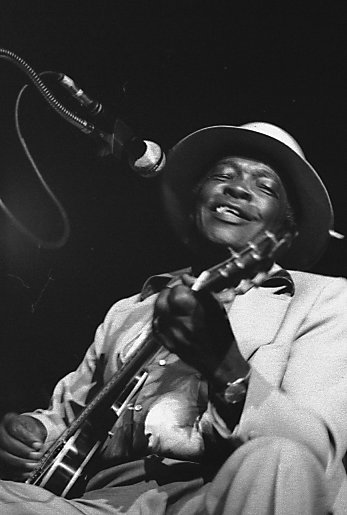

John Lee Hooker
Current Ranking
John Lee Hooker is ranked #113 of 162 guitarists on the Greatest Guitar Player leaderboard, based on our editorial score until fans weigh in. On the blues leaderboard, John Lee Hooker ranks #22 of 32. No fan votes yet, so be the first to rate John Lee Hooker on 8 attributes at greatestguitarplayer.com/vote.
Biography
John Lee Hooker, born in Mississippi around 1917, was one of the most primal and hypnotic forces in the history of the blues, a guitarist and singer whose deep, droning, foot-stomping boogie sounded like it came straight up out of the earth. He took the country blues of the Delta, plugged it in, moved it to Detroit, and turned it into something raw, dark, and utterly his own, becoming one of the most influential bluesmen who ever lived.
Hooker's style was built on groove and feeling rather than formal structure. He often played in a single hypnotic key, riding one churning, insistent rhythm, tapping his foot like a second drummer, and half-singing, half-talking his way through tales of trouble and desire. His early hit Boogie Chillen, just voice, electric guitar, and that relentless stomping foot, became a massive seller and a foundational blues record, and Boom Boom went on to become one of the most covered blues songs of all time.
Here is the gem that made him both a genius and a bandleader's nightmare. Hooker famously did not follow the standard twelve-bar blues structure or any predictable bar count. He changed chords whenever he felt like it, stretching or shortening phrases purely on instinct and emotion, which meant any band backing him simply had to watch him like a hawk and follow wherever his feeling led. His timing was entirely his own, governed by the song's mood rather than any rulebook, and that fearless, idiosyncratic freedom is exactly what gave his music its raw, unpredictable power. You could not chart a John Lee Hooker performance, you could only feel it.
Hooker's influence rippled straight into rock and roll, shaping the Rolling Stones, the Animals, ZZ Top, and countless others who borrowed his boogie. Remarkably, he enjoyed a major career revival late in life, when his 1989 album The Healer, featuring collaborations with admirers like Carlos Santana and Bonnie Raitt, won him a Grammy and introduced his deep, ancient sound to a whole new generation. A Rock and Roll Hall of Fame inductee, he kept performing nearly until his death in 2001. John Lee Hooker remains the embodiment of the blues at its most elemental, the man whose stomping foot and hypnotic groove proved that one voice, one guitar, and one unstoppable rhythm could shake the world.
Legendary Performance
The Rolling Stones' Steel Wheels Tour Guest Appearance
John Lee Hooker's appearance as a guest on the Rolling Stones' Steel Wheels Tour in 1989 was one of the most symbolically loaded moments in rock history: the architect of the boogie, the hypnotic single-chord groove that runs through fifty years of rock music, sharing a stage with the band that had done more than any other to carry that tradition to global audiences. Hooker performed "Boogie Chillen" alongside the Stones to arenas of tens of thousands, his guitar playing as elemental and direct as it had been when he recorded the song in 1948, forty years earlier. The performance demonstrated what no technical analysis could convey: that the power of his playing resided not in complexity but in conviction.
The tour coincided with the commercial resurgence of his career following his appearance in the film The Blues Brothers and the collaborations album The Healer, and it introduced his music to audiences who had grown up on the rock and blues-rock that descended from his original recordings. His guitar work throughout, simple open-chord figures, repetitive and hypnotic, delivered with absolute authority, provided the starkest possible contrast to the elaborate production of the Stones' arena show and emerged from the comparison as the more powerful thing. Simplicity delivered with complete conviction is a rarer and more difficult achievement than technical complexity.
▶ Watch on YouTubeGear
Gibson ES-335 & Epiphone Sheraton
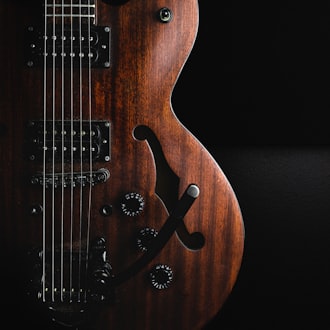
John Lee Hooker's guitar of choice for much of his career was the Gibson ES-335 or similar thinline semi-hollow instruments, whose warm, slightly midrange-heavy tone suited the simple, hypnotic chord figures and single-note lines of his Delta blues style. The ES-335's construction, hollow wings around a solid maple centre block, provided the resonance and warmth of a fully hollow archtop with the feedback resistance required for amplified performance, and its humbucking pickups delivered the smooth, warm output that characterises his recorded sound. He was not a gear enthusiast in the conventional sense; he played whatever instrument served the music, and the music's requirements were consistent and simple.
Silverface Fender & Early Gibson Amplification
Hooker's amplification preferences were similarly unpretentious: Fender and Gibson amplifiers of the 1950s and 1960s provided the warm, clean American tone over which his guitar's natural resonance and the drive of his picking produced the slight natural saturation of his recorded sound. He did not seek distortion or special tonal character from his amplifier; he sought a faithful reproduction of what his guitar produced, and the clean American amplifiers of his era provided this with minimal colouration. The result is a guitar tone defined entirely by the instrument and the player rather than by the amplification system.
Minimal Effects, Pure Signal Chain
Hooker used no effects at any point in his career, his signal chain being the most direct possible: guitar into cable into amplifier. This absence of processing reflects both his musical era, effects pedals were not standard equipment for blues players of his generation, and his musical philosophy, which held that the music's power resided in its simplicity. The single-chord boogie that is his primary musical contribution requires nothing beyond a guitar, an amplifier, and the rhythmic conviction to maintain the groove indefinitely, and his recordings demonstrate that this combination, in the right hands, produces music of remarkable force.
Signature Technique
Signature Technique
John Lee Hooker's guitar technique is among the most deceptive in the history of blues: it appears simple because it is built on repetition, on single chords sustained through rhythmic variation rather than harmonic movement, yet the power it generates is entirely disproportionate to its apparent simplicity. His foundational contribution, the boogie, a propulsive, single-chord groove derived from the barrelhouse piano tradition of the American South, became the rhythmic foundation of rock and roll and, through that, of virtually every genre of popular music that followed. The difficulty of what he did is not technical but existential: maintaining a groove of such intensity for such duration requires a form of musical conviction that cannot be taught.
Hooker's most distinctive technique is the sustained one-chord boogie, a rhythmic guitar figure built on a single root chord with chromatic approach notes and rhythmic variations that create forward motion without harmonic change. Where conventional blues moved through I-IV-V chord changes, Hooker frequently remained on the tonic for entire songs, the interest coming entirely from rhythmic variation and the natural harmonic overtones of his playing. This approach is paradoxically more demanding than conventional chord progressions: without harmonic movement to provide structural clarity, every rhythmic decision must carry the full weight of the music's momentum.
Hooker's early recordings frequently feature the sound of his foot stomping on the floor in time with his playing, a technique he developed performing alone without a rhythm section and that became so habitual he maintained it in full band contexts. This physical externalization of the beat reflects a musical tradition in which rhythm is experienced as bodily before it is understood as musical, and it gives his solo recordings a physical presence that purely instrumental playing rarely achieves. The combination of guitar, voice, and foot produces a sound architecture that is complete without accompaniment, each element filling a role that the others leave vacant.