







Chet Atkins
Current Ranking
Chet Atkins is ranked #40 of 162 guitarists on the Greatest Guitar Player leaderboard, based on our editorial score until fans weigh in. On the country and roots leaderboard, Chet Atkins ranks #3 of 11. No fan votes yet, so be the first to rate Chet Atkins on 8 attributes at greatestguitarplayer.com/vote.
Biography
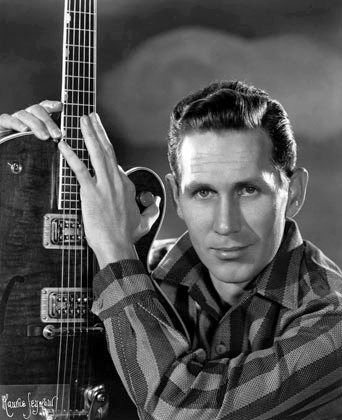
Chet Atkins, born in the hills of east Tennessee in 1924, was so central to the sound of American guitar that fellow musicians simply called him Mr. Guitar. A peerless fingerstyle player and an equally influential record producer, he shaped popular music from two directions at once, dazzling the world with his own playing while quietly engineering the sound of Nashville behind the scenes.
As a guitarist, Atkins refined and popularized a fingerpicking style descended from Merle Travis, using his thumb to keep a steady alternating bass line while his fingers played melody and harmony on top, so that one man sounded like several. The effect was smooth, sophisticated, and endlessly musical, equally at home on country, pop, classical, and jazz material. His signature Gretsch Country Gentleman became one of the most coveted guitars in the world, and generations of players have spent years trying to make a single instrument sound as full and orchestral as he did.
As a producer and executive at RCA, Atkins became one of the principal architects of the smooth, string-laden Nashville Sound that defined country music in the late 1950s and 1960s, working with everyone from Elvis Presley to the Everly Brothers to Dolly Parton. He had a rare double life, a genuine virtuoso who also happened to be one of the most powerful tastemakers in the industry.
Here is the gem that shows how he saw the instrument: Atkins created an honor he called the Certified Guitar Player, or CGP, a tongue-in-cheek but deeply meaningful title he bestowed on only a tiny handful of players he considered true peers, among them Tommy Emmanuel and Jerry Reed. It was guitar knighthood, awarded by the man everyone agreed was the standard. His influence reached far beyond country, too. Mark Knopfler of Dire Straits idolized him and recorded a Grammy-winning album of duets with him, and fingerstyle players across every genre still treat his recordings as essential study. By the time he died in 2001, Atkins had won more Grammys than almost any other instrumentalist and earned a place in both the Country Music and Rock and Roll Halls of Fame. He remains the gold standard for what one person and one guitar can do.
Legendary Performance
Chet Atkins & Friends TV Special
October 1987 · The Bottom Line, New York City, NY
By 1987, Chet Atkins had already accumulated enough accolades to fill several lifetimes: thirteen Grammy Awards, a Country Music Hall of Fame induction, and a production résumé that had shaped the sound of Nashville for three decades. But Atkins had largely retreated from live performance, his last New York City appearance had been more than twenty years prior. The Bottom Line engagement, filmed for a television special, was a quiet earthquake in the world of guitar.
What unfolded that October evening was less a concert than a summit. Atkins shared the stage with a gathering of disciples and peers that read like a fantasy booking sheet: Mark Knopfler, the Everly Brothers, Emmylou Harris, Waylon Jennings, and Willie Nelson. Each had been shaped, directly or indirectly, by Atkins' fingerpicking innovations, a technique he had refined into something so fluid and self-contained that it still sounds futuristic today.
The duet with Knopfler on "Why Worry" was the evening's emotional apex. Two masters of restraint, communicating entirely through tone and timing, each one listening as intently as he played. Atkins' right-hand technique, thumb carrying the bass line while fingers voiced the melody, all simultaneously, all impossibly clean, moved through Knopfler's obvious admiration like a signature being written slowly in light. For those watching, it was a reminder that Chet Atkins hadn't just influenced country music. He had quietly influenced everything.
▶ Watch on YouTubeGear
Gretsch Country Gentleman / 6120
Chet Atkins' long partnership with Gretsch, first as an endorser, then as a co-designer, produced the Chet Atkins Country Gentleman, one of the most elegant semi-hollow electric guitars ever made. Atkins refined the 6120's specifications over years of gigging and recording, eliminating the f-holes on the Country Gentleman to reduce feedback in high-volume environments and adding a range of tonal options that suited his eclectic style. The guitar's warm, rounded attack complemented his immaculate fingerpicking perfectly, no harsh transients, just a pure, singing note with natural sustain. He later moved to Gibson, co-designing the CE and SST models, but his Gretsch years defined his visual and sonic identity.
Low-Volume Studio Setup / RCA Studio Rigs
As a producer and session player at RCA's Nashville studios, Atkins worked in controlled studio environments where amplifier choice was secondary to technique and arrangement. He used a variety of small combo amplifiers, often preferring the warmth of vintage Fender or Gibson valve combos run at modest volumes. His studio recordings, which defined the Nashville Sound, relied on precise microphone placement, careful room acoustics, and immaculate playing rather than any particular amp magic.
Echoplex / Minimal Chain
Chet Atkins was not an effects-heavy player, his technique was so complete that external processing felt superfluous. Where he did use processing, the Echoplex tape delay added depth and dimension to his recordings, particularly on ballads and fingerpicking showcases. The rest of his chain was signal-straight: guitar to amp, with perhaps a touch of studio reverb added by the RCA engineers. His legacy is entirely one of technique: the thumb-and-fingers independence of his Travis-picking style was the effect, and no pedal board could replicate what decades of practice had built.
Signature Technique
Travis Picking & Thumbpick Mastery
Chet Atkins perfected the alternating-thumb style of fingerpicking, often called Travis picking after Merle Travis, who codified it before him, in which the thumb wears a plastic thumbpick and maintains a steady alternating bass line on the lower strings while the index and middle fingers independently play melody and harmony on the upper strings. The effect is one guitar simultaneously doing the work of two: one player keeping a rhythmic, walking bass, another playing a full melodic line above it. The coordination required is considerable, and Atkins made it sound effortless.
What distinguished Atkins beyond technique was his harmonic sophistication. He incorporated jazz chord voicings, classical pieces, and pop ballads into a fingerpicking framework that had been largely rural and folk in character. His recordings of Baroque pieces like "Jesu, Joy of Man's Desiring" on a country-picked electric guitar revealed that the style's reach was unlimited. He served as the architect of the Nashville Sound that shaped country music for decades, and his fingerpicking approach remains the gold standard of the style.