



Curtis Mayfield
Current Ranking
Curtis Mayfield is ranked #41 of 162 guitarists on the Greatest Guitar Player leaderboard, based on our editorial score until fans weigh in. No fan votes yet, so be the first to rate Curtis Mayfield on 8 attributes at greatestguitarplayer.com/vote.
Biography
Curtis Mayfield was born June 3, 1942, in Chicago, Illinois, and grew up singing gospel in his grandmother's Traveling Souls Spiritualist Church. He taught himself guitar as a boy by tuning the strings to match the black keys of the family piano, the notes of the gospel songs he already knew, and he never changed it. That personal F sharp tuning stayed with him for life, and he loved that it made his instrument his alone. He liked to say that no matter how good another guitarist was, when he grabbed Curtis's ax he couldn't play it. As a teenager he joined Jerry Butler in a vocal group called the Roosters, which became The Impressions and broke through with "For Your Precious Love" in 1958. When Butler went solo, the shy kid with the feather-soft falsetto became the group's leader, guitarist, and songwriter.
Through the 1960s Mayfield steered The Impressions through a run of gospel-rooted hits, "Gypsy Woman", "It's All Right", "Keep On Pushing", "Amen", and "People Get Ready", songs so entwined with the civil rights movement that Martin Luther King Jr. used them to rally marchers. At the same time he was quietly building Chicago soul itself, writing and producing for Major Lance, Gene Chandler, and Jan Bradley, and in 1968 he founded Curtom Records, which made him one of the first Black artists in American pop to own his label, his masters, and his publishing.
He went solo in 1970 with Curtis, pairing the joyous "Move On Up" with the apocalyptic funk of "(Don't Worry) If There's a Hell Below We're All Going to Go", then cut the intimate Curtis/Live! at the Bitter End and the lush Roots. In 1972 came Super Fly, his masterpiece, a soundtrack that worked as a warning against the very drug world the film glamorized. "Freddie's Dead" and the title track went gold, the album hit number one, and it famously did better business than the movie it scored. Underneath it all sat that gentle guitar, played with thumb and fingers instead of a pick, curling hammer-ons around his falsetto like a second voice.
On August 13, 1990, a lighting rig blown over by wind fell on Mayfield before an outdoor show at Wingate Field in Brooklyn, leaving him paralyzed from the neck down. He answered with New World Order in 1996, recorded lying on his back and sung a line or two at a time, because gravity gave his diaphragm the push his body no longer could. The honors stacked up at the end: induction into the Rock and Roll Hall of Fame with The Impressions in 1991 and again as a solo artist in 1999, a Grammy Legend Award in 1994, and a Lifetime Achievement Grammy in 1995. He died December 26, 1999, in Roswell, Georgia, at 57, and his fingerprints remain on everyone from Jimi Hendrix and Prince to the whole of neo-soul.
Legendary Performance
Curtis/Live! at the Bitter End
January 1971 · The Bitter End, Greenwich Village, New York
In January 1971, a few months after his debut solo album, Mayfield set up with a four-piece band at the Bitter End, a 230-seat club in Greenwich Village, and recorded the show that became Curtis/Live!. The room was so small the audience chatter is part of the record. Backed by Craig McMullen on second guitar, Joseph "Lucky" Scott on bass, Tyrone McCullen on drums, and Master Henry Gibson on congas and bongos, Mayfield stripped his orchestral studio sound down to voice, two guitars, and groove, and the songs got deeper for it. Impressions classics like "People Get Ready" and "We're a Winner" were reworked into stretched, percolating vamps, and the new material, "Mighty Mighty (Spider and Fly)", "(Don't Worry) If There's a Hell Below We're All Going to Go", landed with a conversational intensity no studio take ever matched.
Between songs he talked to the room in that soft preacher's voice, introducing songs about where America stood, and the double album, mixed by Eddie Kramer at Electric Lady, caught a moment when soul music was becoming social commentary in real time. Critics were lukewarm in 1971, but time flipped the verdict completely. It is now routinely called one of the greatest live soul albums ever made, and its grooves proved durable enough that Jay-Z and Kanye West were still sampling the record forty years later. For a guitarist, it is the essential Mayfield document: an entire concert carried by fingertip dynamics, open-tuned chord curls, and a pocket that never once breaks a sweat.
▶ Watch on YouTubeGear
Fender Telecaster Thinline (Late 1960s)
Known for: The "Curtis/Live!" cover and the black-keys F sharp tuning
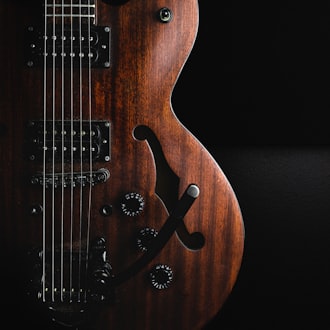
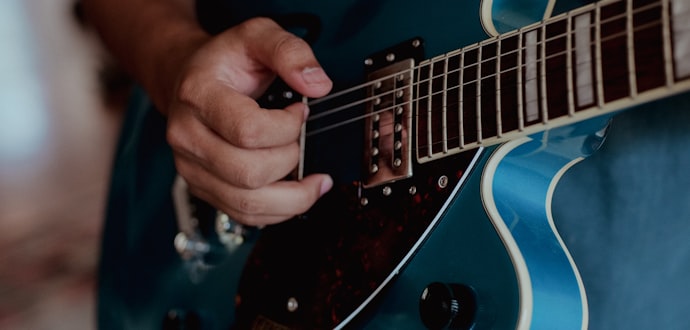
The guitar on the cover of Curtis/Live! is a Fender Telecaster Thinline, the semi-hollow, f-hole version of the Tele that Fender introduced in the late 1960s, and it was the perfect match for Mayfield's touch. The Thinline's airy, slightly hollow warmth softened the Telecaster bite into something rounder and more vocal, which suited a player who used his bare thumb and fingers and rarely dug in hard. Strung up in his black-keys F sharp tuning, it was effectively a custom instrument nobody else could pick up and play.
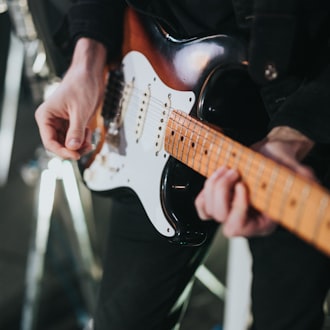
Later in the 1970s he leaned on Stratocasters, usually parked on the middle pickup for that glassy, in-between sweetness, but the approach never changed: clean, warm, understated, the guitar tucked just beneath the vocal like a harmony singer. Whichever Fender he held, the sound people call Curtis is mostly hands, tuning, and restraint.
Fender Twin Reverb
Known for: The glassy Curtom clean tone
Mayfield ran his guitars into a Fender Twin Reverb, the era's definitive clean machine. The Twin's massive headroom meant his chords stayed pure and chiming at band volume, with no breakup to blur the voicings his open tuning produced. A touch of the amp's spring reverb gave the sparkle you hear all over the Curtom catalog, where the guitar glows around the vocal rather than competing with it. It was a session player's choice at heart: reliable, loud, and honest, letting the character come from his fingers rather than the electronics.
Wah-Wah & a Touch of Phasing
For most of the 1960s Mayfield went straight into the amp, but the Super Fly era brought the wah-wah pedal into his kit, and he used it like a percussionist. On "Pusherman" and across the soundtrack, the wah chops muted string chucks into rhythmic breaths that lock with the congas, a texture that became a blueprint for 1970s funk and later for hip-hop producers mining his records. Live in the 1970s he added a touch of phasing for movement, but the chain stayed minimal. The effects were seasoning; the tuning and the thumb were the sound.
Signature Technique
Black-Keys Open F# Tuning & Thumb-Over Soul
Mayfield's whole guitar language grew out of one childhood decision: he tuned his guitar to the black keys of the piano, low to high F sharp, A sharp, C sharp, F sharp, A sharp, F sharp, and never learned standard. The open strings form a warm F sharp chord, so the guitar rings sympathetically under everything, and simple one-finger shapes produce rich, gospel-flavored voicings that standard tuning makes you work for. It also meant his technique was self-invented from the ground up, with his left thumb curling over the top of the neck to grab bass notes and barre shapes no method book would suggest.
His right hand was just as personal. He never used a pick, playing everything with the pad of his thumb and his fingertips, which is why even his funkiest playing sounds soft-spoken. The signature move is the curl: hammer-ons and pull-offs rippling around a held chord, sliding sixths and thirds that answer the vocal line, so rhythm and lead melt into a single embellished chord-melody. Against that he set percussive muted chucks, often through a wah, that function as pure rhythm, a conversation between ringing openness and dead-string chop.
Listen to the way "People Get Ready" breathes, or the way "Move On Up" rides one chord for minutes without getting boring, and you are hearing a player who thought like an arranger: leave space, sit deep in the pocket with the percussion, say one small thing perfectly rather than three things loudly. That approach flowed straight into Jimi Hendrix's ballad style, the embellished chord work of "Little Wing" and "Castles Made of Sand" owes an open debt to Impressions records, and onward through Ernie Isley, Prince, and the entire neo-soul school of D'Angelo and beyond.
The deeper lesson of Mayfield's technique is that limitation can be identity. The tuning locked other players out of his guitar and locked him into a sound nobody could borrow. Fifty years on, players still retune to F sharp just to find out where those chords live, and most discover what Mayfield's peers did: you can copy the notes, but the touch is the instrument.