





Eddie Hazel
Current Ranking
Eddie Hazel is ranked #110 of 162 guitarists on the Greatest Guitar Player leaderboard, based on our editorial score until fans weigh in. No fan votes yet, so be the first to rate Eddie Hazel on 8 attributes at greatestguitarplayer.com/vote.
Biography
Eddie Hazel is the reason people talk about Funkadelic as a guitar band and not just a funk band. As the original lead guitarist of George Clinton's psychedelic army, Hazel played the ten minute title track of 1971's Maggot Brain, a single unbroken cry of a guitar solo that regularly lands on lists of the greatest solos ever recorded. In one performance he fused Jimi Hendrix's fire with the deep feeling of gospel and soul, and in doing so he built the bridge that every funk, rock, and R&B lead player has walked across since.
He was born April 10, 1950 in Brooklyn, New York, and his mother moved the family to Plainfield, New Jersey to raise him away from the city streets. Plainfield turned out to be exactly the right place, because it was also home to George Clinton's barbershop and the doo-wop group he ran out of it, The Parliaments. Hazel grew up singing and playing guitar in church settings and with his neighborhood friend Billy Nelson, and in 1967, when Clinton needed a touring band, the seventeen year old Hazel was recruited on Nelson's recommendation. That backing band soon became Funkadelic, and Hazel's guitar defined its earliest and rawest records, from the swampy self-titled debut through Free Your Mind and Your Ass Will Follow.
The gem is the story of the solo itself. During the Maggot Brain session at United Sound Systems in Detroit, Clinton told Hazel to play the first half as if he had just learned his mother had died, and the second half as if he found out she was still alive. What came out was so complete that Clinton faded most of the other instruments away and released the take nearly alone. There is a second gem hiding in the credits of 1974's Standing on the Verge of Getting It On: contract tangles meant Hazel's songwriting appears under the name Grace Cook, his mother. The man effectively co-wrote one of Funkadelic's best albums under a pseudonym borrowed from the woman the Maggot Brain solo was about.
His later road was rough. A 1974 arrest after an altercation on a flight led to jail time, and drug problems kept his career stop and start, though he wrote much of his lone solo album, 1977's Game, Dames and Guitar Thangs, during that lost stretch, and he kept returning to the P-Funk fold through the 1980s. Hazel died on December 23, 1992 at age 42 of liver failure, and Maggot Brain was played at his funeral. His fingerprints are all over players like John Frusciante, Prince, Mike McCready, and J Mascis, and in 1997 he was inducted into the Rock and Roll Hall of Fame posthumously as a member of Parliament-Funkadelic. For a man who made his masterpiece in one take, the echo has lasted more than fifty years.
Legendary Performance
The "Maggot Brain" Session
1971 · United Sound Systems, Detroit, Michigan
By 1971 Funkadelic had already made two albums of heavy, swampy psychedelic funk, but nothing on them prepared anyone for what happened at United Sound Systems in Detroit during the sessions for Maggot Brain. George Clinton, producing, gave Eddie Hazel a piece of direction that has since become one of the most famous instructions in rock history: play the first half like you just found out your mother died, and the second half like you found out she is alive after all. Hazel, then just 21 years old, closed his eyes and played.
What came out was a ten minute solo over little more than a slow arpeggiated figure, a single sustained emotional arc that starts as grief and climbs toward something like transcendence. Clinton later said the take was so overwhelming that he faded the rest of the band down and let the guitar stand nearly alone, drenched in echo. The legend says it happened in one take, and whether or not overdubs touched the edges, the performance plays like a single unrepeatable event. No chorus, no vocal hook, no structure beyond feeling, and it became the title track of the album and the defining statement of Hazel's life.
Maggot Brain matters because it proved a funk band could produce guitar music as heavy and emotionally serious as anything in rock, and it erased whatever line critics imagined between Black dance music and the guitar-hero tradition Hendrix had just built. Half a century later it is a fixture on greatest-solo lists, it gets covered on stage by players from every genre, and it was played at Hazel's own funeral in 1992. Very few guitarists are remembered for one performance. Almost none are remembered for one performance this completely.
▶ Watch on YouTubeGear
Fender Stratocaster
Known for: the crying lead voice of early Funkadelic
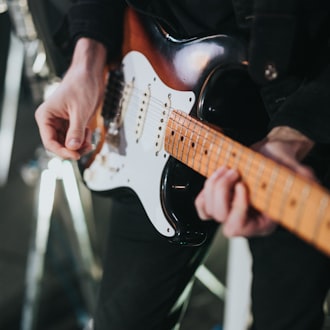
Eddie Hazel is most associated with the Fender Stratocaster, the instrument in his hands in most photographs from Funkadelic's classic era and the natural match for his singing, vocal lead style. The Strat's bright single-coil attack gave his playing its crying, human quality, and its expressive tremolo and easy bending suited a player whose whole approach was built on making the guitar weep, moan, and testify. Through the heavy fuzz and echo of the early Funkadelic records that Stratocaster voice stays recognizable, cutting through the murk with a clear emotional center.
Hazel was never a gear obsessive, and accounts of the exact instruments on specific sessions vary, which itself says something about him. The sound was in his hands and his phrasing, not in a spec sheet, and players chasing the Maggot Brain tone learn quickly that the guitar is the least important part of the equation.
Cranked Tube Stacks
Known for: raw sustain on the early Funkadelic records
Funkadelic in the early 1970s played loud, heavy rooms alongside rock acts, and Hazel drove big tube stacks in the Marshall mold to get there, pushing real tube saturation rather than polite clean headroom. The band's early records have a raw, overdriven weight closer to Band of Gypsys than to the tight funk productions of the era, and that comes from amps being worked hard in a live room.
On record his amp tone is usually heard through a haze of fuzz and tape echo, so the amplifier's job was power and sustain, a foundation that could hold a note forever while the effects shaped its color. That endless singing sustain is half the emotional engine of the Maggot Brain solo.
Wah / Fuzz / Tape Echo
Hazel's effects chain was small but essential: a wah pedal, heavy fuzz, and generous tape echo are the pillars of his recorded sound. The wah was less a rhythm effect than a voice, rocked slowly to make phrases speak like a singer shaping vowels. The fuzz supplied thick, sustaining distortion that let single notes hang and cry, and on Maggot Brain the solo swims in echo, with delay repeats trailing each phrase like a voice in a cathedral. It is one of the earliest and best examples of effects used purely for emotional storytelling rather than novelty, and the wah-plus-fuzz-plus-echo recipe he ran became the template for psychedelic soul guitar.
Signature Technique
Gospel-Soul Phrasing & Crying Sustain
Eddie Hazel played lead guitar like a gospel singer testifying. His core vocabulary was blues pentatonic, learned in the same Hendrix-lit world every player of his generation inhabited, but his phrasing came from church: long held notes with wide, pleading vibrato, phrases that rise like questions and fall like sobs, and a patience almost nobody else had. On Maggot Brain he proves a solo can hold attention for ten minutes with no changes and no hook, purely on the emotional logic of one phrase answering another.
Technically, his signature moves are slow, wide bends that arrive at the note like a voice cracking, sustained tones ridden with fuzz until they bloom into feedback, and a wah pedal rocked in slow motion to shape each note's vowel sound. He thought in breaths rather than bars, letting silence sit between phrases, which is why his solos feel spoken. When the music called for it he could also lock into Funkadelic's rhythm section with tight, syncopated funk figures, and the tension between those clipped rhythm parts and his soaring leads is a defining sound of the band's early records.
The influence runs deep and wide. John Frusciante has spent a career channeling Hazel's crying sustain, Prince's slow-burn solos walk the same gospel path, and grunge-era leads from players like Mike McCready carry the Maggot Brain DNA of feeling over flash. Hazel's real lesson is the simplest one in guitar playing and the hardest to learn: a note means nothing until you mean it.